

Researchers believe that the movement of molten metal in the Earth's core is one of the main causes of magnetic pole reversal.
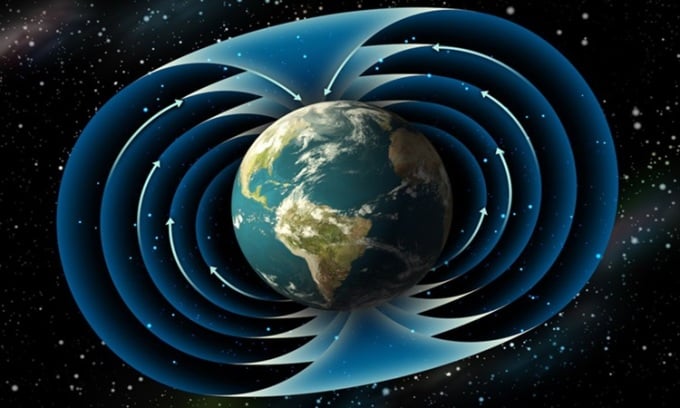
Experts cannot accurately predict when the Earth's magnetic field will reverse polarity. Photo: Space
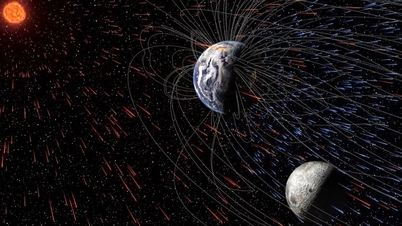
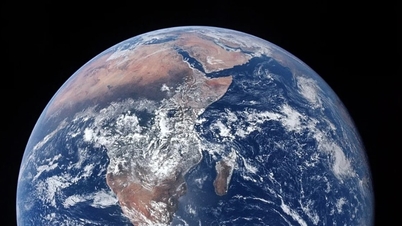
Earth, a rocky planet containing liquid water, is an ideal place for life to thrive for several reasons. Earth is at the right distance from its host star for liquid water to exist on its surface. The gravitational pull of other planets protects Earth from collisions with wandering asteroids. Earth's magnetic field also provides a shield protecting life from charged particles ejected through space, according to Space .
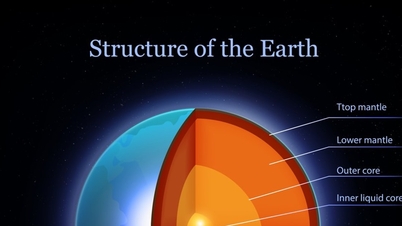
The Earth's magnetic field is created by a complex flow of molten metallic matter in the planet's outer core. This flow is influenced by both the Earth's rotation and the existence of a solid iron core. The result is a bipolar magnetic field whose axis aligns with the planet's rotation axis. Hidden within the chemical composition of ancient rocks is evidence that the Earth's magnetic field is a dynamically changing phenomenon. As lava cools, the iron minerals within it align with the Earth's magnetic field, much like a compass needle pointing north.
The Earth's magnetic field changes over very short and extremely long periods, from a few milliseconds to a few million years. Interactions of the magnetic field with charged particles in space can alter it in the short term, while longer-term magnetic disturbances are caused by processes in the Earth's liquid outer core.
Under the influence of fluid movement within the Earth, the process of geomagnetic field reversal can be divided into three stages. In the magnetic field decay stage, the magnetic field strength weakens and its direction becomes more chaotic. Next, magnetic pole drift is the process where the Earth's magnetic poles begin to shift from their current position and move in the opposite direction. The magnetic pole regeneration stage is when a new magnetic field begins to be established, with the poles eventually reaching the opposite position.
Studies of the past state of the magnetic field reveal that two polarization states could exist. In the current normal state, magnetic field lines emanate from the North Pole and enter the South Pole. A polarization reversal can also occur and is equally stable. Paleomagnetic research indicates that Earth's magnetic field reversal is not periodic and unpredictable, primarily due to the mechanism that creates it. According to geophysicist Leonardo Sagnotti, the flow of liquid metal (mostly molten iron) in the Earth's outer core is highly turbulent and erratic. Magnetic polarization reversals occur during periods of low geomagnetic field intensity and unstable magnetic field structure.
Periods of magnetic pole reversal last for several thousand years. When the magnetic field is about to reverse, it weakens, leading to increased exposure of the Earth's atmosphere to solar wind and cosmic rays in the form of charged particles. Recent research indicates that during the Laschamps magnetic pole reversal event 41,000 years ago, the amount of cosmic rays reaching the Earth's atmosphere globally was three times higher than it is today.
For human civilization, the real concern is not a shift in magnetic poles, but rather a period of declining geomagnetic field strength. Modern society is increasingly dependent on technology. Large numbers of charged particles entering the magnetosphere at lower altitudes will impact security, communications, electrical infrastructure, satellites, and astronauts living in low Earth orbit. In particular, due to the random nature of magnetic field fluctuations, researchers cannot accurately predict when this will occur.
An Khang (According to Space )
Source link


































































































Comment (0)