

"We received instructions to go to Cambodia to implement the rubber planting project on Valentine's Day, February 14, 2011, in a 16-seater vehicle. Since then, the team has stayed and fought, made many sacrifices, and endured countless hardships to get to where we are today," Mr. Trinh Van Hoang, Director of Dau Tieng - Kratie Rubber Joint Stock Company and Dau Tieng Cambodia Rubber Joint Stock Company, told us on the way back to the plantation.
On the afternoon of September 27th, it rained heavily on the plantations of the two companies. Since we couldn't visit the project site, our group sat and chatted with all the rubber company staff, and we heard interesting stories about the journey of rubber development here.
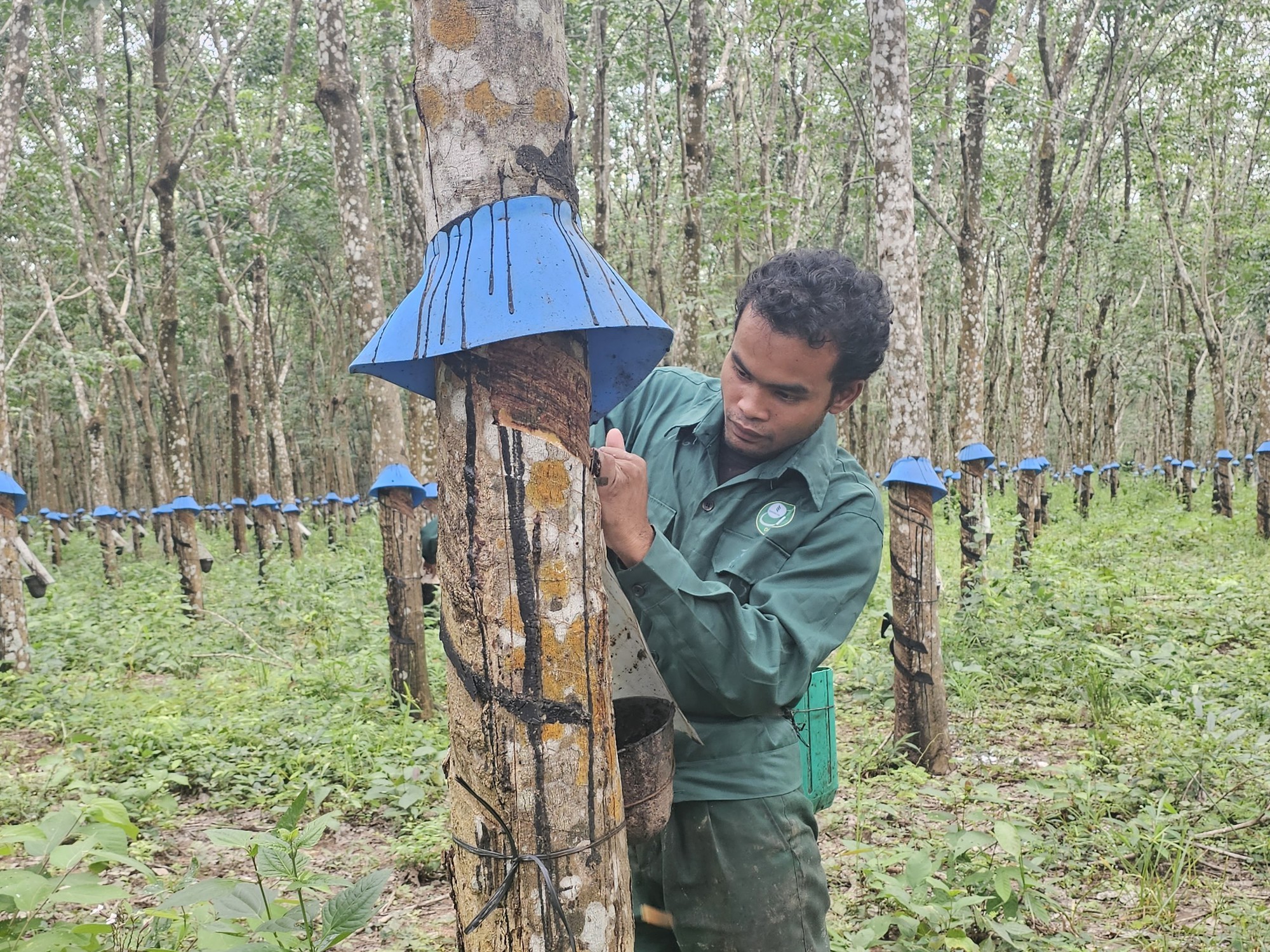
The rubber project developed by VRG in Kratie province employs 100% Cambodian workers.
"We ate rice raw in the middle of the forest…"
In 2011, when we first started implementing a rubber project covering nearly 4,300 hectares in Cambodia, transportation in the project area was extremely difficult. Mr. Hoang recounted that, because there were no roads, staff had to spend half a day navigating the trails used by locals to gather firewood. On weekdays, rubber plantation staff stayed at the center, while those going into the forest carried their personal belongings and tents to rest. When food and water were scarce, they had to go to the market more than 100 km away from the project site. We joked, "With all that hardship, who would give up and return to Vietnam?" Mr. Hoang said, "Because we had a purpose and an ideal when we left, we encouraged each other to stay."
After much effort, the two companies, Dau Tieng - Kratie and Dau Tieng Cambodia, achieved their economic goals. The rubber plantations, started in 2011, began to be harvested in 2018 and yielded high production.
Most of the people we spoke with were officials who had been there since the early days of the project. We heard stories of times when it rained heavily, making it impossible for motorbikes to reach the project area, forcing officials and rubber plantation workers to use bulldozers and tracked vehicles. "We ate our meals in the middle of the forest, it was hard work but fun, we tried our best to keep the whole system going. We accepted our work"... it was as if they were reliving their youth, their eyes filled with emotion and nostalgia as they recalled those memories.
Mr. Tran Van Anh, the company's deputy director, recounted that in 2011, the delegation of officials who went to Cambodia had a clear mindset: they would only return after achieving success. "It was extremely difficult back then, unlike now. But because we were only 30 or 40 years old, the team was very enthusiastic and willing to do any hardship or difficulty. At that time, Director Hoang hadn't even started a family yet."
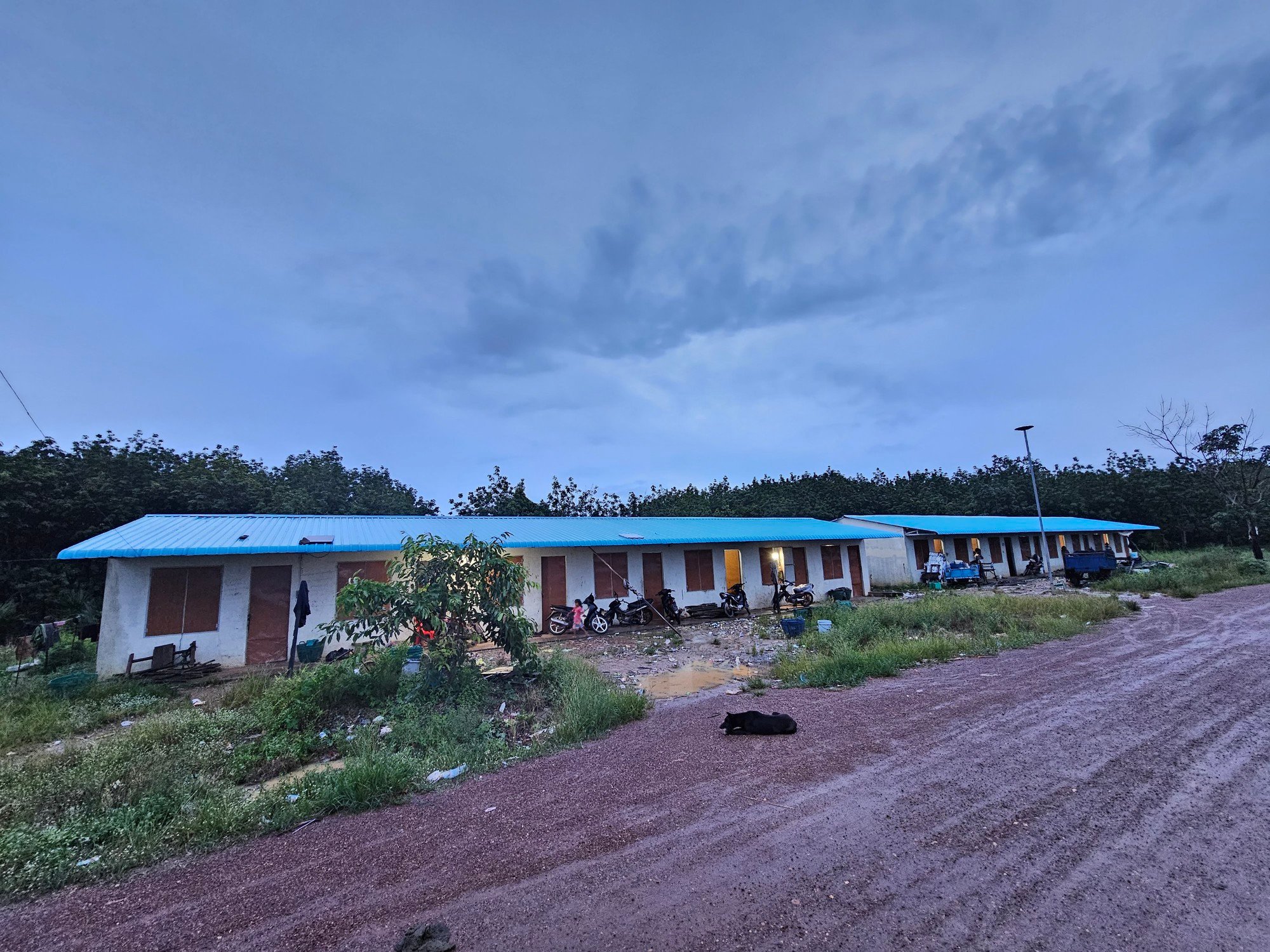
The company's workers' housing complex is cozy when the workers return home from work.
Although there is currently no electricity grid, the staff and employees of the two rubber companies remain steadfast and resilient. They find joy in sports activities, attending workers' weddings, and participating in village festivals. The staff and employees (including Cambodian staff) are like a family, loving and united, always prioritizing the interests of the workers above all else.
Currently, neither company has its own production facility. After harvesting the latex, the two companies transport it to Dong Phu Rubber Joint Stock Company, located approximately 180 km away, for processing. In 2022, Dau Tieng - Kratie Rubber Joint Stock Company achieved a production output of nearly 2,500 tons, while Dau Tieng Cambodia Rubber Joint Stock Company achieved a production output of over 2,000 tons.
Prioritize building housing for workers.
From 2021 to 2022, the two companies began to operate profitably. Even so, the rubber plantation staff and workers still devoted all their resources and efforts to production development and social welfare. It wasn't until 2021 that the temporary shelters for the rubber plantation staff were replaced with new, more spacious offices.
"We're happy to make a profit. For the past fifteen years, we've encouraged each other to keep trying. We only invest gradually when we have sufficient financial resources; we can't spread our investments too thinly across too many areas. We ensure social welfare for our Cambodian workers. We have to build schools and housing for the workers first, then housing for the staff later," Mr. Hoang confided.
The Dau Tieng - Kratie and Dau Tieng Cambodia Rubber Joint Stock Companies share a common management and administration structure. Due to its remote location and desire to harmonize socio-economic interests, the area still lacks electricity. Therefore, employees currently use solar power. Male employees' rooms only have basic electrical equipment such as fans and lighting. Female employees' rooms are more privileged, being equipped with additional amenities such as hair dryers and irons.
The two rubber companies currently employ over 700 workers. Initially, recruitment was difficult, so rubber company officials visited densely populated villages daily to recruit and promote workers. Later, the company employed existing workers to encourage and introduce job opportunities to their families and neighbors. The company had a policy of recruiting Cambodian workers from the beginning of planting, allowing them to learn the trade while earning a salary. However, local workers tend to have low retention rates.
A stable life
The rain had stopped and it was already getting dark. This was the time when rubber plantation workers usually went about their daily routines and ate, so we went to Mr. Tirso's general store to chat. Mr. Tirso is over 40 years old and has worked at the rubber company for almost 10 years.
Previously, Tirso was a truck mechanic. Due to the low and inconsistent income from his work, he was introduced to a job as a rubber plantation worker. In 2012 and 2013, when the rubber plantation project began to take shape, Tirso was the leader in recruiting workers.
In 2013, the company helped Mr. Tirso build a house and open a grocery store on the plantation to sell goods to rubber workers. Every day, his wife stays at home selling goods, while he works as an agricultural employee at Plantation 2, Dau Tieng Kratie Rubber Joint Stock Company.
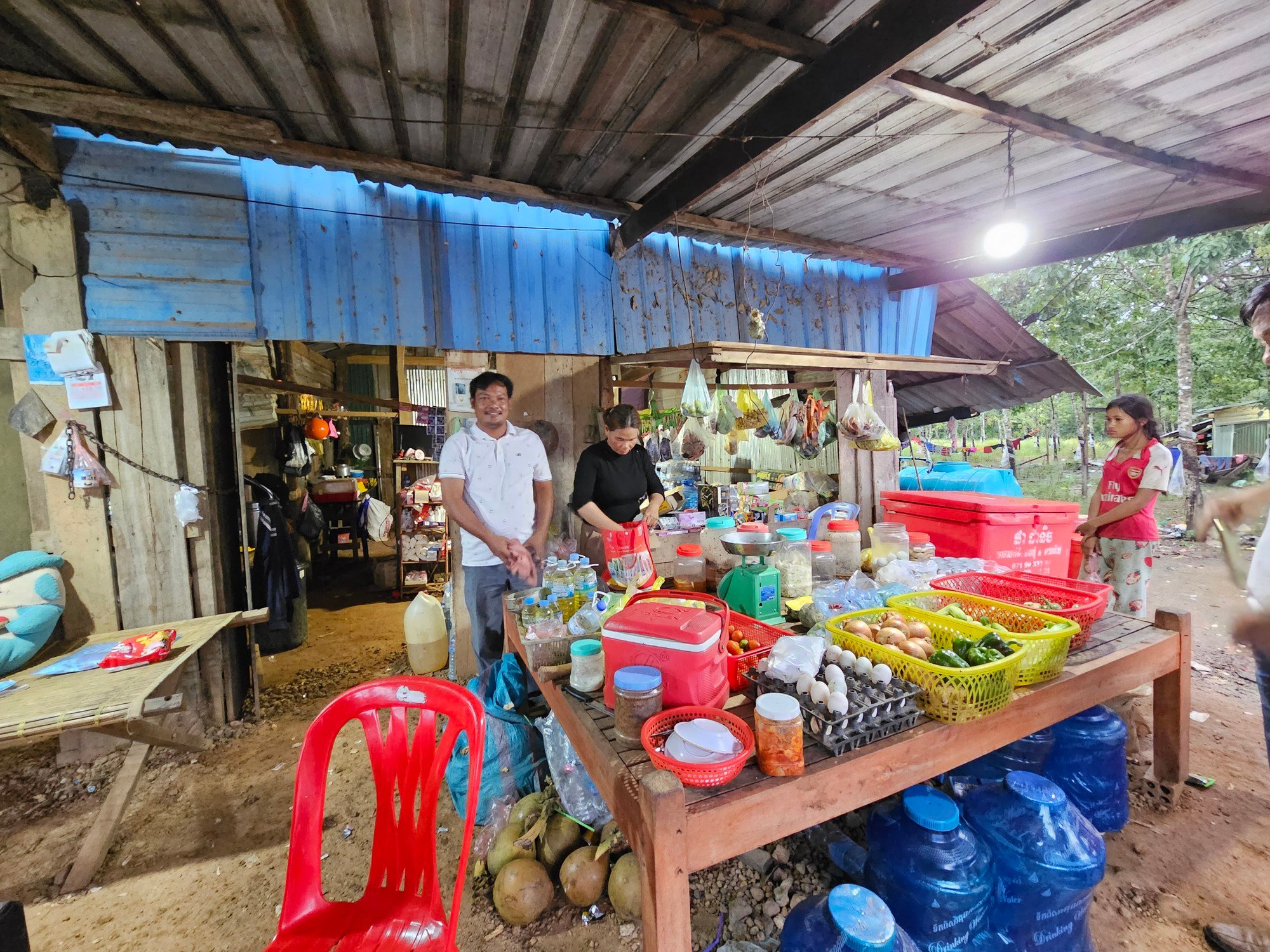
Tirso and his wife's grocery store
Around 5 or 6 PM is the busiest time for Mr. Tirso's grocery store. This is when workers cook their evening meals, so they flock to buy vegetables, fruits, eggs, and other necessities. Mr. Tirso and his wife often sell on credit to the workers, keeping a record of the debt, which they pay at the end of the month when the workers receive their salaries. Since working as rubber plantation workers, their income and living standards have been stable enough to provide for their family and children.
"My salary at the company is around $300, and I get paid regularly every month. The Vietnamese colleagues are friendly and sociable; if I don't know something, I can ask the Vietnamese staff for guidance. They live in our country but don't abuse their power; they always listen to what we have to say," Tirso told us. (to be continued)
Dau Tieng Cambodia Rubber Joint Stock Company was established in 2009; the project involved planting and harvesting nearly 2,300 hectares of rubber in Kratie province, Kingdom of Cambodia in 2011, with a registered charter capital of 450 billion VND. The production output in 2022 exceeded 2,000 tons.
Dau Tieng - Kratie Rubber Joint Stock Company was established in 2009; the project involved planting and harvesting approximately 2,000 hectares of rubber in Kratie province in 2012, with a registered charter capital of 450 billion VND. The production output in 2022 was nearly 2,500 tons.
Source link
![[Photo] Prime Minister Pham Minh Chinh attends the inauguration ceremony of the Vietnam Space Center.](https://vphoto.vietnam.vn/thumb/1200x675/vietnam/resource/IMAGE/2026/03/13/1773397068038_ndo_br_dsc-3366-jpg.webp)
![[Photo] Ho Chi Minh City decorated with flags and flowers ahead of election day.](https://vphoto.vietnam.vn/thumb/1200x675/vietnam/resource/IMAGE/2026/03/13/1773392076518_anh-man-hinh-2026-03-13-luc-15-53-29.png)


















































Comment (0)