


In the US, the Cape Cod area of Massachusetts saw approximately 800-900 sharks swimming through it between 2015 and 2018, potentially reaching one of the highest shark densities in the world .
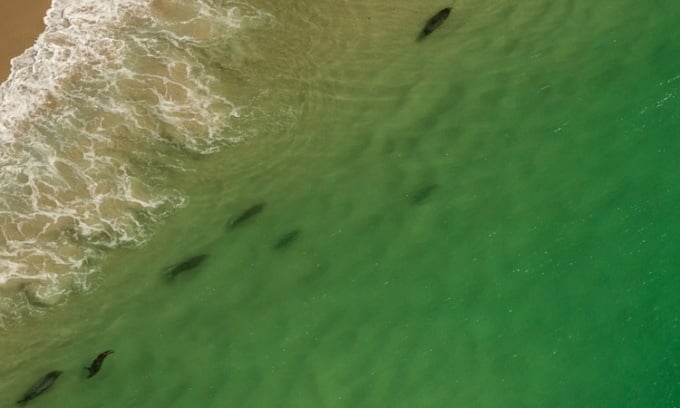
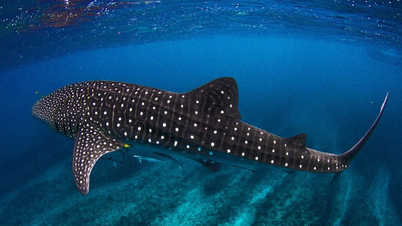
Great white sharks swim near the shore at Cape Cod. Photo: National Geographic
Determining the exact number of sharks roaming the waters around Cape Cod is difficult due to the complexity of counting such a large, reclusive species. However, researchers at the Atlantic Great White Shark Conservation organization have found an answer by combining acoustic tracking, photographic identification, and statistical modeling.
According to research, there were approximately 800-900 sharks swimming in the waters off Cape Cod from 2015 to 2018, according to National Geographic . For comparison, the estimated number of great white sharks off the coast of California is 300. "Shark density in Cape Cod is likely the highest in the world," said Megan Winton, a fisheries scientist who collected the data.
The discovery is particularly noteworthy not only because of the number of sharks but also because they are concentrated along more than 900 km of coastline. Four years of monitoring also revealed that the sharks, mostly adults measuring 2.4-3.7 m in length, spend about half of their time in waters below 4.6 m.
"People may know great white sharks are coming here, but they think they're far out at sea," Winton said. "We've seen sharks as long as 4.6 meters in water that's only 1.2 to 1.5 meters deep. Their camouflage is incredible. People can be right next to them and not see them."
Great white sharks are thriving again in Cape Cod for a simple reason. Their preferred prey is the recovering gray seal population. Hunted to near extinction, seal populations began to revive with the enactment of the U.S. Marine Mammal Protection Act in 1972. Today, seal numbers number around 50,000. Great white sharks, once listed as vulnerable by the International Union for Conservation of Nature, took longer to recover. But thanks to nationwide protection in 1997 and in Massachusetts in 2005, shark populations have steadily grown in the eastern United States.
According to Greg Skomal, a fisheries scientist at the Massachusetts Marine Fisheries Service, the risk of shark attacks is very small; swimmers are more likely to drown. There have only been five shark attacks on people in Cape Cod since 2012, including one fatal accident in 2018. To reduce the risk of shark-human encounters, scientists need to know where and when sharks swim.
To investigate, the research team at Cape Cod compiled a catalog of sharks identifiable by their tags or photographs of their dorsal fin coloration from 2015 to 2018. They then conducted a three-year survey, comparing the number of newly photographed sharks with those already recorded, and recreating encounters using statistical modeling to estimate their numbers. Unlike previous surveys in South Africa, California, and elsewhere, Winton's model considers shark movement. The new model allows consideration of where sharks tend to congregate along coastal areas.
The use of high-quality, portable underwater cameras makes shark identification easier and more accurate. Additionally, a team of experts at the Coastal Research Centre in Cape Cod uses sonar to map shark movements.
Great white sharks are ambush predators, typically stalking prey in deep water and leaping high to surprise their targets. But along the Cape Cod coast, sharks are forced to hunt in shallow waters. They do so by circling the depressions between sandbars, waiting for hungry seals to come into the water to feed. Understanding this unusual behavior helps experts predict shark movements and identify areas that are particularly dangerous for swimmers.
Since 2009, the research team in Cape Cod has tagged a total of 303 sharks with acoustic transmitters. Five trackers can detect acoustic pulses as tagged sharks swim by, transmitting real-time information to lifeguards, beach managers, scientists, and the community via an app.
An Khang (According to National Geographic )
Source link




![[Photo] Prime Minister Pham Minh Chinh presides over the meeting of the Steering Committee for the Development of Science, Technology, Innovation, Digital Transformation and Project 06.](https://vphoto.vietnam.vn/thumb/1200x675/vietnam/resource/IMAGE/2026/02/25/1772024613089_1772024091685-jpg.webp)
![[Photo] Prime Minister Pham Minh Chinh receives the Director General of TASS News Agency (Russian Federation)](https://vphoto.vietnam.vn/thumb/1200x675/vietnam/resource/IMAGE/2026/02/25/1772024599891_dsc-8041-jpg.webp)















































































![[Photo] Lung Phinh is covered in white plum blossoms.](https://vphoto.vietnam.vn/thumb/402x226/vietnam/resource/IMAGE/2026/02/25/1772036291497_tl-z7563533595318-d0f6815e01d4b292632a5f65d005af7d-8745-jpg.webp)
















Comment (0)