

Thousands of years before humans intentionally mummified bodies, nature did it for them through various environments.
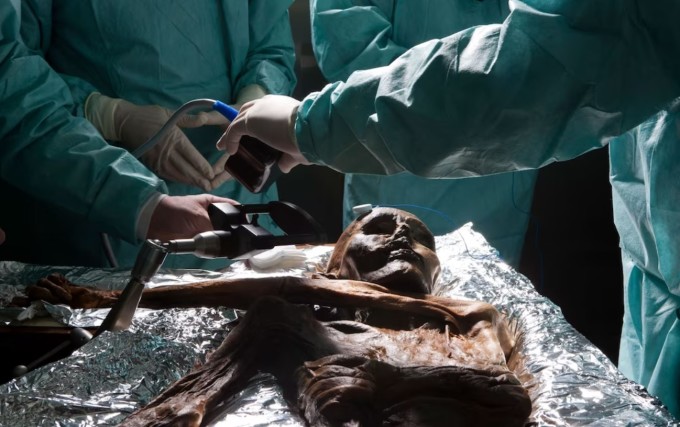
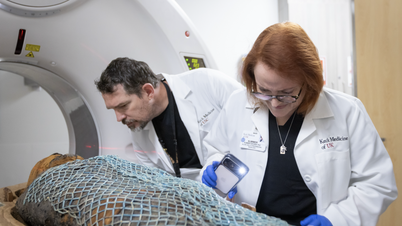
Researchers took brain samples from the Ötzi mummy. Photo: National Geographic.
In nature, human bodies are typically reduced to skeletons after a few years. Civilizations that practiced mummification, such as the ancient Egyptians, could only avoid this reality by employing complex burial processes involving special tools, chemicals, and manipulation, according to National Geographic .
However, there are ways to mummify bodies permanently without using canopy, natron salt, or brain-extraction tools. In fact, some of the oldest Egyptian mummies are likely a result of chance, according to Frank Rühli, director of the Institute for Evolutionary Medicine at the University of Zurich and director of the Organization for Mummification and Paleontology. Buried in shallow gravel, bodies can be naturally preserved for thousands of years by the hot, dry environment of the Sahara desert. Rühli believes this may have inspired the ancient Egyptians to begin mummifying those they revered.
Hot, dry deserts are just one of many environments that can transform bodies into natural mummies. Scientists explain how environments ranging from swamps to ice-capped mountain peaks can hinder the decomposition and mummification process.
Desert
Egypt wasn't the only desert civilization famous for mummies. The Chinchorro people of northern Chile began mummifying bodies about 2,000 years before the Egyptians. But thousands of years before that, the Atacama Desert did the work for them. "One of the interesting things about Chinchorro mummies is that some were intentionally prepared while others are naturally mummified," says anthropologist Bernardo Arriaza of the University of Tarapacá in Chile, who specializes in studying Chinchorro mummies.
Decomposition is a biological process, and without water, organisms cannot function. This is why deserts preserve mummies so well, and why the mummification process of the Egyptians and Chinchorro included a drying step. The oldest Chinchorro mummy, Acha Man, has been naturally preserved by the desert for over 9,000 years. The Tarim mummies in Xinjiang, China, among the most intact, were buried in boat-shaped sarcophagi for 4,000 years in the Taklamakan Desert.
Salt
For some of the unfortunate Iranian miners trapped in caves at the Chehrabad salt mine, salt preserves bodies just as well as the desert. "They work in the salt mine and then the mine collapses," Rühli explains. This has happened many times (at least twice) over the past 1,000 years. The salt mine becomes a burial ground for young men who lived centuries apart. While the weight of the salt presses down on the miners, the salt rocks draw water from their bodies, embalming them.
According to Arriaza, the salt in the dry soil of the Atacama Desert also helped preserve Chinchorro's mummy. The soil contains many nitrate, nitrogen, potassium, sodium, and calcium compounds, which contribute to dehydration of the body.
Ice
Dehydrating a body isn't the only way to prevent decomposition. Low temperatures slow down most biological processes, and complete freezing also prevents decomposition for thousands of years. Pathologist Andreas Nerlich of Munich's Klinik Bogenhausen, who studied Ötzi, a 5,300-year-old ice mummy exposed on a melting glacier in the Ötztal Alps near the Austrian-Italian border, believes that mummies like Ötztal will be preserved as long as there is ice.
Although rare, ice mummies can be remarkably well-preserved compared to dehydrated mummies. This is because the dehydration process wrinkles and distorts the tissue, but the frozen internal organs largely retain their shape. Permafrost, a layer of ground that remains frozen year-round, can also mummify bodies. The 2,500-year-old Ice Maiden in Siberia was frozen in a block of ice after its tomb was flooded. Because the tomb was located in permafrost, the ice that formed inside never melted.
Freeze-dried
Combining cold and dry conditions can mummify bodies even when the environment isn't consistently cold enough to keep corpses frozen year-round. This is the process that occurred with some Inuit women and children in Greenland. They were naturally mummified in their graves after death, most likely due to famine or disease in the 15th and 16th centuries.
"Although the weather is very cold in Greenland, the environment is not like the Arctic with its permafrost," said paleontologist Niels Lynnerup of the University of Copenhagen. "The bodies were buried under rock crevices, so there was still wind blowing through. The wind dried the bodies, and this, combined with the cold temperature's effect of slowing down bacterial activity, created mummies."
Most Inca mummies discovered in the Andes mountains were preserved in a similar way. The Llullaillaco Virgin Mummy, the body of an Inca girl who died of cold in the Andes after a sacrificial ritual, is a unique case of cryopreservation.
An Khang (According to National Geographic )
Source link
![[Photo] General Secretary and President To Lam visits and delivers a policy speech at Tsinghua University.](https://vphoto.vietnam.vn/thumb/1200x675/vietnam/resource/IMAGE/2026/04/14/1776164592318_vna-potal-tong-bi-thu-chu-tich-nuoc-tham-va-phat-bieu-chinh-sach-tai-dai-hoc-thanh-hoa-trung-quoc-8700658-5437-jpg.webp)
![[Image] Expediting land clearance at Alley 310 Nghi Tam to facilitate the construction of Tu Lien Bridge](https://vphoto.vietnam.vn/thumb/1200x675/vietnam/resource/IMAGE/2026/04/14/1776160406551_ndo_br_z7724148990408-9e5d4777e3c4504998b4286178b2e66e-jpg.webp)

![[Photo] General Secretary and President To Lam and his wife begin their state visit to China.](https://vphoto.vietnam.vn/thumb/1200x675/vietnam/resource/IMAGE/2026/04/14/1776133794926_z7723148772587-ffefa3c4b1e54e100de1554593a862c6-jpg.webp)

























![[Photo] General Secretary and President To Lam receives Slovak Prime Minister Robert Fico](https://vphoto.vietnam.vn/thumb/1200x675/vietnam/resource/IMAGE/2026/04/13/1776080592076_a1-bnd-8227-6002-jpg.webp)
























































Comment (0)