

Researchers have concluded that animal species, especially those on land, are often limited in size due to the law of growth correlation and resource abundance. However, no one knows exactly how large animals in the wild can grow.
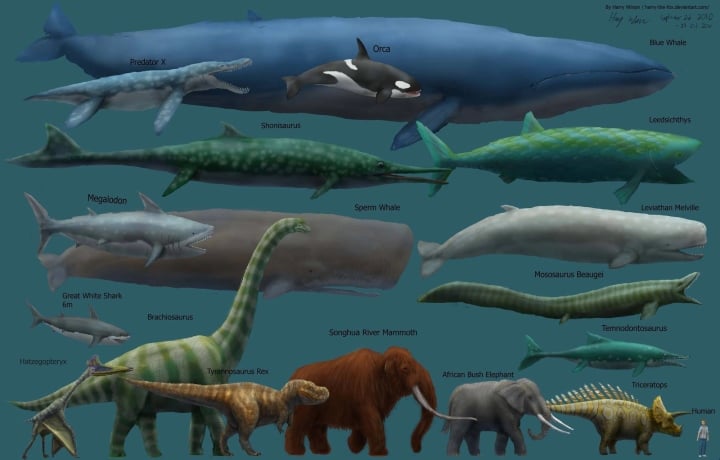
List the largest animals that have ever existed in nature.
How big can animals get?
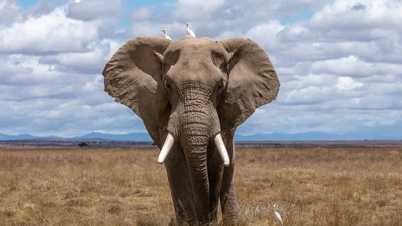
Many speculate that the largest animal to have ever walked the Earth was likely the Argentinosaurus, a titanosaur that weighed 70 tons. Currently, the heaviest land animal in the world is the African elephant, also known as the Loxodonta, which weighs less than 6 tons.
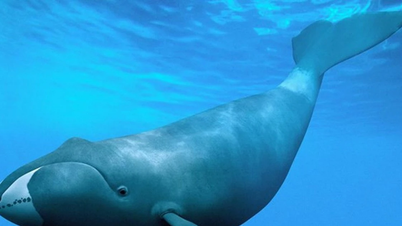
However, when compared to the blue whale, neither dinosaurs nor African elephants can compete. This is because the blue whale weighs an average of 150 tons, possibly the heaviest animal ever to have lived on the planet. Regarding the question , "How big can animals get?" , Geerat Vermeij, a professor of geobiology and paleontology at the University of California, shared that he is unsure of the answer because size depends on many factors.
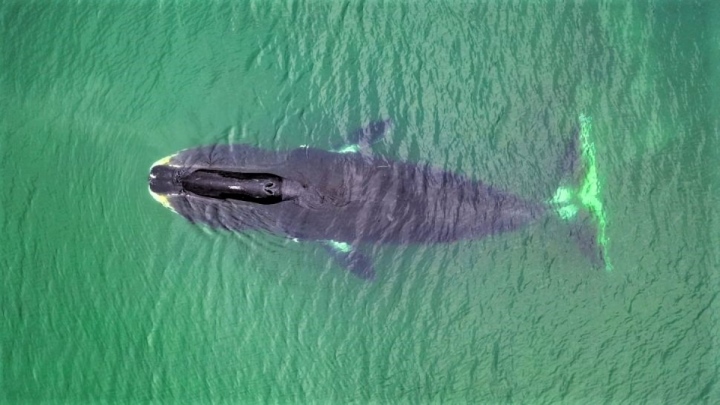
Blue whales typically weigh around 150 tons.
Felisa Smith, a professor of paleontology at the University of New Mexico, used the square-cubic law to explain how large animals can grow. According to this law, as an animal increases in size, its volume grows faster than its surface area. Therefore, the larger the animal, the larger its limbs need to support its weight.
If you increased the size of an elephant several times, the square-cube law dictates that it would collapse because its limbs wouldn't grow proportionally to its mass. The only way for a super-giant elephant to stand is to possess proportionally large legs. However, if the elephant weighs 120 tons, its legs would become impractical and cumbersome.
Animals in a rich environment can reach their maximum size.
One of the factors influencing animal size is the abundance of resources. Animals living in a rich environment with high-quality food will have very favorable conditions to reach their maximum body size.
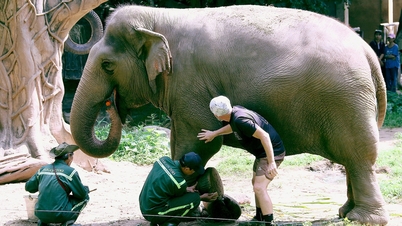
According to Jordan Okie, a biologist at the University of Arizona, whales, elephants, and many other large animals tend to live in nutrient-rich environments. This nutrient requirement also explains why lizards like titanosaurs are much larger than the largest land mammals. Mammals, being warm-blooded and having a faster metabolism, typically need to consume ten times more food than lizards to grow to their full size.
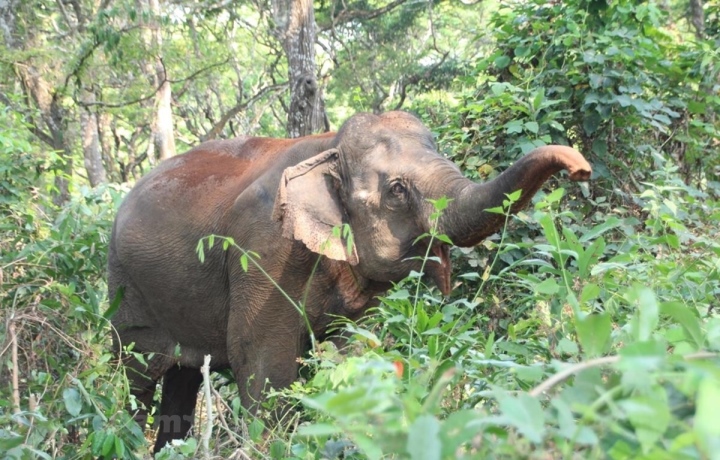
Elephants absorb nutrients very well.
Normally, blue whales, being warm-blooded mammals, would be classified as small animals. However, surprisingly, blue whales can weigh around 150 tons – an exception to these rules.
The blue whale's remarkable success is due to its unique habitat. These large marine animals can utilize buoyancy to increase their size without putting strain on their muscles and skeletons. Jordan Okie, a biologist at the University of Arizona, explains that aquatic animals are less constrained by biomechanical limitations.
The ocean also provides abundant, nutrient-rich resources for their growth. Jordan Okie further explains that the advantage of the baleen plates in their jaws has allowed whales to consume plankton efficiently enough to support their enormous size.
Tuyet Anh (Source: Compilation)
Beneficial
Emotion
Creative
Unique
Source

































































































Comment (0)