


In Binh Thuan province, Mr. Mai Van Lam and more than a dozen fishermen in Phan Thiet city make a living diving to catch clams, which they sell for 150,000-200,000 VND per kilogram.
Around 8 a.m., with calm seas and gentle breezes, Mr. Lam from Ham Tien ward tied his clam-scavenging equipment and a buoy onto his old motorbike and rode to Mui Ne beach, about three kilometers from his house. Upon arrival, Mr. Lam pushed the buoy into the water, attached his battery-powered diving device to it, and towed it out to sea, about 15 meters from the shore.
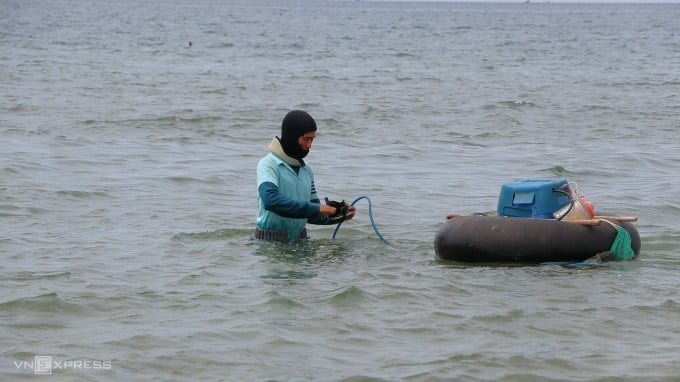
Mr. Mai Van Lam pushes a buoy and diving equipment out into the sea off Mui Ne, preparing to dive for clams. Photo: Viet Quoc
Previously, this clam diver had tied a heavy lead weight around his waist to help his body sink more easily while diving. Wearing goggles and a snorkel more than 5 meters long connected to a battery-powered oxygen compressor, Mr. Lam submerged into the water, holding a pointed iron rod about 60 cm long in his hand.
Every 10-15 minutes, he surfaces to rest, removes his snorkel to breathe fresh air, and empties a few freshly caught clams into a mesh basket on the float. "This job requires good health; being submerged in water is very tiring," Mr. Lam said.
When diving underwater, the fisherman pokes the pointed end of an iron rod into the sand to probe. If he sees air bubbles rising, he knows there are clams beneath the sand. He digs the sand out 20-30 cm, catches the clams, and puts them into a mesh bag tucked into his belt. He continues this process of diving along the Mui Ne - Ham Tien coastline to hunt for clams.
Every day, he spends about 6 hours underwater, from 8 am to 2 pm, before packing up his equipment and bringing it ashore. Mr. Lam says that each diving trip yields about 5 kg of clams, which he sells for 100,000-200,000 VND per kg, depending on size. On average, he earns 600,000-700,000 VND per trip.
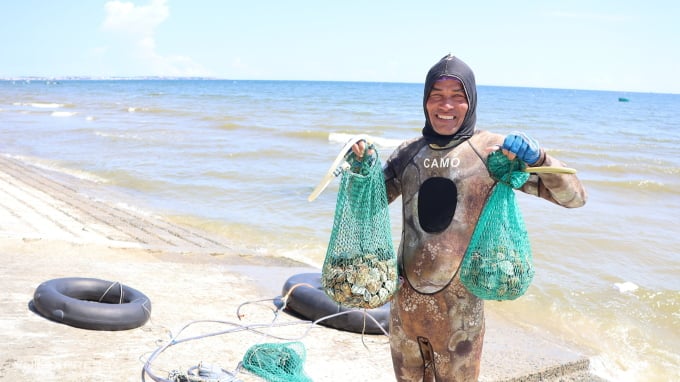
Fisherman Nguyen Nam with the clams he just dived for in the Rang sea. Photo: Viet Quoc.
At Rang beach, about 3.5 km away, Mr. Nguyen Nam, a fisherman from Ham Tien ward, had just dived and caught nearly ten kilograms of clams. Taking off his swimsuit, he sat down to sort the clams by size, putting them into two baskets. He had nearly 4 kg of large clams (25-30 clams per kilogram), and the rest were smaller clams (40-50 clams per kilogram).
After tidying up the buoys, air compressor, and hoses, Mr. Nam neatly tied them to his motorbike and rode to the seafood markets to buy and sell. Large clams were purchased for 200,000 VND, while smaller ones fetched 100,000-150,000 VND per kilogram.
"Today was a good day, I earned over a million dong," Mr. Nam said, adding that this profession is unpredictable; there are days when the sea is windy and they only catch a few dozen fish, "just enough to bring home for a meal."
Fishermen in Phan Thiet say that clams live in the sand on beaches near the shore where the tide rises and falls. The beaches from Hoa Thang to Mui Ne, Phan Thiet, have many large clams, so fishermen often dive to catch them. However, fishermen don't dive to catch clams every day. They only dive when the sea is calm and the water is clear, because that's when the clams are clearly visible. On stormy days, they take a break and switch to other work.
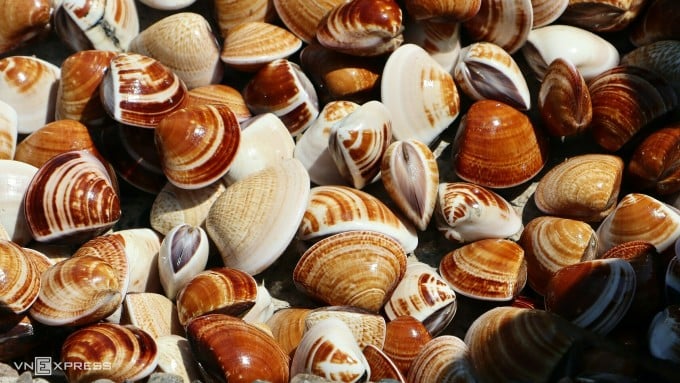
Sea clams are caught by divers in the waters off Phan Thiet. Photo: Viet Quoc.
Clams are bivalve mollusks that typically live along tidal flats in the sea. Their diet consists of plankton, algae, and detritus in the sand. Clams found in Phan Thiet waters are usually glossy brown, light brown, or white with brown streaks. Since clam farming is not yet developed locally, most of the clams are harvested from the wild.
Ms. Le Thi Be, a seafood buyer in Phan Thiet, said that clams caught in the Phan Thiet sea are plump, have a fragrant flavor, and are sold at a higher price by restaurants than farmed clams imported from other places. "Seafood connoisseurs can tell immediately whether a clam is wild-caught or farmed," Ms. Be said.
According to published studies, clam meat is highly nutritious and beneficial to human health. It contains many nutrients such as protein, fat, vitamin B12, vitamin C, and various trace elements including zinc, iron, potassium, calcium, and manganese.
Live clams, when purchased, should be soaked in clean water with a few slices of chili for two hours to allow them to release all the dirt and sand. Clams are used to prepare many delicious dishes such as porridge, soup, stir-fried with lemongrass and chili, stir-fried with coconut, satay, steamed with lemongrass, etc. Among them, steamed clams with lemongrass are the easiest to prepare and the most popular dish in the coastal city of Phan Thiet.
Viet Quoc
Source link















































































Comment (0)