

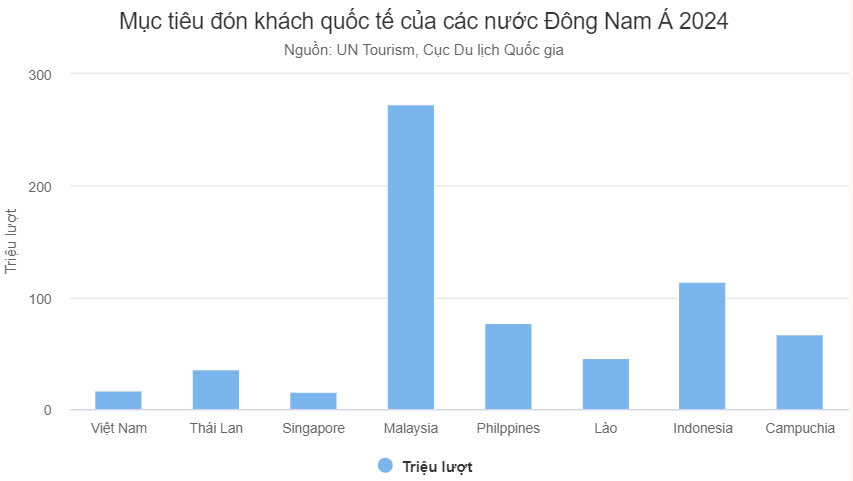
With approximately 17 million international visitors and 120 million domestic visitors, Vietnam's tourism sector in 2024 has strived to recover to pre-pandemic levels and accelerate its race in the region.
"Increasing from 12.6 million international visitors last year to 17.5 million this year is a significant achievement for the tourism industry," said Nguyen Van My, Chairman of Lua Viet Travel Company. In addition to promotional campaigns targeting the world , this year localities have continuously organized a series of events and festivals to attract tourists. The more organized, systematic, and attractive approach shows that Vietnamese people are gradually becoming more conscious of attracting international visitors.
"2024 was a successful year for the industry. The near-pre-pandemic recovery demonstrates Vietnam's competitiveness and attractiveness," said Pham Hai Quynh, Director of the Asian Tourism Development Institute.
According to Mr. Quynh, one of the reasons for the strong growth in international tourist numbers is the government's opening up to international tourism and the intensified tourism promotion efforts. Infrastructure, hotels, and tourism services have improved, enhancing the visitor experience. Vietnam has also promoted many attractive tourism types such as beach tourism, ecotourism, cultural tourism, culinary tourism , and MICE (Meetings, Incentives, Conferences, and Exhibitions). MICE is one of the thriving tourism sectors this year, with a prime example being the group of 4,500 Indian tourists who visited Vietnam in August.
From August 15, 2023, Vietnam extended the temporary stay period from 15 to 45 days for citizens of 13 countries with unilateral visa exemptions, and also implemented electronic visa (e-visa) issuance for citizens of all countries and territories at 13 airports, 13 seaports, and 16 land border gates; the temporary stay period was extended from 30 days to 90 days, and the visa is valid for multiple entries.
"My sister booked a tour to Vietnam right after the official announcement that the visa extension period had been extended to 45 days. She will be in Ha Giang in February 2025, when the cherry blossoms are in full bloom," said Maria Sanchez, a Spanish tourist currently traveling in Vietnam. Many of her friends have also shifted their plans to visit Vietnam in 2025, following the visa relaxation policy that came into effect in August.
"Tourists say the 45-day stay limit is great; they can travel more, stay in each place longer, instead of just seeing things like they did with the 15-day limit," said Nguyen Ba Thang, a tour guide specializing in the Spanish market, based in Ho Chi Minh City.
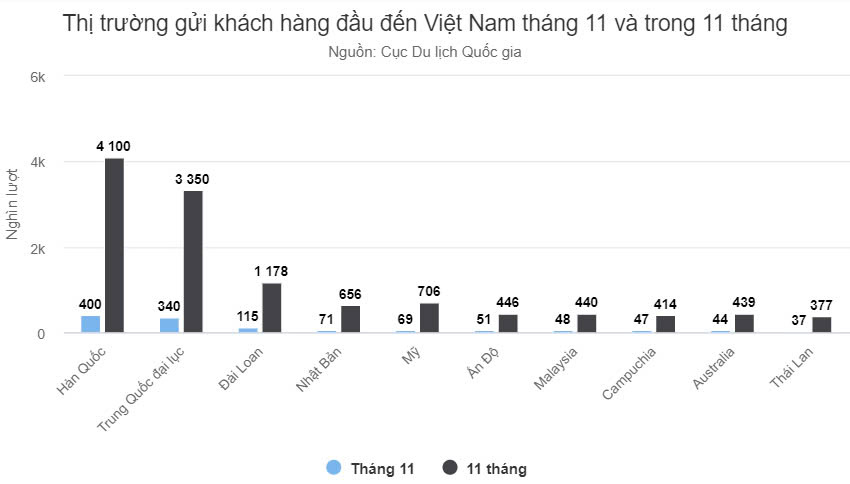
According to Nguyen Tien Dat, Vice Chairman of the Hanoi Tourism Association, this year's success in the tourism industry is partly due to the significant contribution from tourists from mainland China, Taiwan, and South Korea. The number of visitors from these three markets in the first 11 months of the year reached approximately 8.6 million, accounting for 54% of the international tourist market share. In addition, a major growth driver for Vietnam this year also comes from European tourists, especially from countries benefiting from relaxed and unilateral visa exemption policies such as Italy, France, and the United Kingdom.
"Vietnamese tourism is gradually becoming more organized," is the assessment of Mr. Vu Van Tuyen, Director of Travelogy Tourism Company. Previously, Vietnamese tourism lacked attractive products for tourists. Products were often overlapping and similar, lacking differentiation. But this year, things have changed. Many places now offer unique tourism products that encourage visitors to stay longer; instead of 7-10 days, tourists are now staying for 3-4 weeks.
"This year, Hanoi has expanded its range of nighttime tourism products, not only in the city center but also in the suburbs, allowing visitors to stay for a week or two without getting bored," Mr. Tuyen said.
Experts also highly appreciate Vietnam's domestic tourism, estimating 120 million arrivals by the end of this year; a 13% increase compared to last year's 106 million and 1.5 times the 80 million arrivals in 2019. This figure is particularly significant given the high airfare prices during the first nine months of this year.
"Vietnamese tourists are now very smart consumers," Mr. Dat explained, clarifying why airfares are expensive but the number of tourists hasn't decreased. Many have chosen to travel closer to home, using cars or trains, or flying at inconvenient times to save costs. Many of them even travel 2-3 times a year.
"Since plane tickets are expensive, we choose to travel during the off-season. During the peak summer season, the family chooses to take the train from Hanoi to Hue or Da Nang, or choose nearby destinations that can be driven to, which are much more affordable," said Nguyen Ngoc Lan Anh, 30, about her plans to travel three times a year.

Experts say that this year, popular tourist destinations have also implemented various stimulus policies such as discounted room rates. Khanh Hoa is an example of the tourism industry's success this year, with both international and domestic visitor numbers increasing significantly. The province reached its target before the end of the year. To achieve this, in addition to strengthening bilateral tourism promotion, the province also opened more direct flights, targeting large tourist groups such as South Korea.
Khanh Hoa province in general, and Nha Trang in particular, are highly regarded by tourists for their delicious food, beautiful beaches, fair pricing, affordable hotel rooms, and abundant supply. Many of Mr. My's company's clients who visited Nha Trang were very satisfied. "The locals in Nha Trang say that here, they only charge that price. Tourists are surprised and very impressed with this place," Mr. My said.
The sharp increase in airfares this year is unfortunate for the tourism industry. If prices had been the same as in previous years, the number of domestic tourists would certainly have increased even more, and Vietnam's tourism industry wouldn't have lost a large number of tourists who chose to travel internationally instead.
Many experts believe that to bring airfares back to stable levels like in previous years, airlines should proactively reduce prices. "Airlines need to restructure, streamline operations, and reduce fixed costs. Then, lowering airfares will no longer be an issue," Mr. Dat said.
The shortage of qualified human resources is also something that CEOs of many travel companies hope to address in the coming year. Besides the lack of tour guides who speak rare languages such as Spanish and Portuguese, the industry is also facing a shortage of skilled tour guides.
In addition, experts hope that industry officials will conduct more research on the number of days tourists stay, the amount of money tourists spend, and the preferences of each tourist market in order to develop long-term tourism development strategies.
According to statistics released on November 6th by the National Tourism Administration, South Korea was the largest source of tourists in the first 11 months of the year, followed by mainland China, India, the United States, Japan, and Australia. However, besides statistics on the number of visitors, Vietnam's tourism industry lacks other detailed data such as spending and length of stay.
Mr. Dat assessed Vietnam's visa policy for international tourists as "very good." However, he still hopes the government will expand the list of unilateral visa exemptions, especially targeting major source markets for Vietnamese tourists, as well as address air pollution in Hanoi. "Tourists from many countries with clean environments will never return if they visit polluted places," he said.
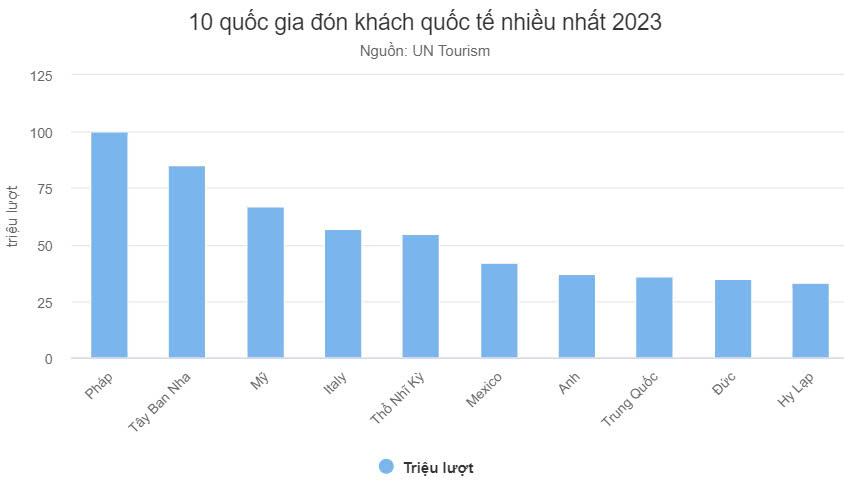
Experts also expressed their hopes for Vietnam. "We are not resting on our laurels" this year. Chairman of Lua Viet Tours, Nguyen Van My, stated that it's not just Vietnam's tourism industry that's accelerating; many other countries are also accelerating and growing faster. While Vietnam is currently "near recovery," Malaysia has already recovered since 2023 with 28 million visitors.
The Chairman of Lua Viet believes that the figure of 17 million is not necessarily a measure of the industry's success, especially when compared to other countries in the region. Singapore is estimated to welcome 15-16 million tourists, fewer than Vietnam, but this country has a small area of 700 km2 and is only 100 km2 larger than Phu Quoc Island. Thailand is estimated to welcome 36 million international tourists in 2024, with a population of nearly 72 million people - equivalent to two Thais welcoming one tourist. Thus, if compared in this way, the Vietnamese tourism industry needs to set a target of welcoming 50 million tourists, out of a total population of over 100 million people.
"We run, but other countries run faster," the American said.
Source


![[Photo] Signing ceremony of cooperation documents between Vietnam and Cambodia](/_next/image?url=https%3A%2F%2Fvphoto.vietnam.vn%2Fthumb%2F1200x675%2Fvietnam%2Fresource%2FIMAGE%2F2026%2F02%2F06%2F1770364590364_vna-potal-le-ky-cac-van-kien-hop-tac-giua-hai-nuoc-viet-nam-campuchia-8577065-1695-jpg.webp&w=3840&q=75)




Comment (0)