

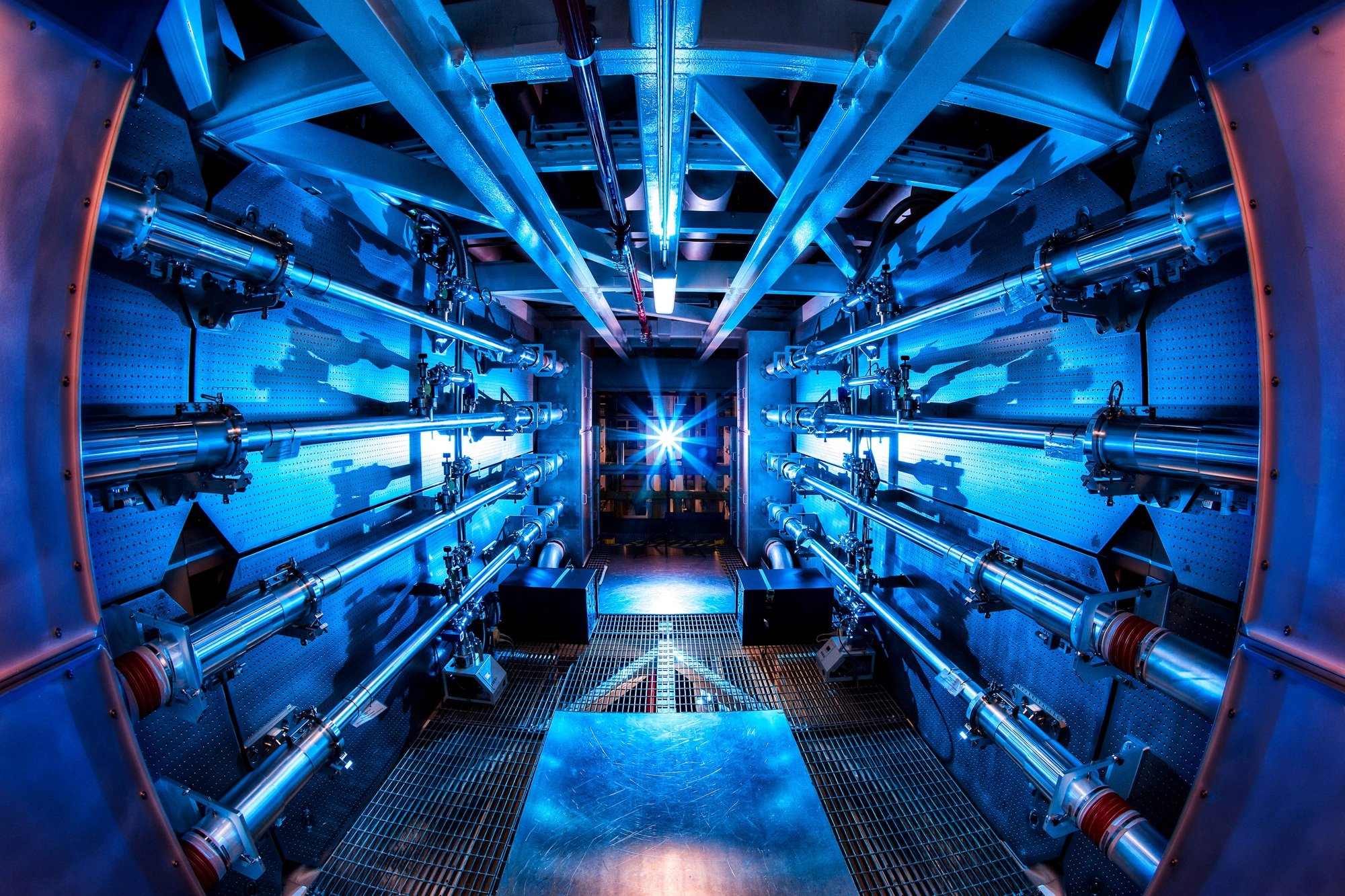
Laser power booster device in the experiment
The Guardian reported on August 7th that scientists at Lawrence Livermore National Laboratory (California, USA) have just obtained a large amount of energy from nuclear fusion, also known as fusion reactions.
While nuclear reactors around the world utilize uranium fission, scientists worldwide have long pursued the ambition of conducting fusion reactions, which are far more difficult to achieve.
Fusion reactions hold promise as a clean, safe, and virtually limitless source of energy.
According to a spokesperson for Lawrence Livermore National Laboratory, scientists conducted a second fusion test on July 30th and achieved even higher energy than the first test in December 2022. The final results will be analyzed in detail.
In the experiment, scientists fired multiple high-energy laser beams at a small target, heating hydrogen isotopes deuterium and tritium to temperatures exceeding 3 million degrees Celsius and simulating the conditions of a star.
This process releases a massive amount of energy, promising a sustainable and low-carbon alternative to fossil fuels or fission.
According to the Department of Energy, the laboratory harvested a large amount of energy from a December test, generating 3.15 megajoules after a 2.05-megajoule laser beam was fired at a target.
In other words, fusion testing produces more energy than is supplied. The U.S. Department of Energy calls this "a major scientific breakthrough in decades, paving the way for advances in defense and a clean energy future."
One kilogram of fusion fuel, composed of hydrogen isotopes deuterium and tritium, provides the same energy as 10 million kilograms of fossil fuel. However, it took scientists 70 years of research to achieve this breakthrough.
However, scientists believe that this technology still needs a lot of time before it can be applied to nuclear power plants, and therefore is unlikely to solve the immediate climate crisis.
Source link


















































































































Comment (0)