

With serious training for 16-20 weeks, a beginner runner can successfully conquer the 42km race.
According to Runner's World , 16-20 weeks (4-5 months) is the standard timeframe for training for a first marathon. This is long enough for beginners to get used to the intensity of the exercise, improve their fitness, and increase their endurance.
16-20 weeks is the standard, but many factors can affect the training process, making it longer or shorter. Individuals with a pre-existing fitness level and who regularly play sports will adapt more quickly to long-distance running, possibly needing only 12 weeks to prepare. Meanwhile, those unfamiliar with exercise, overweight, or with weaker physiques may take more than 24 weeks (6 months). Additionally, training plans can be interrupted by unexpected injuries or work schedule changes.
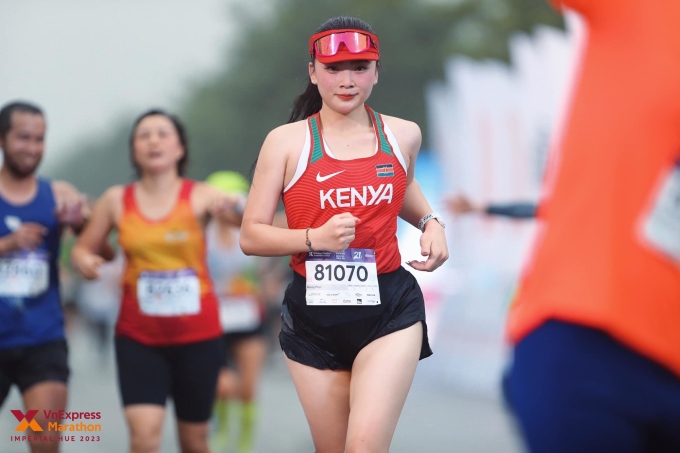
A runner participating in the VM Hue 2023 race. Photo: VM
The training regimen will include 3-4 sessions per week, with the rest of the time dedicated to rest and relaxation to allow muscles to recover. According to Laura Noris, a running coach and content creator in the US, the principle for training for a first marathon is to avoid pushing yourself or rushing. Runners should not aim for a sub-5 or sub-4 finish in their first marathon. Noris believes that the goal should only be to finish safely within the allotted time.
"Pushing yourself to the limit might yield results, but afterwards runners are more likely to become exhausted, injured, and lose their passion for running. I would never want that to happen to my students," shared Noris, who has coached over 200 amateur and professional athletes.
According to Laura Noris, the first six weeks are a foundational training period to build lung and leg muscles. The training volume during this time shouldn't be excessive. For example, the first week might involve a 15-minute run on Monday, increasing to 20 minutes on Wednesday and 25 minutes on Saturday. Sundays are for an hour-long easy run. In subsequent weeks, runners will gradually increase the distance or duration of their runs, perhaps from 3km to 5km and then 7km, but ideally not exceeding 10km.
Laura Noris believes that speed isn't the most important factor in the first few weeks. Instead, runners can relax during training, combining running and walking. For example, run for 30 seconds then walk for a minute, then gradually improve to running for a minute and walking for 30 seconds. "This method helped me get started with running. The goal is to create comfort, minimize injury, and allow the body to gradually adapt," shared the coach, who is pursuing a Master of Science in Sports Science at Concordia University.
Once they have a foundation, runners can register for a short race, around 5km, aiming to complete it in 45 minutes or an hour to find motivation and test their training progress. This will also serve as a stepping stone to boost their morale for future training sessions.
Between weeks 6 and 16, runners will enter an advanced training cycle. During this cycle, the distance run each week will increase compared to the previous week, but not by more than 10-15%.

Runners run on sand dunes at the VnExpress Marathon Quy Nhon 2022. Photo: VM
Laura Noris has three pieces of advice for this stage. First, speed isn't the most important thing. According to her, regardless of the distance, runners should always ensure they can still talk to people around them without getting out of breath. For example, with four training sessions per week, runners should have at least two easy runs, while the rest can be pace training, long runs, or intermediate sessions. "As distance increases, the body expends more energy. When the body changes, it takes time to gradually adapt. Therefore, most training sessions should take place at a slow pace to reduce the risk of injury," the coach shared.
Secondly, supplementary exercises such as cycling, yoga, swimming, etc., are important. Athletes can play additional sports or do supplementary exercises in their free time or on days without scheduled races. Finally, proper energy intake is crucial. Glycosenes and carbohydrates are two important substances for athletes, helping to replenish energy and avoid burnout during training and competition. Therefore, energy drinks, gels, and energy bars should always be readily available.
After months of training, the final thing runners need to focus on is listening to their bodies. If they're not yet confident and comfortable, runners can choose to participate in 21km or even a few 10km races to build a habit before gradually progressing to a full marathon.
In Vietnam, runners can choose races within the VnExpress Marathon system to test the results of their training. On June 11th, the VnExpress Marathon Sparkling Quy Nhon will take place with a scale of 10,000 athletes. The race allows participants to explore the beauty of the vibrant coastal city in the South Central region, via the famous Thi Nai sea bridge. Participating in the race is also a way for families to combine sports and tourism during their summer vacation.
Hoai Phuong
Source link


![[Photo] Prime Minister Pham Minh Chinh attends the Conference on the Implementation of Tasks for 2026 of Vietnam Television.](/_next/image?url=https%3A%2F%2Fvphoto.vietnam.vn%2Fthumb%2F1200x675%2Fvietnam%2Fresource%2FIMAGE%2F2026%2F01%2F10%2F1768047311329_ndo_br_dsc-3214-jpg.webp&w=3840&q=75)










































![[Infographics] Resolution No. 79-NQ/TW of the Politburo on the development of the state-owned economy](https://vphoto.vietnam.vn/thumb/402x226/vietnam/resource/IMAGE/2026/01/10/1768038914679_chp_3-11-23.jpeg)









































Comment (0)