

According to a report from the Hanoi Department of Health , to date, Hanoi has inspected and traced the origin of food at 20 school cafeterias. Of these, 15 facilities met the standards, with rapid testing of 190 out of 190 samples passing.
According to a report from the Hanoi Department of Health, to date, Hanoi has inspected and traced the origin of food at 20 school cafeterias. Of these, 15 facilities met the standards, with rapid testing of 190 out of 190 samples passing.
Over the past period, Hanoi has consistently prioritized food safety in schools. In particular, the inspection and supervision of school cafeterias has been intensified. The goal is to have 100% of educational institutions inspected and supervised according to regulations; specifically, in 2023, 84.5% of institutions were inspected.
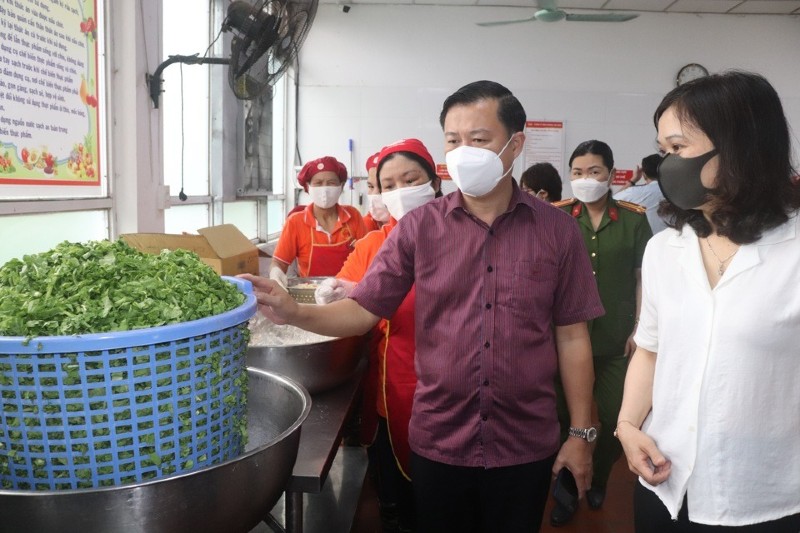 |
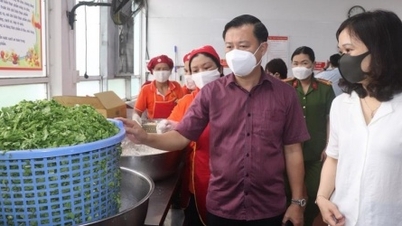
| Leaders of the Hanoi Food Safety and Hygiene Department inspect school cafeterias. |
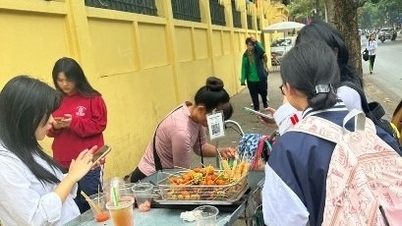
However, inspecting and controlling street food and vendors in the area around school gates remains challenging.
In light of this situation, from the beginning of August 2024, Hanoi began organizing specialized inspection teams to check food safety in schools, focusing not only on school cafeterias but also on food businesses in areas near schools...
According to Dang Thanh Phong, head of the Hanoi Food Safety and Hygiene Department, from August 2024 to the end of August 2025, the entire city will focus intensely on ensuring food safety both inside and outside schools. Hanoi will review educational institutions, collective kitchens, and school canteens under its management.
School kitchens are strictly controlled in terms of food origin and processing to ensure safety for teachers and students. In addition, food services outside and around schools need to be monitored and inspected by local authorities to ensure food safety.
On the other hand, authorities are investigating and reviewing food service establishments, street food vendors, and grocery stores selling pre-packaged and ready-to-eat processed foods around schools, categorized by product type and item.
The city will focus on inspecting and monitoring spontaneous food stalls and vendors around school gates because the unclear origin of food from these stalls poses a risk to the health of students...
In particular, the inspection, monitoring, and traceability of food in and around school gates will be carried out seriously and regularly; organizations and individuals violating food safety regulations will be strictly dealt with.
In addition, the city has recently inspected, monitored, and traced the origin of food at 19 food service establishments in the airport area, of which 12 establishments met the standards, with rapid testing of 190 out of 190 samples passing.
Currently, there are more than 4,000 school cafeterias in Hanoi. According to Dang Thanh Phong, Head of the Hanoi Food Safety and Hygiene Department, from August 2024 to the end of August 2025, the entire city will focus intensely on ensuring food safety both inside and outside schools.
Accordingly, school kitchens are strictly controlled in terms of food origin and processing to ensure safety and prevent food poisoning among students and teachers. In addition, local authorities need to strengthen inspection and supervision of food services around schools.
To ensure food safety, the Hanoi Food Safety and Hygiene Department requests that inspection teams from districts, counties, and towns focus on conducting surprise inspections and follow-up checks to assess the extent to which establishments have rectified violations and existing problems.
This allows for the timely detection of unsafe food, establishments with violations, and those not fully complying with processing procedures. Furthermore, localities need to continue strengthening communication and guidance for schools, reminding students not to consume food of unknown origin provided by strangers.
Source: https://baodautu.vn/kiem-soat-bep-an-tap-the-truong-hoc-d229020.html













































































Comment (0)