

In Quang Nam, after failing in his attempt to collect and sell chicken feathers, Nguyen Ha Thien independently researched and transformed them into organic fertilizer, generating a monthly revenue of 200 million VND.
At the end of November, at the organic fertilizer production facility for chicken feathers owned by 31-year-old Thien, located in the planned industrial cluster area of Duy Nghia commune, Duy Xuyen district, four workers were operating the machinery. The factory is designed as a closed system with an odor control system.
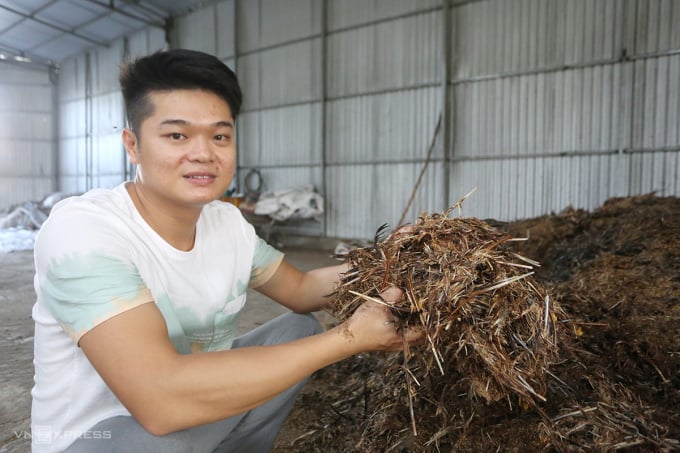
Nguyen Ha Thien stands beside a pile of newly collected chicken feathers for the production of organic fertilizer. Photo: Dac Thanh
Born in Duy Phuoc commune, Duy Xuyen district, after finishing 12th grade, Thien followed in his family's footsteps and opened a clothing shop and pub in Hoi An city. The business provided a decent income, but he wasn't satisfied and wanted to find a new way to make a living.
In 2021, knowing that chicken feathers were being bought in Can Tho for export to China, Thien became a middleman, buying poultry feathers in Central Vietnam, drying them, and selling them for 8 million VND per ton. He sold about 15 tons of chicken feathers each month. After three months, traders forced the price down to 5 million VND per ton, leaving him with no profit, so he stopped.
Because he had a contract with the owner of the poultry slaughterhouse, Thien had to buy chicken feathers and resell them to kumquat tree growers in Hoi An. Chicken feathers contain protein, calcium, magnesium, sodium, copper, and nitrogen, which help plants grow well, especially kumquat trees sold during Tet (Lunar New Year). However, applying chicken feathers directly as fertilizer will breed bacteria, chicken mites, and create a foul odor.
"Why not turn chicken feathers into organic fertilizer, mitigating the drawbacks compared to direct application?", Thien wondered.
To experiment, he dried chicken feathers and hired a mechanic to design a drying and grinding system costing nearly 600 million VND. However, drying chicken feathers at high temperatures produces foul-smelling biogas, affecting the surrounding area. After drying and grinding, the chicken feathers in granular form cannot be compressed into pellets.
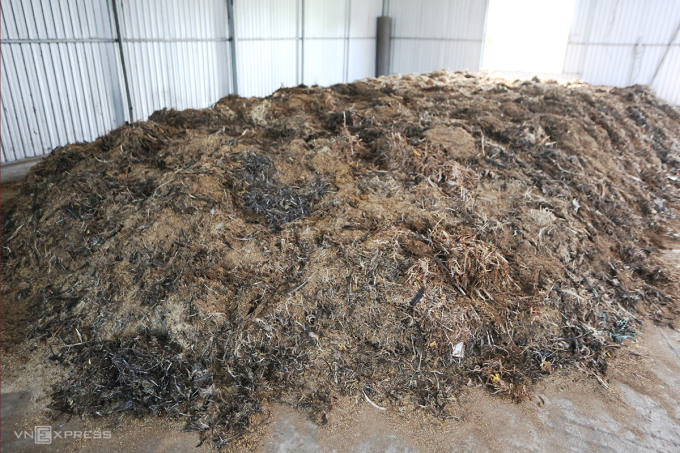
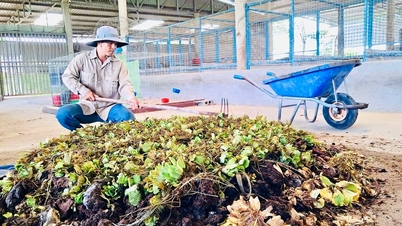
Chicken feathers are mixed with rice bran, rice husks, and probiotics, then fermented for 30-50 days until decomposed, dried, and ground into a fine powder. Photo: Dac Thanh
All the self-made machinery could only be salvaged from a few parts; Thien had to sell the rest as scrap metal, losing about 500 million VND and all his capital. Relatives and friends advised him to stop, to avoid falling into debt, because "easy things won't come your way."
But Thien didn't give up. "As long as I'm breathing, I can still make ends meet. The clothing shop and the pub still provide income," he explained, justifying his loans from the bank and relatives to pursue the production of organic fertilizer from chicken feathers.
Seeing farmers mix animal manure with rice husks and rice bran, compost it until it decomposes, and then use it as fertilizer, Thien decided to try it himself. He collected chicken feathers, let them dry, then mixed them with rice husks, rice bran, and various types of probiotics. After many trials with different ratios of rice husks, bran, and probiotics, he finally found his own formula.
Chicken feathers make up 70% of the mixture, while the rest consists of rice husks, rice bran, and probiotics. This mixture is then composted for 30-50 days, reducing odor by up to 80% compared to drying. The chicken feather mixture is then dried, finely ground, and compressed into pellets. Testing on plants showed that this organic chicken feather fertilizer promotes healthy growth and significantly increases yields.
Using chicken feather fertilizer also stimulates earthworm growth and makes the soil more porous. This type of fertilizer retains its smell even after about four hours when spread on the ground. To fertilize plants, you need to loosen the soil, spread the fertilizer, and then cover it up, Mr. Thien explained.
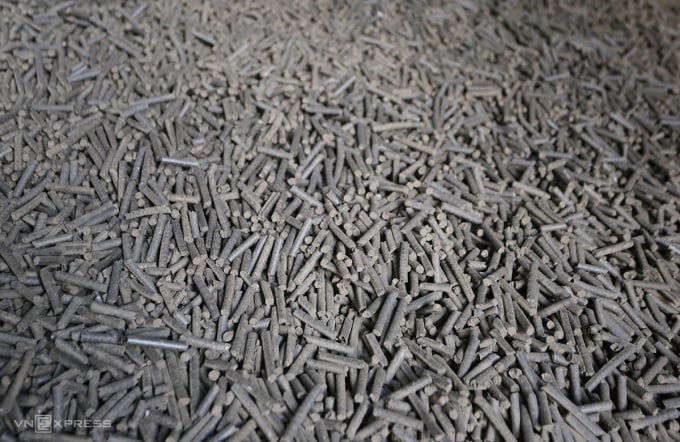
Pelleted chicken manure is sold for 10,000-22,000 VND/kg. Photo: Dac Thanh
Because the facility was located in a residential area, it generated unpleasant odors, leading to complaints from residents. Mr. Thien was forced to relocate the facility to Duy Nghia commune, an area designated for an industrial cluster and situated far from residential areas. He invested over 2.5 billion VND in the new facility, which features a closed corrugated iron roof and uses activated carbon to treat the odors.
Since August 2023, the facility has been operating steadily, purchasing approximately 1.7 tons of poultry feathers daily from over 30 slaughterhouses in Da Nang and Quang Nam provinces. After composting and processing, each ton of fresh feathers yields about 400 kg of organic fertilizer.
Each month, the facility sells approximately 30 tons of organic chicken manure to provinces in Central and Southern Vietnam, priced at 10,000-22,000 VND/kg, generating revenue of 200 million VND. After deducting expenses, Thien earns a profit of about 30 million VND per month. The facility currently provides employment for four people, with incomes ranging from 5-7 million VND per month.
"My wish is to expand production, but the current facility is only leased on a short-term basis. Hopefully, in the future, when the industrial cluster is established, the government will grant long-term land leases," Thien said.
Ms. Le Thanh Nga, owner of the Old Brick Kiln Farm in Duy Vinh commune, Duy Xuyen district, said she bought chicken feather fertilizer from Mr. Thien to experiment on one vegetable bed and compare it with another bed using manure. The results showed that the bed using chicken feather fertilizer had a faster germination rate, greener vegetables, and especially, the soil was more porous than the other bed. "I bought chicken feather fertilizer to fertilize 500 square meters of land dedicated to vegetable cultivation. The price is reasonable, and the fertilizer is good for both plants and soil," she said.
Currently cultivating 2 hectares of purple rice, Ms. Nga plans to use organic chicken feather fertilizer on a portion of her land next season as a control group, compared to the land fertilized with manure. If it proves suitable for the rice plants, she will replace manure with organic fertilizer. This is because using manure requires collecting it, then composting it, which is time-consuming and labor-intensive.
Source link

![[Photo] Prime Minister Pham Minh Chinh presides over a meeting on private sector economic development.](/_next/image?url=https%3A%2F%2Fvphoto.vietnam.vn%2Fthumb%2F1200x675%2Fvietnam%2Fresource%2FIMAGE%2F2025%2F12%2F20%2F1766237501876_thiet-ke-chua-co-ten-40-png.webp&w=3840&q=75)































































Comment (0)