

Contractors are urgently drilling geological boreholes, reinforcing the Bai Gio tunnel, and clearing debris, with plans to complete the work by April 22nd to allow North-South train traffic to resume.
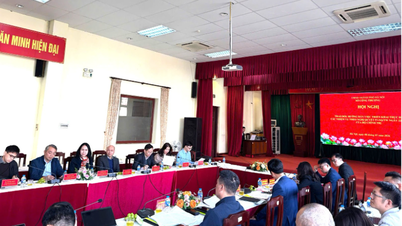
On the morning of April 16th, Deputy Minister of Transport Nguyen Danh Huy held an online meeting with the field task force to discuss solutions to the landslide at the Bai Gio railway tunnel in Khanh Hoa province.
Representatives of the field task force stated that surveys revealed the landslide material contained rocks of various sizes and heavily weathered rocks in the form of sandstone and gravel. Currently, large rocks have completely filled the tunnel arch, with a volume of approximately 150 m3. The geological structure of the tunnel ceiling consists of stacked and interlocking rocks, creating large voids.
Following the principle of maintaining stability above and within the tunnel, on April 15th, the contractor reinforced the collapsed rock mass in the tunnel by installing anchors to create compartments for injecting cement grout to solidify the loose rock and create a rigid framework. At the mountaintop, where the tunnel collapsed, the contractor drilled geological surveys to inject cement grout to fill the collapsed space, aiming to stabilize the rock mass.
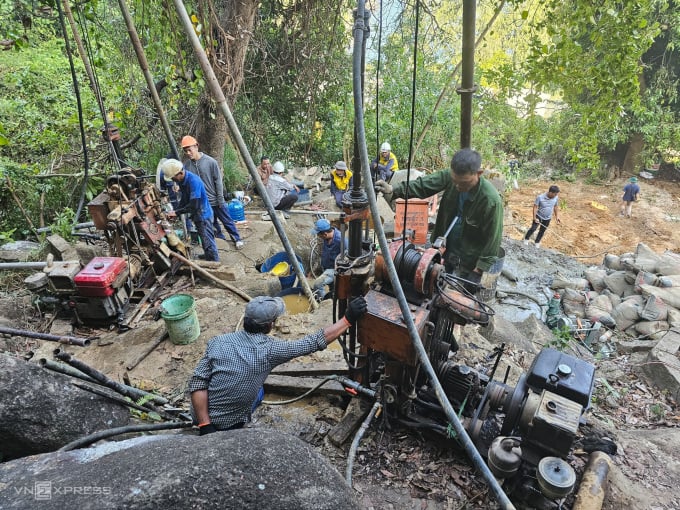
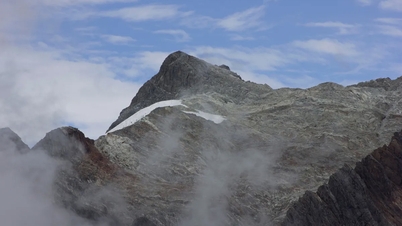
On April 15th, the contractor drilled two boreholes in the mountain: one 23 meters deep (reaching the tunnel roof), and the other approximately 18 meters deep. Concrete will then be pumped in using a concrete pump. Photo: Bui Toan
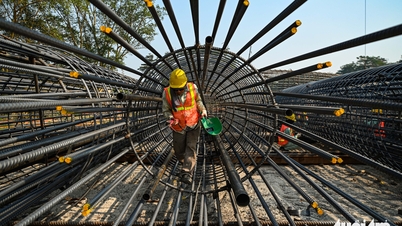
Today, the construction team is preparing the anchor drilling equipment, high-pressure grouting machines, mixing plants, anchors, etc., to drill and insert anchors into the sinkhole opening and pump high-pressure grout to create stable adhesion. Afterward, workers will gradually excavate the collapsed soil and rock in the tunnel, installing support frames as they excavate.
After installing all the support frames in place, the contractor will spray mortar and pour concrete for the tunnel lining. It is expected that the work will be completed by April 22nd, allowing North-South train traffic to resume.
To rectify the problem, the Song Da 10 contractor mobilized 20 officials and workers, along with a line of construction equipment and machinery. Construction and Investment Company No. 3 had approximately 80 workers. Phu Khanh Railway Joint Stock Company, the unit managing the railway section through Khanh Hoa, deployed about 250 people to the construction site.
According to Mr. Dang Sy Manh, Chairman of the Board of Directors of Vietnam Railways Corporation , the landslide at Bai Gio tunnel has forced the railway industry to reroute an average of 10 trains per day. By the evening of April 15th, the units had reroute more than 13,000 passengers on 38 trains from Tuy Hoa station (Phu Yen) to Gia station (Khanh Hoa) and vice versa.
77 freight trains have been stranded. The railway industry has had to negotiate with shippers to reroute cargo; so far, 16 trains have been moved through the affected area, prioritizing perishable goods, frozen goods, and express delivery shipments.
Mr. Manh assessed that the Bai Gio tunnel incident caused significant damage to railway transport. The Corporation proposed that relevant authorities consider providing financial support to minimize losses, that local authorities arrange for transfer vehicles, and that road usage fees be waived for vehicles transporting passengers and goods through the Deo Ca tunnel.
After resolving the collapse of the Bai Gio tunnel, the competent authorities should consider allocating funds for the first phase of reinforcement of 12 weak tunnels on the North-South line with an estimated cost of 500 billion VND, and develop a plan to address the 27 weak tunnels along the entire railway line.
At the meeting, Deputy Minister Nguyen Danh Huy assessed that the Bai Gio tunnel has very complex geological conditions, was built a long time ago, its structure has deteriorated, and the possibility of landslides has been predicted by state management agencies since 2020.
The work is being carried out according to the "four on-site" principle, ensuring five requirements: the earliest possible reopening of the road, the fastest mobilization of forces, the most innovative solutions, absolute safety, and the highest concentration of resources by all units working 24/7, in accordance with the Prime Minister's directives. The working group of the Ministry of Transport will hold daily briefings with the units on-site to monitor construction progress and provide timely guidance.
The Bai Gio Tunnel is over 400 meters long, 5 meters high, 4 meters wide, and approximately 900 meters high, located in Dai Lan commune, Van Ninh district, Khanh Hoa province. The project is currently undergoing reinforcement and renovation as part of Package 11A of the Vinh - Nha Trang section's project to reinforce weak tunnels, build new stations, and renovate the superstructure. The project is managed by Project Management Board 85 - Ministry of Transport.
At noon on April 12, while the contractor was demolishing the old tunnel lining, a tunnel arch collapsed, disrupting train operations.
Source link





















































































Comment (0)