Earthworms are quite familiar creatures, especially in rural areas. On average, earthworms are 10-35 cm long. Earthworms play an important role in agriculture because they loosen the soil and increase its fertility. In addition, earthworms are a food source for livestock and poultry. Although they are invertebrates, they are still capable of moving underground. So how do earthworms move?
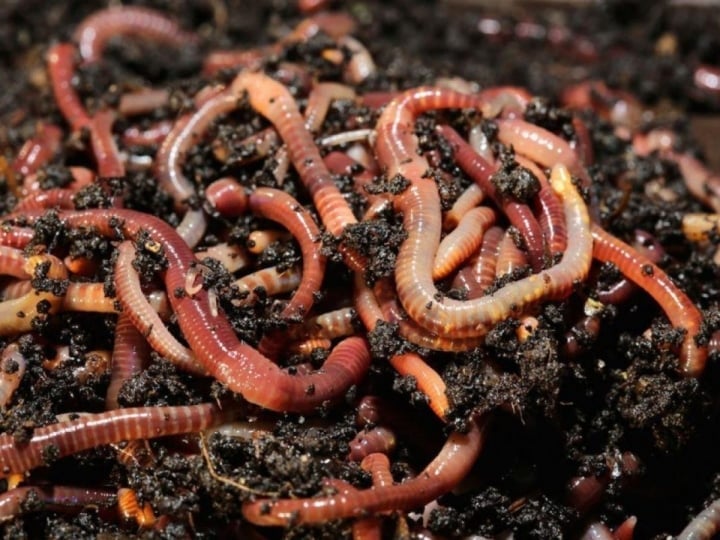
Earthworms are invertebrates, but they can still move easily.
Worms preparing to crawl
Earthworms have a tube-within-a-tube body structure, segmented externally with corresponding internal segments, and typically have stiff bristles on all segments.
First, the earthworm must extend the front part of its body using its muscles. As the front part lengthens, a bristle-like structure (called a setae) emerges from the front of the worm and anchors itself in the soil. At this point, the setae act as an anchor, allowing the earthworm to pull its rear part forward.
Shrink your body to puff up your head and tuck in your tail.



Once the rear part of its body has moved forward, the earthworm retracts the setae from the front and anchors the setae from its rear into the soil. Now, the setae from the rear act as an anchor, propelling the earthworm forward. This process is repeated, allowing the earthworm to move. It can be seen that earthworms move underground thanks to the elasticity of their bodies, combined with the use of bristles and the entire body structure.
Characteristics of earthworms
Earthworms feed on organic matter including plants, protozoa, larvae, rotifers, nematodes, bacteria, fungi, and other microorganisms. Earthworms have the following external characteristics: bilateral symmetry, a true body cavity, a long, segmented body with well-developed muscles for contraction and expansion, a mouth at the head, and an anus at the tail.
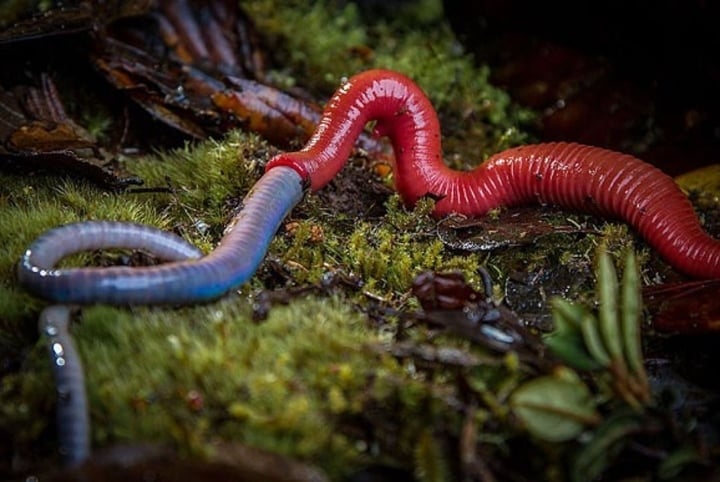
Earthworms can devour each other.
Earthworms have bristles around each segment at the head, which they use to grip the soil when burrowing (earthworms don't have legs). Their bodies are covered in mucus, with thin, moist skin to allow for gas exchange and reduce friction while burrowing. When searching for food, if they encounter dry, hard soil, they secrete mucus to soften it before swallowing it. Their eyes are reduced, adapted to their burrowing lifestyle.
Worms are hermaphroditic. Each worm possesses both male (testes) and female (ovaries) reproductive organs. During reproduction, two worms join their heads together to exchange sperm. After the two bodies separate for 2-3 days, the genital girdle detaches and slides forward, receiving eggs and sperm along the way. When it detaches from the body, the girdle constricts at both ends, forming a cocoon. Inside the cocoon, after a few weeks, the eggs hatch into young worms.
The effect of earthworms on soil and plants.



Earthworms are considered "workers" that help loosen the soil, improving its water retention. At the same time, earthworms create space in the soil, allowing plant roots to access more oxygen. Earthworm waste is a very good natural fertilizer for plants. Earthworm castings can also help plants avoid certain harmful pests.
Tuyet Anh (Source: Compilation)
Beneficial
Emotion
Creative
Unique
Wrath
Source
![[Photo] General Secretary and President To Lam receives Palestinian Ambassador Saadi Salama](https://vphoto.vietnam.vn/thumb/1200x675/vietnam/resource/IMAGE/2026/06/25/1782365384740_a1-bnd-9423-8322-jpg.webp)


![[Image] Ho Chi Minh City: Ma Lang area, Chicken-Rice Market about to change its appearance](https://vphoto.vietnam.vn/thumb/1200x675/vietnam/resource/IMAGE/2026/06/25/1782377698627_ndo_br_m1-jpg.webp)

![[Image] Schools organize meetings and introduce teaching models to students admitted to grade 10.](https://vphoto.vietnam.vn/thumb/1200x675/vietnam/resource/IMAGE/2026/06/25/1782368077271_ndo_br_z7970052192242-1ec8daeb77a6eed1a4e9f58c564ddd3e-jpg.webp)
















![[GALLERY] Discovering 5 amazing Samsung features that few people know about.](https://vphoto.vietnam.vn/thumb/402x226/vietnam/resource/IMAGE/2026/06/25/1782394498324_tin-6-png.webp)