

China: After five years of construction, the world's largest and fastest-growing wind tunnel has become operational in the suburbs of Beijing.
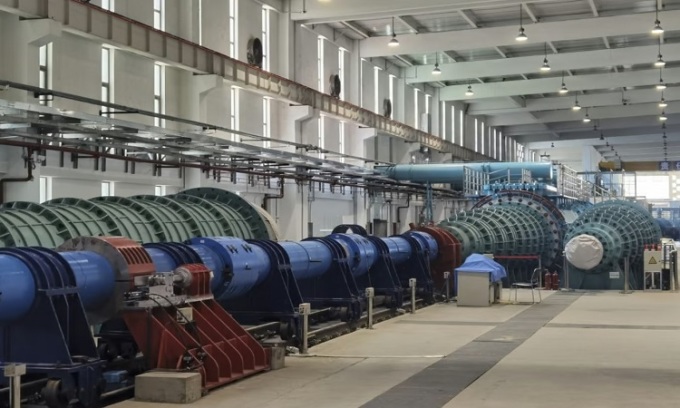
The JF-22 wind tunnel can simulate supersonic speeds of Mach 30. Photo: SCMP
Located in Huairou District north of Beijing, the JF-22 wind tunnel has a diameter of 4 meters and can generate airflow at speeds up to 10 km/s, according to final assessments conducted on May 30. This makes the structure the world's largest and fastest wind tunnel, capable of simulating supersonic flight conditions up to Mach 30 (37,044 km/h), according to the Institute of Mechanical Engineering, the agency managing the JF-22.
This tunnel will "support research and development of China's hypersonic space transport systems and aircraft," according to an announcement by the institute on June 2. For comparison, the Mach 10 (12,348 km/h) tunnel at NASA's Langley Research Center in the US, a key hypersonic testing facility, has a test chamber diameter of nearly 0.8 meters. A larger test chamber allows researchers to bring larger aircraft models, or even entire weapons systems, into the wind tunnel to collect more accurate flight data. Most intercontinental ballistic missiles have a diameter of less than 4 meters.
The JF-22 is linked to a goal set by the Chinese government and its efforts to achieve it by 2035: deploying a fleet of hypersonic aircraft capable of carrying thousands of passengers into space each year, or to any location on the planet within an hour. However, such aircraft must withstand the extreme temperatures and pressures of hypersonic flight, maintain a stable flight path, and provide a safe and comfortable environment for passengers.
At five times the speed of sound, the gas molecules surrounding the aircraft begin to compress and heat up, leading to molecular dissociation. These gas molecules break down into constituent atoms, which can then react with each other to form new chemical substances. Understanding the complex physics of the gas flow associated with molecular dissociation is crucial in the development of supersonic aircraft.
Through studying phenomena in experimental environments such as wind tunnels, scientists can explore how supersonic vehicles interact with their surroundings and develop new technologies to improve performance and safety. Wind tunnel testing can help identify potential problems or design flaws before the vehicle is built and test-flown, reducing the risk of failure or accidents.
According to some estimates, simulating Mach 30 flight conditions inside a large wind tunnel would require an amount of electricity equivalent to the power output of the Three Gorges Dam, which is practically impossible. Therefore, Professor Jiang Zonglin, the lead scientist on the JF-22 project, came up with an innovative solution.
To generate the high-speed airflow necessary for supersonic testing, Jiang proposed a new type of shock wave generator called a "direct-reflecting shock wave engine." In conventional wind tunnels, airflow is generated by expansion, where high-pressure gas is rapidly discharged into a low-pressure chamber, creating a supersonic stream. However, this method has some limitations when extremely high speeds and temperatures are required for supersonic testing.
Jiang's reflected shockwave engine overcomes the limitations by using a precisely timed series of explosions to generate a series of shock waves that reflect off each other and converge at a single point. The resulting extremely powerful burst of energy is then used to propel the airflow in the wind tunnel at ultra-high speeds.
This initiative paved the way for many achievements by making hypersonic flight research more precise and efficient. Using explosives to generate energy in wind tunnels comes with many disadvantages, such as danger to both people and equipment, noise pollution, and air pollution. However, because the energy is generated from explosions rather than fixed machinery, the intensity and duration of the explosions can be adjusted to create diverse airflow for testing various types of vehicles or materials.
The National Association for Natural Sciences of China sent 16 independent experts to evaluate the JF-22 in several key areas, including effective test time, total temperature, total pressure, and nozzle flow. They concluded that the JF-22 achieved world-leading performance. Along with the JF-12 tunnel, the JF-22 became the only ground-based test facility that met all aspects of near-space vehicle testing.
An Khang (According to SCMP )
Source link
![[Photo] Prime Minister Pham Minh Chinh holds a phone call with Algerian Prime Minister Sifi Ghrieb](https://vphoto.vietnam.vn/thumb/1200x675/vietnam/resource/IMAGE/2026/03/18/1773849689752_ndo_br_dsc-9609-jpg.webp)



![[Photo] General Secretary To Lam presides over a thematic session on strategic technology.](https://vphoto.vietnam.vn/thumb/1200x675/vietnam/resource/IMAGE/2026/03/18/1773838586650_anh-1-bnd-1822-7089-jpg.webp)

























































![[Infographics] 6 changes to the 2026 high school graduation exam](https://vphoto.vietnam.vn/thumb/402x226/vietnam/resource/IMAGE/2026/03/19/1773873998293_fb_6-thay-doi-cua-ky-thi-tot-nghiep-thpt-nam-2026-dai-dien.png)














Comment (0)