

Editor's Note: Former Deputy Prime Minister Vu Khoan always showed special interest in the People's Army Newspaper (QĐND). Whenever we contacted him for an interview or requested an article, he happily agreed. When he discovered interesting topics, he would proactively write about them and send them to the newspaper immediately. Recently, he sent an article titled "Defense Diplomacy Accompanying the Nation" to the People's Army Newspaper. He passed away before it could be published. The People's Army Newspaper is pleased to present his article.
Although the new National Defense Law of 2018 stipulates that defense diplomacy is one of the fundamental aspects of building a national defense system, in reality, our Army has engaged in diplomatic activities since its inception and throughout its history, in extremely diverse and effective forms.
In terms of methods, besides conventional diplomatic activities such as exchanges, contacts, and negotiations, defense diplomacy is also demonstrated through the fighting and sacrifices of volunteer troops, as well as resounding victories on the battlefield, thereby creating a favorable environment for peace talks during wartime and contributing to the country's international integration during peacetime.
The Vietnam Propaganda and Liberation Army was founded at a time when World War II was ongoing not only in Europe but also in the Asia-Pacific region. In Vietnam, the Japanese fascists had ousted the French colonialists and occupied our country. In this context, our Party, under the direct leadership of President Ho Chi Minh, intensified preparations for the general uprising.
To serve the cause of the struggle for independence, President Ho Chi Minh advocated for the support of the Allied countries against fascism, including the United States. At that time, there was a US Air Force unit stationed in Yunnan (China). After we rescued pilot William Shaw, whose US Air Force plane was shot down by the Japanese in Hoa An district, Cao Bang province, we returned him to the US 14th Air Wing. On this occasion, President Ho Chi Minh personally went to Kunming to meet General Claire Lee Chennault, Commander of the 14th Air Wing, and requested that he provide equipment, weapons, and trainers for the Viet Minh. Responding to President Ho Chi Minh's request, US aircraft dropped equipment, weapons, and several officers at the Lung Co airfield (Tuyen Quang). Furthermore, the two sides established a "Viet-American Company" for joint operations, commanded by Comrade Dam Quang Trung and advised by Major Allison K. Thomas.
This first international operation was greatly contributed to by the commander of the Vietnam Propaganda and Liberation Army, Comrade Vo Nguyen Giap, along with several team members, including Comrades Dam Quang Trung and Phung The Tai, both of whom later became Generals of the Vietnam People's Army.
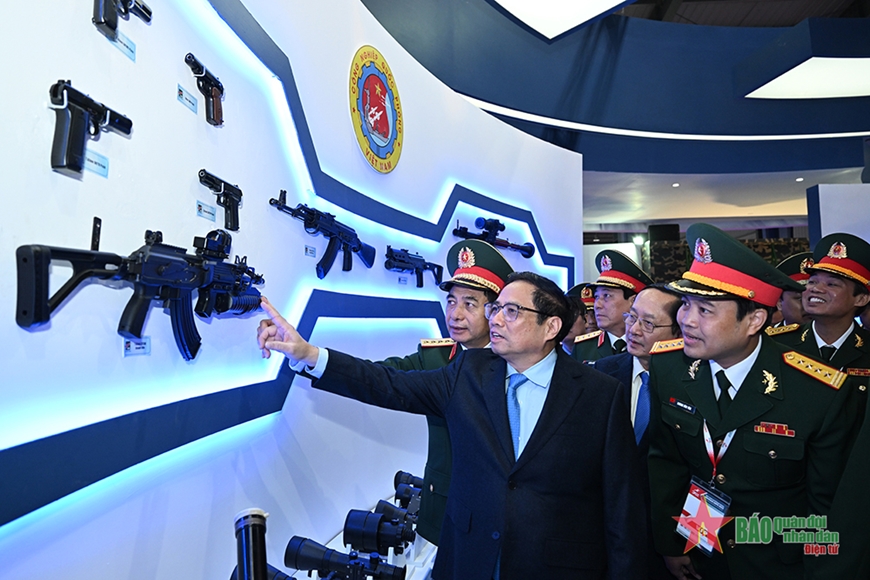 |
| Prime Minister Pham Minh Chinh and other delegates visit the Vietnam International Defence Exhibition 2022. Photo: Vu Phong |
During the resistance war against French colonialism, our army carried out numerous defense and security activities, most notably the coordinated operations with friendly countries Laos and Cambodia, as well as the People's Liberation Army of China.
In December 1947, the Vietnam-Cambodia-Laos Liberation Committee was established, and Vietnamese volunteer troops fought alongside the resistance forces of the Lao Itxala Front and the Khmer Issarak Front in the struggle for independence of each country. This activity began with the decision of the joint conference of the three countries in March 1951, which clearly stated the decision to establish a people's alliance between Vietnam, Laos, and Cambodia based on the principles of voluntarism, equality, mutual assistance, and respect for each other's sovereignty. One of the manifestations of this coordinated struggle was the Upper Laos Campaign in 1953.
In 1949, at the suggestion of the Chinese Communist Party, our army and the People's Liberation Army of China established the Ten Thousand Great Mountains Command to conduct the Ten Thousand Great Mountains Campaign, forming the Ung-Long-Kham liberated zone bordering our northeastern border. After this campaign, our army handed over many captured weapons to the People's Liberation Army of China.
During the Border Campaign of 1950 and the Dien Bien Phu Campaign of 1954, our army closely cooperated with Chinese expert delegations led by Generals Tran Canh and Vi Quoc Thanh. After the complete liberation of the northern border provinces and the establishment of diplomatic relations with China, the Soviet Union, and Eastern European countries, especially after the Geneva Accords were signed and the North was liberated, defense diplomacy was strongly and comprehensively implemented through establishing defense relations with fraternal countries, securing support, military equipment aid, and training personnel. From that time on, the mechanism of exchanging delegations and opening military attaché offices was established.
Defense diplomacy activities were further strengthened and expanded during the resistance war against the US and after the liberation of the South and the reunification of the country in 1975. During this period, defense diplomacy with socialist countries was further strengthened in a "mobile and flexible" manner, given that the Soviet Union and China had not yet found common ground on certain issues.
Shortly after the reunification of the country, our army once again had to go into battle on the southwestern border. Because of the responsibility to protect the homeland and help the Cambodian people escape the genocidal regime, the Vietnamese Volunteer Army once again set out to fight, honored by the Cambodian people as the "Buddhist army," thereby contributing with their blood to strengthening the friendly relations between our country and our neighbor. Another less-mentioned aspect of defense diplomacy is the training of national liberation fighters from some "third world" countries.
At pivotal moments in the resistance struggle, President Ho Chi Minh, and after his death, General Secretary Le Duan, personally "went on expeditions" to meet with high-ranking leaders of friendly parties to inform them of the situation, coordinate actions, and secure support and assistance. Each of these trips included military generals. Accompanying President Ho Chi Minh to China and then the Soviet Union after the liberation of the northern border provinces in 1950 was Comrade Tran Dang Ninh, Head of the General Department of Supply (later renamed the General Department of Logistics). The successful 15th Central Committee Conference, 2nd term, in 1959, opened a new era for the revolution in the South. President Ho Chi Minh traveled to China and the Soviet Union, accompanied by General Nguyen Chi Thanh, Lieutenant General Nguyen Van Vinh, Head of the Central Unification Committee, and Major General Le Chuong, Director of the Propaganda Department (General Political Department). As the war on the southwestern border intensified, a high-level delegation of our Party, led by General Secretary Le Duan, traveled to the Soviet Union to hold talks with the Soviet leaders. Comrade Le Trong Tan also accompanied them. Representatives from the Ministry of National Defense also participated in the signing of the Treaty of Friendship and Cooperation.
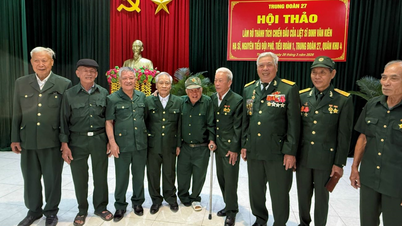
General Vo Nguyen Giap's visits to several African countries and Cuba after the country's reunification were warmly welcomed by the people of those countries as a hero. Our Heroes of the People's Armed Forces have participated in many world youth and student festivals as well as other international events, always becoming a focal point that further enhances the name of Vietnam. We cannot fail to mention the international activities of our veteran comrades, who have made significant contributions to the policy of closing the past and looking towards the future with countries that once invaded our country, further illuminating the selfless and humane spirit of the nation.
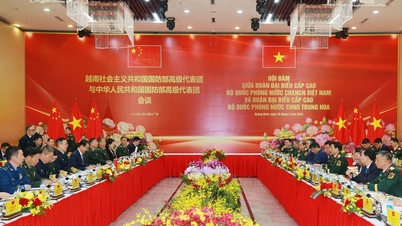
During the period of reform and international integration, defense diplomacy has become increasingly vibrant, taking place in many diverse forms. Among the prominent defense diplomacy activities is the initiative to host the first ASEAN Expanded Defence Ministers' Meeting (ADMM+); many male and female officers of the Vietnam People's Army have been deployed to participate in United Nations peacekeeping operations, not only as peacekeeping troops but also as working troops and diplomatic troops through skillful "people-to-people relations" with local people, contributing to enhancing our country's prestige and international standing. This is in addition to the bilateral and multilateral relationships that our Army has established with the armies of many other countries, demonstrated through mechanisms of dialogue, exchange, joint patrols, training, and the education of officers and experts... contributing to building and increasing trust, expanding cooperation, and facilitating the task of consolidating peace and stability in the region and the world.
Besides contributing to the formation of guidelines and policies at Party Congresses and the leadership activities of the Central Committee, as well as the activities of the National Assembly and the Government, the Army has proposed the "four no's" principle: No participation in military alliances; no alliance with one country against another; no allowing foreign countries to establish military bases or use territory to fight against other countries; and no use of force or threat of force in international relations. In the context of a complex and volatile global situation, this principle was put forward at a very opportune time and is also one of the early and proactive preventative measures...
With these significant contributions, it can be affirmed that our Army is truly a "diplomatic army" alongside its other functions such as a "fighting army," a "working army," and a "production and labor army."
VU KHOAN
Source


































Comment (0)