

As the European Union drafts legislation to curb electricity price volatility, France clashes with Germany over the future of nuclear power.
The bill to reform the electricity market, currently being drafted by the European Commission, poses a major challenge to France's need to modernize its nuclear power plants. Therefore, France has submitted documents to persuade the Commission to consider its issues, but has encountered strong opposition from Germany and its allies.
Even France's traditional allies in the nuclear power sector, including the Eastern Bloc and Finland, are showing cautious support. France is trying to rally support from other countries before the summer holidays, but the situation remains quite fragile, according to Le Monde .
Following a surge in energy prices in the summer of 2022 due to the Ukraine conflict, the European Commission introduced a bill on March 14th to limit volatility in electricity prices, provided they are decarbonized.
The bill would allow member states to subsidize energy production within their territories, whether from renewable or nuclear sources, without violating aid laws. It would also allow countries to impose sudden taxes on electricity producers when prices rise.
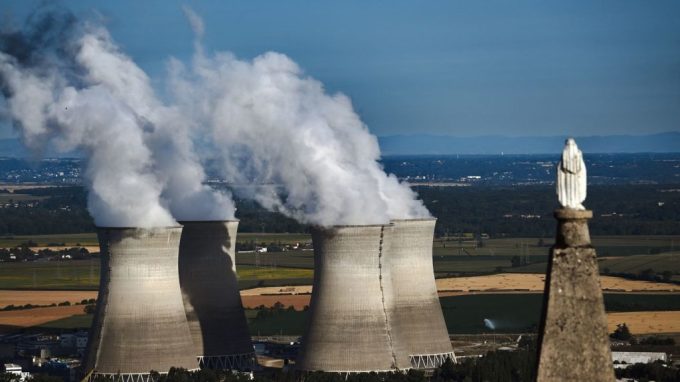
Steam rises from cooling towers at the Bugey nuclear power plant in Saint-Vulbas, central France, on July 20. Photo: AFP
For Germany and allies like Luxembourg and Austria, France cannot take advantage of this new law to finance upgrade programs aimed at extending the lifespan of nuclear power plants. "Berlin is panicking because their industry is losing competitiveness. They want to keep electricity prices high so that France doesn't benefit from nuclear power," said a diplomat who supports nuclear power.
Germany, with its growing number of renewable energy projects, supports the mechanism proposed by the Commission to subsidize the construction of new power plants. France's allies – those without large-scale nuclear power – are concerned with how they can financially support new power plants. Therefore, "Paris risks being isolated in its fight," a source explained.
At the European Council meeting on June 29 and 30, German Chancellor Olaf Scholz and French President Emmanuel Macron discussed the issue but failed to reach a consensus. They had planned to discuss it again on July 3, on the sidelines of the French president's state visit to Germany. However, the Elysée Palace was forced to cancel the trip due to riots following the death of young Nahel. Since then, discussions between the two countries have stalled.
Not wanting France to take advantage of the new bill, Germany also wants more subsidies for electricity costs for its energy-intensive industries. They plan to launch a €30 billion package between now and 2030, but requiring European Commission approval is inconsistent with current rules. "In Germany, energy is primarily based on fossil fuels. This falls outside the scope of the Commission's electricity market reform bill," the source added.
France is also losing ground in the European Parliament, with the Industry Committee revising its reform draft on July 19, making government support for nuclear power plants more difficult. "France lost in the Industry Committee, but the battle will be fought again in the plenary session in September and, above all, in the European Council," said Pascal Canfin, chair of the European Parliament's Environment Committee.
Since Berlin decided to phase out nuclear power following the Fukushima disaster in 2011, France and Germany have been at odds over the fate of atomic energy in Europe. It's been an endless economic, political, and diplomatic battle, further dramatized by global warming and the conflict in Ukraine.
This confrontation is being waged against a series of different EU bills designed to decarbonize the European economy, strengthen energy independence, and prevent a surge in electricity prices like last year.
Sometimes, Paris wins a round, as in the heated debate over whether to include nuclear energy in the green classification and labeling system to guide private investment. But at other times, Berlin gains the upper hand, for example with the draft law presented by the European Commission on March 16th, aimed at supporting the development of the decarbonization industry in Europe. The bill still needs to be negotiated in the European Parliament and among the 27 member states, but the initial steps are not favorable to Paris.
Nevertheless, Europeans frequently make complex compromises that allow both sides to achieve more or less of what they want. A prime example is the "Renewable Energy Directive." This policy stipulates that by 2030, 42.5% of Europe's energy supply should be wind and solar power. Passed in mid-June after intense discussions, the Directive ultimately allowed France to include hydrogen produced from nuclear power when measuring the country's green energy output.
Phiên An ( according to Le Monde )
Source link

















































































Comment (0)