

The draft Population Law proposes that provinces and cities with low birth rates will provide a one-time financial support to women when they have a second child, and offer tuition fee exemptions for their children.
This information was provided by Mr. Mai Trung Son, from the Population Department ( Ministry of Health ), at the workshop "Low Birth Rate in Vietnam: Current Situation and Solutions" on November 10th. Experts and policymakers came together to assess the current situation and propose policy directions and intervention solutions for this issue.
According to the latest Population and Housing Census data, the birth rate has decreased in most socio -economic regions, with a particularly sharp decline in the Southeast and Mekong Delta regions. Currently, each woman of childbearing age in the Southeast region gives birth to only 1.56 children, while in the Mekong Delta it is 1.8 children.
"If the fertility rate is below 1.3 children per woman, it is almost impossible to recover to the replacement fertility rate," Mr. Son said, citing the example of Ho Chi Minh City, where the fertility rate was only 1.24 children in one year – the locality with the lowest birth rate in the country for many years.
In other regions, birth rates have decreased but remain high. In the Central Highlands or the northern mountainous areas, the average woman gives birth to over 2.4 children. The disparity in birth rates between regions is "not only significant" but, according to Mr. Son, "the gap is widening even further."
Deputy Minister of Health Nguyen Thi Lien Huong acknowledged that Vietnam's population growth rate has been controlled, reaching replacement level for the past 15 years, meaning that on average, each woman of childbearing age in Vietnam gives birth to about 2.1 children. However, Vietnam is facing a significant disparity in birth rates between regions.
Currently, 33 provinces and cities have high fertility rates (over 2.2 children per woman). 21 provinces and cities have low fertility rates (under 2 children per woman). Some areas have very low fertility rates, concentrated in the Southeast region, the Mekong Delta, and the Central coastal region. Provinces and cities with low fertility rates include: Ho Chi Minh City, Dong Thap, Hau Giang, Ba Ria - Vung Tau, Binh Duong, Khanh Hoa, Long An...
"Provinces with low birth rates have a population of nearly 38 million people, accounting for almost 40% of the country's population, and have a significant impact on sustainable development," Deputy Minister Huong said.
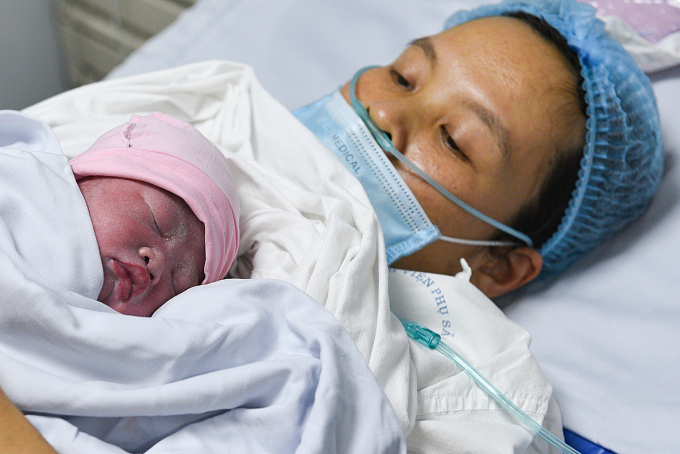
A baby is born at the National Obstetrics and Gynecology Hospital. Photo: Thanh Hue
Therefore, experts believe that policies to intervene in birth rates must be differentiated for different regions and localities, and cannot be applied uniformly. A representative from the Population Department stated that they are currently drafting a Population Law, which proposes encouraging women to have two children in provinces and cities with low birth rates. The draft also proposes a one-time financial support for women giving birth to a second child, with the aim of helping them take time off work and focus on their health during pregnancy.
Additionally, the draft proposes waiving or reducing tuition fees and providing financial support for education costs for preschool and primary school children, especially in industrial zones and export processing zones. It also suggests creating a suitable community environment to encourage couples to have two children. Provinces and cities with low birth rates should review and abolish policies that encourage fewer births, instead encouraging couples to have two children.
According to experts, low birth rates have long-term consequences, including higher healthcare and other social costs. A smaller workforce also reduces economic competitiveness and consumer demand, leading to lower economic growth and a decline in living standards.
Many countries facing declining birth rates have continuously implemented measures to curb the decline. For example, South Korea, which holds the record for the lowest birth rate in the world, has tripled its funding for fertility programs and significantly increased subsidies to encourage families to have more children. In Hungary, women who have four or more children are exempt from personal income tax for life.
Le Nga
Source link








































































































Comment (0)