

The Institute for Development Studies proposes that Binh Chanh District should be a city directly under Ho Chi Minh City because the locality is not likely to be transformed into a district before 2030.
The proposal was put forward by the Ho Chi Minh City Institute for Development Studies (HIDS) in a draft submission to finalize the plan to transform Binh Chanh district into a city or urban district, scheduled for September 22nd.
Binh Chanh is a suburban district located at the southwestern gateway of Ho Chi Minh City, covering an area of 252 km2, second only to Can Gio and Cu Chi. It has the largest population in the country with 711,000 people. In recent years, the rate of urbanization in the district has accelerated.
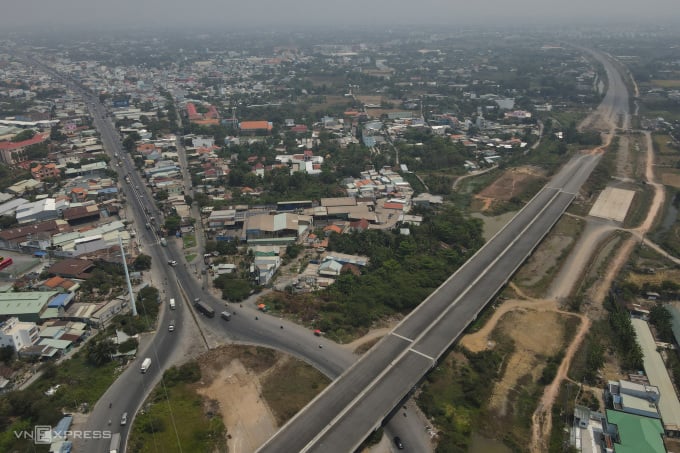
A view of part of Binh Chanh district from above. Photo: Thanh Tung
According to HIDS, based on the current situation and the standards set forth in the Resolution on urban classification; the Resolution on standards of administrative units and classification of administrative units, Binh Chanh is unlikely to be transformed into a district-level administrative unit between now and 2030.
Meanwhile, this locality could meet the criteria for classification as a type III urban area, transforming into a city within a city by 2025. To achieve this goal, by 2030, Binh Chanh district needs to invest in many urban infrastructure development projects, transportation, environmental improvement, etc. The total investment capital is estimated at approximately 122,695 billion VND, including socialized capital.
According to Resolution 1211 of the Standing Committee of the National Assembly , the criteria for a city under a province or a city directly under the Central Government include: a population of 150,000 or more; an area of more than 150 km2; more than 10 subordinate commune-level administrative units; and a ratio of wards to the total number of commune-level administrative units of 65% or more...
The criteria for becoming a district within a centrally-governed city include: a population density of at least 10,000 people per square kilometer; a non-agricultural labor force ratio of at least 90% of the total labor force; a proportion of industry, trade, services, and tourism in the economic structure of at least 90%; and a comprehensive and complete urban infrastructure.
According to HIDS, despite being a transportation hub connecting Ho Chi Minh City with the Mekong Delta provinces, the district's internal transportation infrastructure remains limited, especially in neighboring areas and those bordering Long An province. This has significantly hindered urbanization, economic development, and connectivity between the two regions.
Furthermore, the district has abundant land that is not being exploited effectively, and the administrative structure at the rural level faces many difficulties, hindering breakthroughs in economic and social development to improve the quality of life for the people.
The transformation from a district-level administrative unit to an urban-level administrative unit (city-within-a-city model) is expected to help Binh Chanh invest in infrastructure and exploit its potential and strengths.
The plan to invest in the development of districts to establish them as administrative units of districts or cities is a task set out in the Resolution of the 11th Congress of the Ho Chi Minh City Party Committee for the 2020-2025 term. Over the past two years, five districts of Ho Chi Minh City – Cu Chi, Binh Chanh, Can Gio, Nha Be, and Hoc Mon – have all expressed their desire to become cities before 2030.
Late last year, following a meeting on the progress of the investment and construction project to transform districts into urban districts (or cities) in the 2021-2030 period, the Ho Chi Minh City People's Committee requested that suburban districts not seek approval to become urban districts or cities, but wait until they meet the standards of Ho Chi Minh City before deciding on a suitable model for each locality.
Le Tuyet
Source link


![[Photo] General Secretary To Lam receives President of the European Council Antonio Costa](/_next/image?url=https%3A%2F%2Fvphoto.vietnam.vn%2Fthumb%2F1200x675%2Fvietnam%2Fresource%2FIMAGE%2F2026%2F01%2F29%2F1769697816651_a1-bnd-5216-9741-jpg.webp&w=3840&q=75)


![OCOP during Tet season: [Part 3] Ultra-thin rice paper takes off.](/_next/image?url=https%3A%2F%2Fvphoto.vietnam.vn%2Fthumb%2F402x226%2Fvietnam%2Fresource%2FIMAGE%2F2026%2F01%2F28%2F1769562783429_004-194121_651-081010.jpeg&w=3840&q=75)


![OCOP during Tet season: [Part 2] Hoa Thanh incense village glows red.](/_next/image?url=https%3A%2F%2Fvphoto.vietnam.vn%2Fthumb%2F402x226%2Fvietnam%2Fresource%2FIMAGE%2F2026%2F01%2F27%2F1769480573807_505139049_683408031333867_2820052735775418136_n-180643_808-092229.jpeg&w=3840&q=75)
![OCOP during Tet season: [Part 1] Ba Den custard apples in their 'golden season'](/_next/image?url=https%3A%2F%2Fvphoto.vietnam.vn%2Fthumb%2F402x226%2Fvietnam%2Fresource%2FIMAGE%2F2026%2F01%2F26%2F1769417540049_03-174213_554-154843.jpeg&w=3840&q=75)





Comment (0)