

Depending on how it's defined, the boundary of the Solar System could be the Kuiper Belt, the heliocentric belt, or the Oort Cloud.
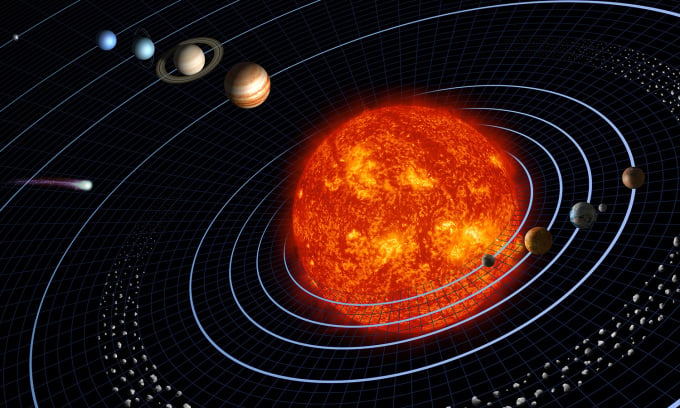
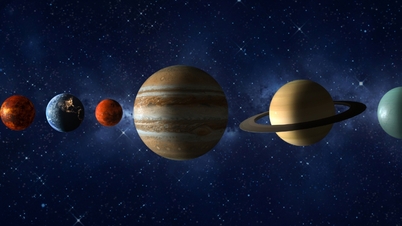
The Solar System consists of 8 planets. Image: NASA/JPL
The Solar System is vast, containing 8 planets, 5 dwarf planets, hundreds of moons, millions of asteroids and comets. All of them orbit the Sun, and in many cases, orbit each other, at speeds of thousands of kilometers per hour. So where is the end of the Solar System? The answer depends on how this planetary system is defined.
According to NASA, the Solar System has three potential frontiers: the Kuiper Belt (a belt of rocky celestial bodies beyond Neptune's orbit), the heliocentric belt (the edge of the Sun's magnetic field), and the Oort Cloud (a region containing distant comets, almost invisible from Earth).
Kuiper Belt
The Kuiper Belt extends from 30 to 50 astronomical units (AU) from the Sun (1 AU is approximately the distance between the Earth and the Sun). This region is filled with asteroids and dwarf planets, such as Pluto, that have been ejected from the inner regions of the solar system by gravitational battles with other planets.
Some astronomers argue that the Kuiper Belt should be considered the edge of the Solar System because it represents what would otherwise be the edge of the Sun's protoplanetary disk. The protoplanetary disk is a ring of gas and dust that later develops into planets, moons, and asteroids.
"If we define the solar system in a narrow way, meaning it consists only of the Sun and the planets, then the edge of the Kuiper Belt could be considered the edge of the solar system," said Dan Reisenfeld, a researcher at Los Alamos National Laboratory in New Mexico, USA.
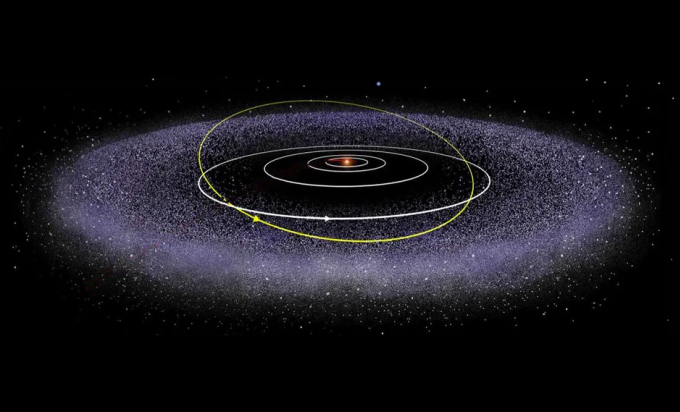
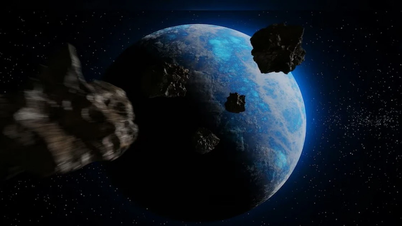
The Kuiper Belt is full of asteroids orbiting the Solar System. Photo: BBC
But some astronomers consider this definition too simplistic. "That's not really true. Things have shifted a lot—mostly outward—since planets formed," explains Mike Brown, an expert at the California Institute of Technology (Caltech).
Accordingly, the Kuiper Belt does not contain everything in the Solar System. In October 2023, the discovery of a series of new objects outside the Kuiper Belt suggested that a "second Kuiper Belt" might exist further out. Some researchers argue that the uncertainty surrounding the outer edge of this region makes it unsuitable as a reliable boundary of the Solar System.
Full sun
The heliopause is the outer edge of the heliosphere—the region influenced by the Sun's magnetic field. During heliopause, the solar wind, or stream of charged particles emitted from the Sun, becomes too weak to repel the incoming radiation from stars and other celestial bodies in the Milky Way.
"Because the plasma inside the solar full moon originates from the Sun and the plasma outside the solar full moon originates from interstellar space, some people consider the solar full moon to be the boundary of the solar system," Reisenfeld said. The space outside the solar full moon is also often called "interstellar space" (the space between stars).
Two spacecraft have already passed through the heliocentric zone: Voyager 1 in 2012 and Voyager 2 in 2018. Upon flying out of the heliocentric zone, the Voyager spacecraft quickly detected changes in the type and intensity of magnetism and radiation hurtling toward them. Brown said this indicated they had crossed some kind of boundary.
However, the heliosphere is not spherical but rather an elongated shape. Therefore, using heliocentricity to define the Solar System would create a distorted system, contradicting the views of some researchers on planetary systems.
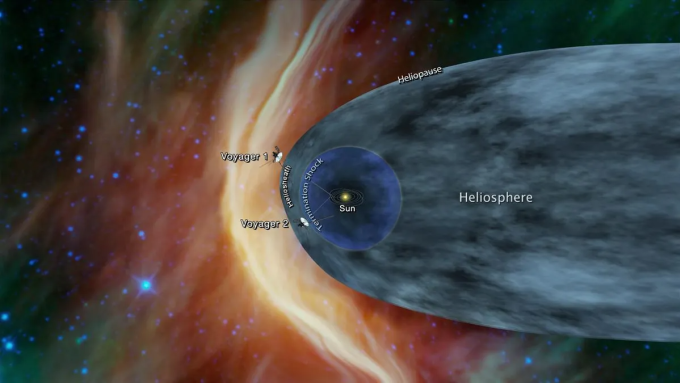
A simulation of the Voyager 1 and Voyager 2 spacecraft flying in space. Image: NASA/JPL-Caltech
Oort cloud
According to NASA, the Oort Cloud is the farthest and widest potential boundary of the solar system, extending to about 100,000 AU from the star. "Those who define the solar system as everything gravitationalally bound to the Sun consider the edge of the Oort Cloud to be the edge of the solar system," Reisenfeld said.
For some researchers, this is the ideal choice for the boundary of the Solar System because, theoretically, a planetary system includes all objects orbiting a star. However, other researchers argue that the Oort Cloud lies in interstellar space, making it outside the Solar System, even if bound to the Sun. Furthermore, scientists are uncertain about the true end point of the Oort Cloud, making it a less reliable boundary than the Kuiper Belt.
The most common border
Of the three potential boundaries, the heliocentric boundary is the most frequently used by researchers and NASA to define the Solar System. This is because it is the easiest to identify, and the magnetic features on either side differ significantly.
But this doesn't mean everything beyond the solar full moon has to be an interstellar object, such as the giant space rock 'Oumuamua,' according to Reisenfeld. "The Oort cloud is also part of the material that makes up planets. So it contains solar system material, not interstellar material," he said.
Thu Thao (According to Live Science )
Source link






![[E-Magazine]: Listening in silence to the changing seasons](https://vphoto.vietnam.vn/thumb/402x226/vietnam/resource/IMAGE/2026/04/17/1776436870717_e-magazine-lang-w1200t0-di2615d199d5160004t11920l1-lynkgm-017.webp)























































































Comment (0)