

In Ho Chi Minh City, Phan Phuoc Thang (39 years old), who has performed the task of loading radioactive sources four times, still hasn't forgotten the trembling feeling he experienced the first time he did it.
Phuoc Thang has been working at the Radiation Technology Research and Development Center (Vinagamma) in Thu Duc City, Ho Chi Minh City, since 2008. Young people like Thang back then were given priority to perform source loading at a distance of 6 meters from the radioactive source at the bottom of a water tank. With 6 meters of water shielding, the staff performing this job were ensured an environment similar to the outside, resulting in a low radiation dose received.
Thang recounted that in the unit, everyone usually divided the tasks among themselves. Older employees with families often took on the job of moving the Co-60 from outside into the source loading area. "Those uncles and aunts who have wives and children would be in charge of transporting the source," Thang said, adding that many people believed that being too close to a radiation source meant receiving a higher radiation dose, which would affect reproductive ability.
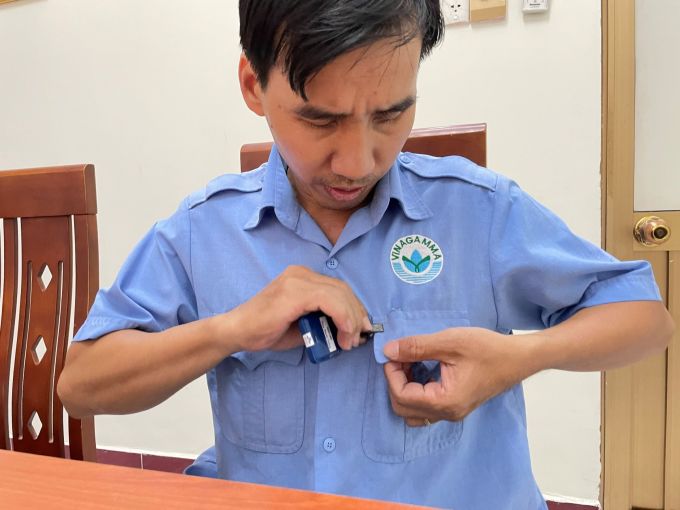
Mr. Phan Phuoc Thang carries a radiation dose measuring device while working at close range to the irradiation machine at Vinagamma. Photo: Ha An
The sources, when transported, are contained in multi-layered, protected containers. These containers, with a volume of approximately 1 m³ and weighing 5 tons, are typically transported by forklift in a zigzag pattern to reach the irradiation chamber. The containers are then lifted by cranes and placed into a 6-meter-deep water tank, where they are lowered to the bottom.
After opening the protective cover, the person in charge of this stage must use the grippers at the bottom of the tank to pick up the power strips and insert them into each power module of the device.
Thang shared that the scariest thing about handling the radiation source is that it might fall off the table at the bottom of the tank. If it falls, reattaching it becomes very difficult and time-consuming. Therefore, it requires staff to have sharp eyesight, with the aid of magnifying glasses and lights to perform the task. The person loading the source must be both accurate and quick, because the closer they are to the source, the higher the radiation dose they will receive.
Here, every two years, staff must refill the Cobalt-60 (Co-60) radioactive source for the industrial irradiation system. This source emits gamma rays used for sterilizing harmful microorganisms in food, fruits, medical equipment, and other items.
Every two years, a team of 10-12 Vinagamma technicians recharges the radioactive source in the irradiation chamber for 2-3 days. The reason is that Co-60 is an unstable isotope that continuously decays and emits gamma rays. After 5.25 years, the radioactive source's activity is halved due to its half-life, so it must be replenished to maintain its potency.
Due to close contact with the radiation source, the staff here will receive a direct radiation dose to their bodies. Therefore, each staff member must wear a dose meter to monitor their body's radiation levels before each procedure.
To ensure that no one receives an overdose, staff at Vinagamma do not allow one person to handle radioactive sources for an extended period; instead, they rotate shifts. "I've been doing this job for many years, but I feel perfectly healthy," Thang said.
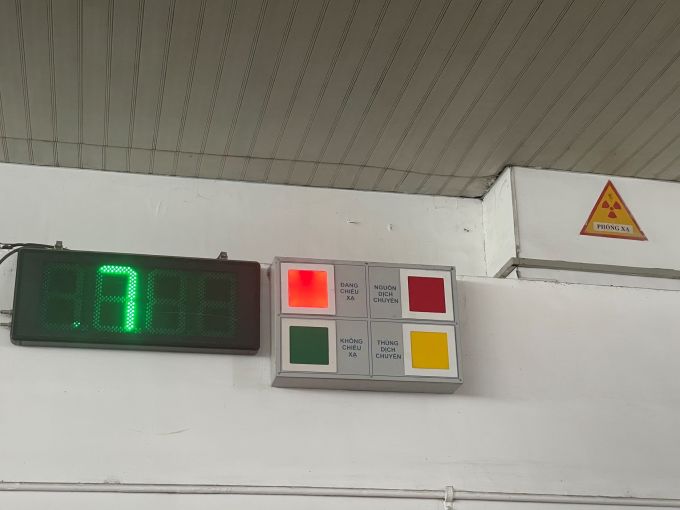
Indicator lights showing the operating status of the irradiator and a radiation warning board at Vinagamma. Photo: Ha An.
Mr. Nguyen Thanh Cuong, Director of Vinagamma, said that the unit currently has 26 technical staff and 92 workers. Equipment operators must have a certificate of knowledge in radiation safety. According to regulations, they must undergo training and have their certificate renewed every two years. Every three months, the dosimeters attached to employees must be sent for testing to check the radiation dose they receive.
Regarding the design of the irradiation facility, Mr. Cuong stated that it must be calculated and simulated with sufficiently thick concrete walls capable of shielding, so that the radiation background of the outermost wall will be almost the same as the ambient level. When the irradiation machine stops operating or experiences any malfunction, or if outsiders intrude, the radiation source will be moved down to a water tank to ensure safety, along with multiple layers of protection. "Safety is the first requirement," Mr. Cuong said.
According to data from the Department of Radiation and Nuclear Safety, there are currently more than 600 facilities nationwide that use and manage radioactive sources, with a total of 5,400 radioactive sources. Of these, 2,000 are in use and more than 3,000 are being temporarily stored.
Ha An
Source link

![[Photo] Standing Committee member of the Party Central Committee Tran Cam Tu working with the Central Inspection Committee](https://vphoto.vietnam.vn/thumb/1200x675/vietnam/resource/IMAGE/2026/05/28/1779969579668_ndo_br_bnd-2495-jpg.webp)











![[GALLERY] A "billion-dollar" game that hasn't even been released yet is already driving gamers crazy.](https://vphoto.vietnam.vn/thumb/402x226/vietnam/resource/IMAGE/2026/05/28/1779977371733_goi-3-png.webp)
























































Comment (0)