

Many people believe that humans only use 10% of their brain, but in reality, even when resting or sleeping, a large portion of the brain remains active.
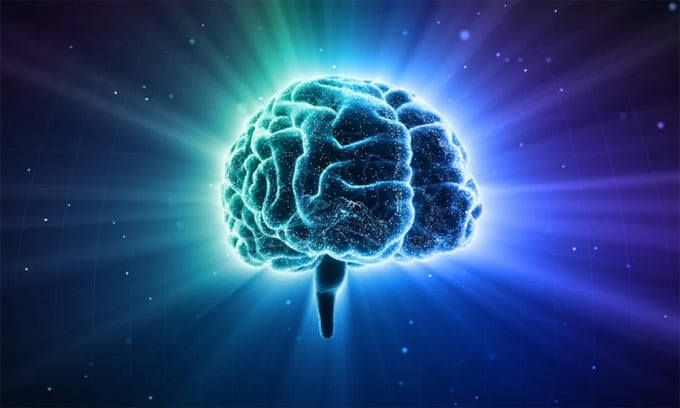
Most parts of the brain are active almost all the time. Photo: BlueBackIMAGE/Shutterstock
The brain, the most complex organ in the human body, is composed of three main regions: the cerebrum, cerebellum, and brainstem (brainstem). These brain regions function both independently and in coordination to perform tasks. Therefore, the amount of brain activity used varies depending on the task. While not all areas may be activated at all times, this doesn't mean some parts become redundant, IFL Science reported on May 29th.
"We use almost every part of our brain. Most of the brain is active almost all the time," says neuroscientist Barry Gordon at Johns Hopkins School of Medicine. In fact, over a 24-hour period, all areas of the brain are in use. Even when people are resting or sleeping, a large portion of the brain remains active.
"Evidence suggests that you use 100% of your brain in a given day," says John Henley, a neuroscientist at the Mayo Clinic. However, this doesn't mean that when a part of the brain is removed or damaged, people are unable to perform daily tasks. "The brain has ways of compensating to ensure that the remaining parts take over," Henley adds. This flexibility explains why some people who are missing a part of their brain can still function and work.
Previously, many believed that humans only use 10% of their brain. However, scientists have used functional magnetic resonance imaging (fMRI) to refute this information. fMRI measures blood flow and oxygenation in the brain to detect activity in different brain regions. This technique shows that, even when performing simple tasks, not just 10% of the brain is active, but a much larger amount.
So, does 10% refer to the number of brain cells? That's also incorrect, according to the BBC . When any nerve cell becomes redundant, it degenerates and dies or is invaded by other nearby areas. The human body won't let brain cells wander around useless.
Therefore, according to neuroscientist Amy Reichelt, the 10% figure is meaningless. The brain accounts for only 2% of body weight but uses 20% of the body's energy. So there's no reason to waste a large amount of the body's resources and supply energy to only 10% of the brain.
Thu Thao (According to IFL Science )
Source link











































































































Comment (0)