

CO2 is considered the main culprit behind global warming and climate change. Therefore, burying CO2 at the bottom of the sea is seen by many countries around the world as an effective measure to deal with this toxic gas and combat climate change.
In early 2023, Denmark officially launched a project to store CO2 emissions on the seabed. The project, called Greensand, utilizes an existing oil field developed by the British chemical company Ineos and the German oil company Wintershall Dea, and is expected to store up to 8 million tons of CO2 emissions per year by 2030.
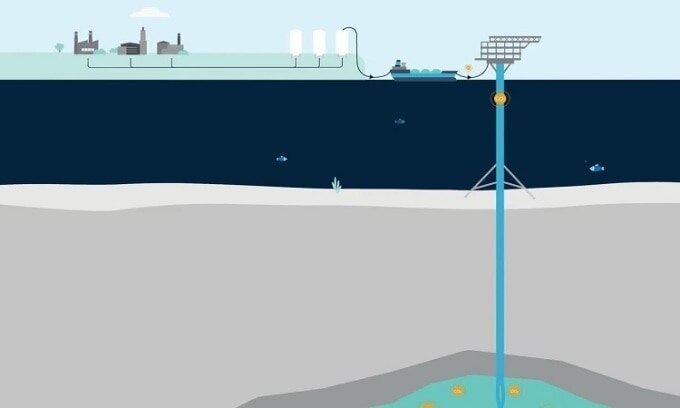
The Greensand project will collect and liquefy industrial CO2 and pump it down old oil wells. (Photo: Semco Maritime)
At the Greensand project, CO2 emissions are transported in specialized containers to the Nini West field, where they are pumped into a storage tank located 1.8 km below the seabed.
Denmark aims to achieve CO2 neutrality by 2045. Authorities say this approach is a crucial tool in Denmark's climate change toolkit.
Prior to Denmark, Norway had also implemented several CO2 storage projects. The country boasts the best prospects for CO2 storage on the European continent, particularly in the depleted North Sea oil fields. The government has funded 80% of the infrastructure, investing €1.7 billion to develop this technology.
Norwegian companies have even planned to build a giant pipeline to develop the world's first cross-border CO2 transport and storage service, expected to launch in 2024.
Accordingly, a pipeline will pump liquefied CO2 into geological pockets 2,600 meters deep on the ocean floor, and this CO2 will remain there indefinitely. This pipeline system has the capacity to transport 20 to 40 million tons of CO2 per year, equivalent to the emissions produced by 3 to 6 million people.
There are currently around 30 CO2 storage projects operating in Europe. However, these projects can only address a very small fraction of the CO2 that European countries are currently emitting.
According to the European Environment Agency (EEA), European Union (EU) member states emitted 3.7 billion tonnes of CO2 in 2020 alone – a year that saw a decline in economic activity due to the COVID-19 pandemic.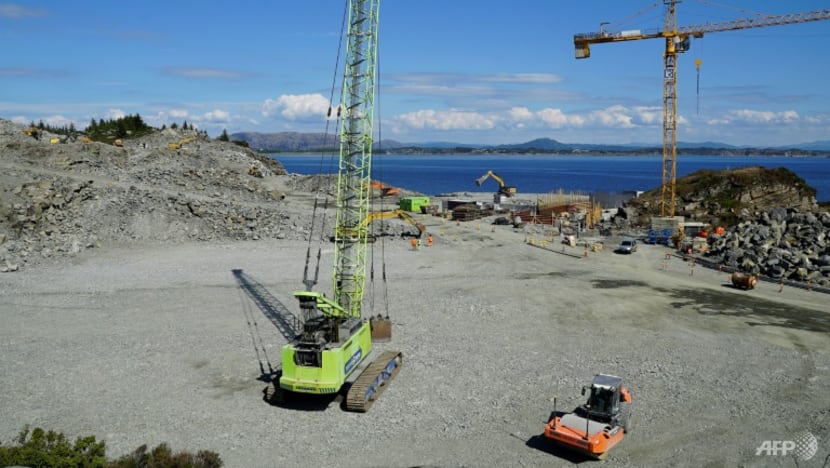
Construction of a facility to pump liquefied CO2 onto the seabed in Norway. (Photo: AFP)
Not only are scientists planning to "bury" CO2, but they are also developing a plan to transform this toxic gas into rock. In 2016, an international team of scientists mixed CO2 with water and then pumped this liquid mixture down into a layer of basalt rock deep underground.The chosen pilot site is the Hellisheidi power plant in Iceland – the world's largest geothermal energy producer. This plant emits 40,000 tons of CO2 annually, only 5% of the emissions of a similarly sized coal-fired power plant, but still a worrying figure.
Scientists were initially concerned that this liquid mixture would take hundreds, even thousands of years, to solidify. However, after only two years, 95-98% of the pumped mixture had already solidified into chalky white boulders.
The only obstacle to this type of CO2 storage technology is that it requires a lot of water; specifically, each ton of CO2 needs to be dissolved in 25 tons of water. However, scientists say that in some locations, seawater can be utilized.
Currently, CO2 capture and storage is the only technology capable of reducing greenhouse gas emissions on a large scale from many industries. It is considered a viable solution for CO2-heavy industries as a way to continue operating and cope with increasingly stringent emission reduction measures aimed at combating climate change.
CO2 is considered the main culprit behind global warming and climate change, which is why scientists have long sought to develop solutions for capturing and storing CO2. Basalt has emerged as a strong candidate. This type of rock is formed from magma erupting from volcanoes and then cooling; it has a dense, porous structure and is very rich in calcium, iron, and magnesium. Basalt is a constituent of much of the Earth's seabed. |
Ngoc Chau




























































































Comment (0)