

The issue of "fake PhDs" is a troubling topic that is attracting significant public attention.
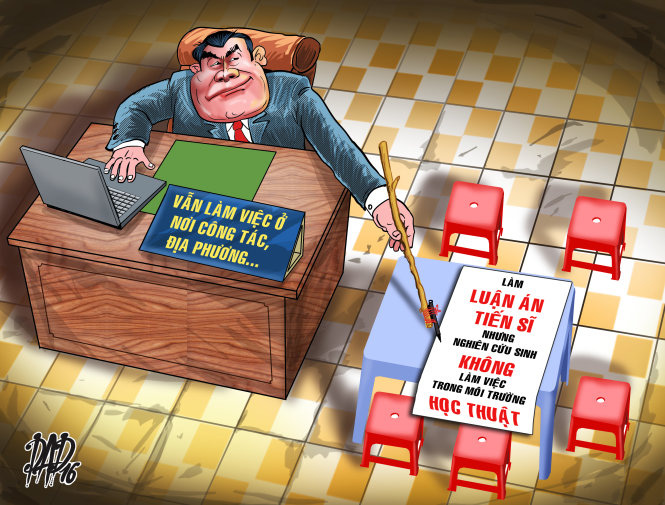
This is not just a story about a few individuals who cheated, but also a warning about the loopholes in quality control of doctoral training and the laxity in the supervision process.
These loopholes have led to some unqualified, or even fraudulent, individuals still achieving high academic degrees.
Responsibilities of the training institution and the instructor
Worryingly, these vulnerabilities are often only exposed through social media instead of being discovered by responsible regulatory agencies.
This indicates that quality control and monitoring at training institutions are not sufficiently effective, and reflects a lack of close coordination among relevant agencies. Although monitoring procedures may exist on paper, their enforcement is being neglected.
In the higher education system, especially at the doctoral level, the role of professors and associate professors is crucial. They not only impart knowledge but also shape the thinking and develop the character of the next generation.
Their responsibility extends beyond evaluating academic performance; it also includes ensuring that every doctoral graduate meets the required standards of competence and ethics. An irresponsible or lenient professor or associate professor can degrade the quality of education and damage the reputation of the entire higher education system.
Although professors and associate professors are primarily responsible for guidance, supervision, and evaluation, the responsibility for control rests with the training institutions themselves. Universities need to establish stricter mechanisms for academic quality control and internal oversight to ensure transparency and fairness in the training process.
It's not enough to rely solely on the personal ethics of professors or associate professors; a clear system of accountability is needed. Universities must be accountable to society for the quality of their education, instead of leaving public opinion and social media to the role of uncovering wrongdoing.
Accountability
Over the years, the higher education system has made numerous efforts to improve the quality of training, from enacting stricter admission regulations and requiring doctoral students to publish scientific papers to tightening the dissertation defense process.
However, these measures are still not strong enough or implemented consistently, allowing many cases to still circumvent the system. This raises questions about the accountability of educational institutions and their direct responsibility to society for the educational products they deliver.
Furthermore, the practice of "playing both sides" needs to be curbed. Training institutions should not simultaneously be places of training and places where regulations are lax. The accreditation, supervision, and evaluation of training quality should be more substantive to ensure objectivity. This will not only improve the quality of doctoral training but also restore public trust.
Professional ethics should always be prioritized. Educational management agencies should discipline doctoral supervisors and evaluation committee members who lack responsibility and professional ethics. Quality gaps can only be sustainably closed when those in positions of responsibility and authority consistently uphold a spirit of dedication and integrity.
The issue of "fake PhDs" is not a new problem, but it has persisted in the Vietnamese education system. Only when the loopholes in quality management are sustainably closed, the responsibilities of training institutions are clearly defined, and objective and substantive accreditation is established, can we build a strong academic foundation.
完善 regulations for doctoral training
In the context of increasing university autonomy, professors and associate professors play a very important role, but the responsibility of training institutions to ensure the quality of doctoral training is even more crucial because these institutions have the authority to decide on personnel selection, training, supervision, and degree awarding.
State management agencies need to further improve training regulations, specify the competence and professional ethics of instructors, strengthen the application of technology to monitor training quality, promptly handle violations, and support quality management for training institutions.
Source: https://tuoitre.vn/bit-lo-hong-dao-tao-tien-si-ra-sao-20241102091946494.htm





















































































Comment (0)