

Under the leadership of the Party, with its democratic and scientific methods and approaches to governance, constantly innovated to suit the requirements and tasks of each period, the Vietnamese revolutionary cause has progressed.

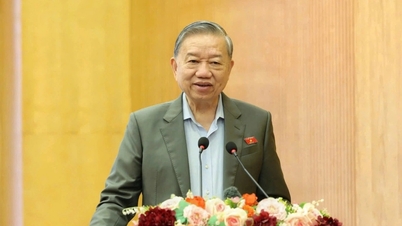
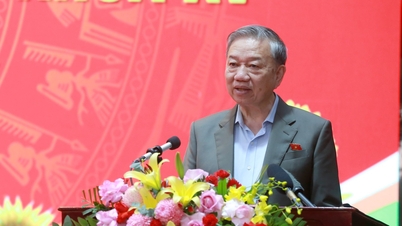
On September 16th, we are pleased to present an article by Comrade To Lam, General Secretary of the Central Committee of the Communist Party of Vietnam and President of the Socialist Republic of Vietnam: "Continuing to vigorously innovate the Party's methods of leadership and governance is an urgent requirement of the new revolutionary stage."
The following is the content of the article:
"CONTINUING TO STRONGLY INNOVATE THE PARTY'S METHODS OF LEADERSHIP AND GOVERNANCE IS AN URGENT REQUIREMENT OF THE NEW REVOLUTIONARY PERIOD."
To Lam
General Secretary of the Central Committee of the Communist Party of Vietnam
President of the Socialist Republic of Vietnam
1. For over 94 years of leading the Revolution, our Party has continuously sought, developed, supplemented, and perfected its leadership methods, enhancing its leadership capacity and governing ability. This is a key factor ensuring the Party remains clean and strong, guiding the revolutionary ship through all rapids and achieving one victory after another. The country is facing a new historical moment, a new era, an era of national resurgence, and the urgent need for a strong renewal of leadership methods and enhancement of leadership capacity and governing ability to continue advancing the nation is pressing.
The concept of a "ruling party" was first introduced by VI Lenin in 1922. From 1925-1927, in his book "The Revolutionary Path," President Ho Chi Minh addressed the issue of a ruling party. He considered the leadership of the State and society by the Communist Party of Vietnam as a principle demonstrating the Party's ruling role; the Party holds this immense responsibility because its purpose is nothing other than "leading the suffering masses in class struggle to eliminate imperialist capitalism and realize a communist society," "apart from the interests of the nation and the Fatherland, the Party has no other interests," and "the Party is not an organization for seeking power and wealth. It must fulfill the task of liberating the nation, making the Fatherland prosperous and strong, and the people happy."
In his Testament, President Ho Chi Minh wrote: "Our Party is a ruling Party." Regarding leadership, in his work "Correcting Working Methods," President Ho Chi Minh dedicated a section to this issue. He asked: "What does true leadership mean?" and answered: "True leadership means: 1) Deciding on all issues correctly… 2) Organizing the implementation correctly… 3) Organizing the control…"; and to do all three correctly, according to him, one must rely on the people.
Based on the viewpoints of Marxism-Leninism and Ho Chi Minh Thought, the 7th Party Congress for the first time addressed the issue of "renewing the content and methods of the Party's leadership," emphasizing the need to "specifically define the relationship and working methods between the Party and the State and people's organizations at all levels, first and foremost at the central level."
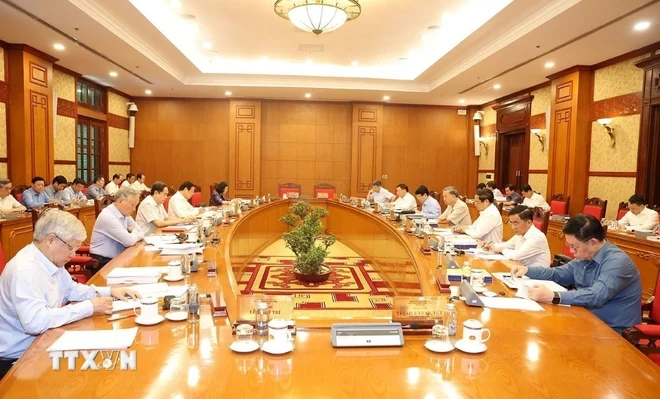
The 1991 Platform for Building the Country during the Transition Period to Socialism defines the Party's leadership method as follows: “The Party leads society through its platform, strategies, policy orientations and work guidelines; through propaganda, persuasion, mobilization, organization, inspection, and through the exemplary actions of its members. The Party nominates outstanding members with sufficient capacity and qualities to work in leading government agencies and mass organizations. The Party does not replace the work of other organizations in the political system”; “The Party leads the political system, and at the same time is a part of that system. The Party maintains close contact with the people, is subject to the people's supervision, and operates within the framework of the Constitution and laws.”
The Mid-term National Conference of Delegates of the 7th Party Congress affirmed that "the Party leads according to the principles of democratic centralism, collective leadership, and individual responsibility; leadership is exercised through Party organizations, not just through individual Party members; leadership is exercised through collective decisions and by monitoring, providing guidance, inspecting implementation, encouraging positive aspects, and correcting deviations, in order to strongly promote the role and effectiveness of the State, rather than acting as a substitute for the State."
The 8th, 9th, 10th, 11th, and 12th Party Congresses all continued to supplement and develop the views on the Party's leadership methods; the 13th Party Congress emphasized "Continuing to strongly innovate the Party's leadership methods in the new conditions."
Based on a review of 15 years of implementing Resolution No. 15-NQ/TW of the 10th Central Committee of the Communist Party of Vietnam, the 6th Central Committee Meeting of the 13th Party Congress issued Resolution No. 28-NQ/TW on November 17, 2022, on continuing to innovate the Party's leadership and governance methods over the political system in the new period. The Party's leadership and governance role over the State and society is affirmed in the Constitutions of the Socialist Republic of Vietnam; the mechanism of "Party leadership, State management, and people's ownership" has also been affirmed and implemented through strict regulations in the Party Charter, the Constitution, and legal provisions, as well as the regulations and rules of other organizations within the political system and mass organizations.
Under the leadership of the Party, with its democratic and scientific methods of governance, constantly innovated to suit the requirements and tasks of each period, the Vietnamese revolutionary cause in general, and the reform process in particular, has achieved many miracles and great accomplishments. From a country that was virtually unknown on the world map and heavily devastated by war, Vietnam has risen to become a symbol of peace, stability, hospitality, and a destination for international investors and tourists.
From a backward economy, Vietnam has risen to become one of the top 40 economies, with a trade volume among the top 20 countries in the world, and a crucial link in 16 Free Trade Agreements (FTAs) connecting with 60 key economies in the region and globally. From a country once isolated and besieged, Vietnam has established diplomatic relations with 193 United Nations member states, has strategic and comprehensive partnerships with 30 countries, including all major powers, and is an active member of over 70 regional and international organizations.
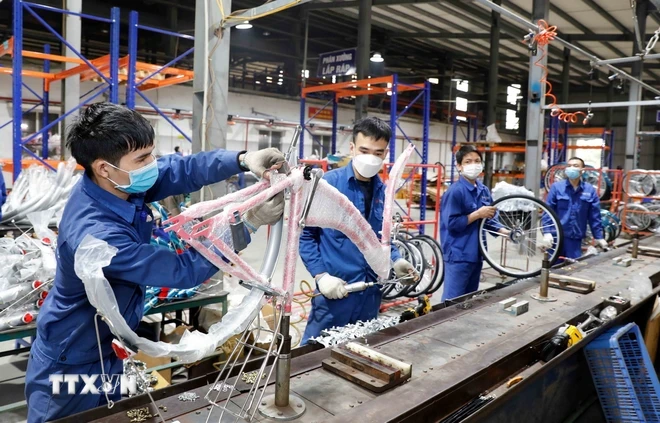
With the happiness and well-being of its people as its ultimate goal, Vietnam is regarded by the United Nations and international friends as a success story, a shining example of poverty eradication and continuous improvement of the material and spiritual lives of its people.
Simultaneously, a stable political system has been established with the mechanism of "Party leadership, State management, and people's mastery." The Party's organizational structure has undergone numerous improvements, gradually taking shape, and is continuing to be reformed and reorganized. The political system, with the socialist rule of law state of the people, by the people, and for the people as its core, has been built and perfected, affirming its role in managing and directing all aspects of social life. The Vietnam Fatherland Front is truly an organization representing and protecting the legitimate rights and interests of the people; gathering and promoting the strength of national unity, implementing democracy, strengthening social consensus; conducting social supervision and criticism; and participating in building the Party and the State. Political and social organizations represent the legitimate rights and interests of all classes and strata of the people; uniting, gathering, propagating, and mobilizing the people to actively implement the Party's policies and guidelines. That system is increasingly affirming its suitability and superiority, enjoying the trust and support of the vast majority of cadres, Party members, and people from all walks of life, and receiving high praise from international friends.
However, the Party's leadership reform still faces many shortcomings and limitations. There is still a tendency to issue numerous documents, some of which are vague, scattered, overlapping, and slow to be supplemented, amended, or replaced. Some major Party policies and orientations have not been institutionalized in a timely and complete manner, or if they have been, their feasibility is low. The overall model of the political system is not yet complete; the functions, tasks, powers, and working relationships of organizations, individuals, and leaders are still unclear; decentralization and delegation of power are not strong enough. The organizational model of the Party and the political system still has inadequacies, making it difficult to define the boundaries between leadership and management, easily leading to excuses, taking over responsibilities, or neglecting the Party's leadership role. Administrative reform and the renewal of working styles and methods within the Party are slow; meetings are still frequent.
2. To continue to vigorously innovate leadership methods, enhance leadership capacity and governance capacity, and ensure that the Party is the great helmsman leading our nation forward; some key tasks are:
Firstly , it is essential to unify understanding and strictly implement the Party's leadership and governance methods, absolutely preventing any excuses, substitutions, or laxity in the Party's leadership. The Party leads through the political system, of which the Party is the core; through ideology, guidelines, policies, and the pioneering and exemplary conduct, as well as regular self-criticism and criticism by cadres and Party members; through the institutionalization of the Party's guidelines and policies into state laws; through mobilizing and persuading the people to implement the Party's guidelines and policies, nominating outstanding representatives to the state apparatus, and through inspection and supervision. The Party governs through law, leading the drafting of the Constitution and laws, and simultaneously operating within the framework of the Constitution and laws. Party cadres and members abide by and uphold the law. The ruling Party leads the state; The power of the ruling party is political power, setting policies and guidelines, while state power is the power to manage society on the basis of law. The Party's leadership ensures that power truly belongs to the people, and that the state is truly of the people, by the people, and for the people. The Party comprehensively leads the country and is responsible for all successes and shortcomings in the cause of building and defending the Fatherland.
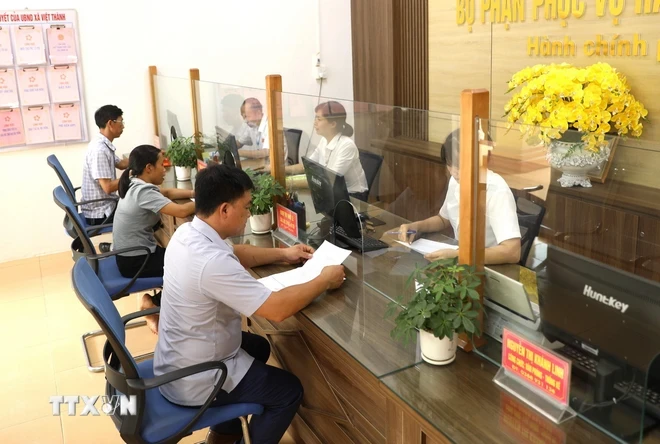
Secondly , focus on streamlining the organizational structure of Party agencies, ensuring they truly serve as the intellectual core, the "general staff," and the vanguard leading state agencies. Build truly streamlined advisory bodies for Party committees; staff should possess strong political qualities, capabilities, excellent professional skills, expertise, responsibility, and proficiency in their work. Research and promote the consolidation of some advisory and support agencies of the Party; conduct a comprehensive assessment of the concurrent holding of positions within the Party and the political system to make appropriate decisions. Ensure that the Party's leadership tasks do not overlap with management tasks; clearly distinguish and define the specific tasks of leaders at all levels in different types of Party organizations, avoiding situations of overlapping responsibilities or duplication and formalism. Strongly innovate working styles and methods towards a scientific and professional direction, with the motto "play the right role, know the job."
Thirdly , we must vigorously innovate the issuance, dissemination, and implementation of Party resolutions; building grassroots Party organizations and Party members who are truly the "cells" of the Party. Resolutions of Party committees and organizations at all levels must be concise, easy to understand, easy to remember, easy to absorb, and easy to implement; they must accurately identify the requirements, tasks, paths, and methods of development of the country, the nation, each locality, each ministry, and each sector; they must have vision, scientific basis, practicality, feasibility, and viability; creating enthusiasm, trust, expectations, and motivation to encourage action among cadres, Party members, economic sectors, businesses, and the people in implementing the Party's resolutions. The dissemination and implementation of resolutions must create self-awareness and self-ingrainment, especially of new viewpoints, policies, and solutions. Focus on building good Party branches and good Party members; To improve the quality of Party branch activities and put the Party's policies and guidelines into practice in real life.
Fourth , continue to innovate inspection and supervision work; promote the application of information technology and digital transformation in the Party's activities. The Party's inspection and supervision ensure that work is done better, resolutions are implemented effectively; the Party and State apparatus operates effectively and efficiently, in accordance with policies and guidelines, with the right people in the right jobs; promptly identify new factors, good and creative methods; correct and adjust deviations or prevent wrongful acts and violations of Party regulations and State laws. Maximize the role of inspection and supervision of Party committees and inspection committees at all levels. Issue regulations on decentralizing inspection and supervision authority, linked to detecting and strictly handling all acts of abusing inspection and supervision for corruption and negative practices. Focus on digital transformation in Party work; To build a database of Party organizations, Party members, and Party documents, connecting from the central level to the grassroots, and synchronously connecting with the national population database and other databases, effectively serving the work of protecting internal political security and building a clean and strong Party.
Lenin taught: "When the situation has changed and we have to deal with a different kind of task, we should not look back and use the methods of yesterday." The practice of innovation is always in motion and developing, demanding continuous innovation in the Party's leadership and governance methods, based on steadfast adherence to the Party's principles; imbued with the teachings of General Secretary Le Duan: "Leadership must be firm and principled, never wavering in the face of the difficulties and challenges of the revolution."
Source

![[Photo] Two flights successfully landed and took off at Long Thanh Airport.](/_next/image?url=https%3A%2F%2Fvphoto.vietnam.vn%2Fthumb%2F1200x675%2Fvietnam%2Fresource%2FIMAGE%2F2025%2F12%2F15%2F1765808718882_ndo_br_img-8897-resize-5807-jpg.webp&w=3840&q=75)




























































Comment (0)