

On March 25th, the Prime Minister chaired a specialized Government meeting on lawmaking for March 2024.
At the meeting, the Government discussed a series of typical draft laws such as the draft Law on Fire Prevention, Fighting and Rescue (amended); the Law on Urban and Rural Planning; the Law on Geology and Minerals...
Regarding the draft Law on Geology and Minerals, the Government held in-depth discussions on issues where there were differing opinions, such as the scope of regulation for the management of mineral processing activities; decentralization and delegation of authority in mineral management; mineral classification and decentralization in mineral exploitation licensing; and regulations on the State's investment in the exploitation of strategic, important, and economically valuable minerals with high demand.
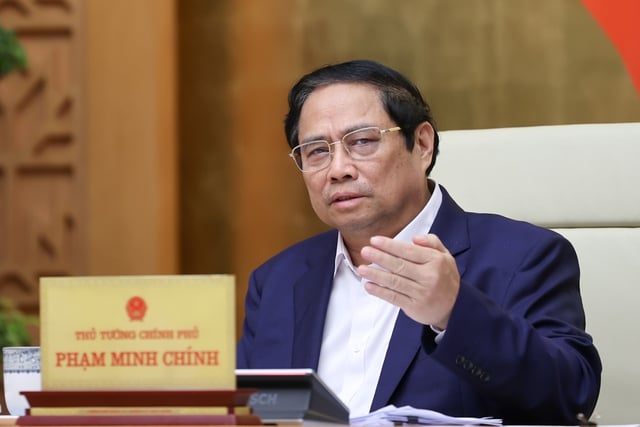
Prime Minister Pham Minh Chinh speaks at the session (Photo: VGP).
The delegates also discussed the collection of fees for mineral exploitation rights… in order to effectively exploit the country's mineral resources, eliminate the "request-and-grant" mechanism, and combat negativity and corruption in mineral management and exploitation.
Government members believe that the Resolution needs to specify the criteria for selecting judicial offices to participate in the pilot program, the procedures for issuing criminal record certificates; the responsibilities of agencies and units coordinating the search and verification of information to issue criminal record certificates; the collection and use of fees for processing administrative procedures for issuing criminal record certificates; and the scope of certificate issuance…
Regarding the proposal to amend the Law on Management and Use of State Capital Invested in Production and Business Enterprises, the Government members stated: "The amendment of the aforementioned Law is absolutely necessary to institutionalize the guidelines and policies of the Party, the National Assembly, and the Government on reforming and improving the efficiency of State-owned enterprises, further perfecting the legal framework for managing and investing State capital in enterprises, and resolving difficulties and obstacles encountered in the past."
In particular, the Government focused its discussions on the management of state capital invested in enterprises; enterprise investment activities; the arrangement and restructuring of state capital in enterprises; regulations on agencies and representatives of capital owners; and corporate governance…
In addition to providing feedback on each draft law and resolution, Prime Minister Pham Minh Chinh requested that members of the Government, especially the ministries and agencies in charge of drafting, review the content of the draft laws and resolutions to ensure their appropriateness and maximum institutionalization of the Party's guidelines and the State's policies on related issues; and to ensure consistency and compatibility between the laws and resolutions and existing laws and regulations, avoiding conflicts and contradictions.
In particular, the head of government emphasized: "Laws and resolutions must maximize the country's resources; avoid waste, negativity, corruption, and the 'give-and-take' mentality."
"Ministries and agencies must clarify, in draft laws, especially amendments, which content should be retained, which is new, which needs improvement, and which should be abolished. Draft laws must be developed in a way that promotes decentralization and delegation of power; and reduces administrative procedures," he further emphasized.
The Prime Minister instructed relevant ministries, agencies, and organizations to continue seeking further opinions from experts, scientists, managers, and stakeholders; and especially to coordinate closely with relevant agencies and departments, particularly those of the National Assembly, in the process of drafting laws and resolutions.
Ministers and heads of ministerial-level agencies and government agencies are requested to continue allocating resources and facilities for the work of drafting laws and improving institutions; to strengthen communication to gather broad public opinion, and at the same time, to analyze and explain relevant contents so that people deeply understand them in order to contribute to the improvement of laws and agree to their implementation when they come into effect…
Source

![[Photo] Closing Ceremony of the 10th Session of the 15th National Assembly](/_next/image?url=https%3A%2F%2Fvphoto.vietnam.vn%2Fthumb%2F1200x675%2Fvietnam%2Fresource%2FIMAGE%2F2025%2F12%2F11%2F1765448959967_image-1437-jpg.webp&w=3840&q=75)
![[Photo] Prime Minister Pham Minh Chinh holds a phone call with the CEO of Russia's Rosatom Corporation.](/_next/image?url=https%3A%2F%2Fvphoto.vietnam.vn%2Fthumb%2F1200x675%2Fvietnam%2Fresource%2FIMAGE%2F2025%2F12%2F11%2F1765464552365_dsc-5295-jpg.webp&w=3840&q=75)















































![[OFFICIAL] MISA GROUP ANNOUNCES ITS PIONEERING BRAND POSITIONING IN BUILDING AGENTIC AI FOR BUSINESSES, HOUSEHOLDS, AND THE GOVERNMENT](https://vphoto.vietnam.vn/thumb/402x226/vietnam/resource/IMAGE/2025/12/11/1765444754256_agentic-ai_postfb-scaled.png)













































Comment (0)