

On November 30th, in Tra Vinh , the Ministry of Agriculture and Rural Development and the People's Committee of Tra Vinh province held a conference to implement measures to prevent and combat drought and saltwater intrusion, ensuring agricultural production and people's livelihoods during the 2023-2024 dry season in the Mekong Delta region.
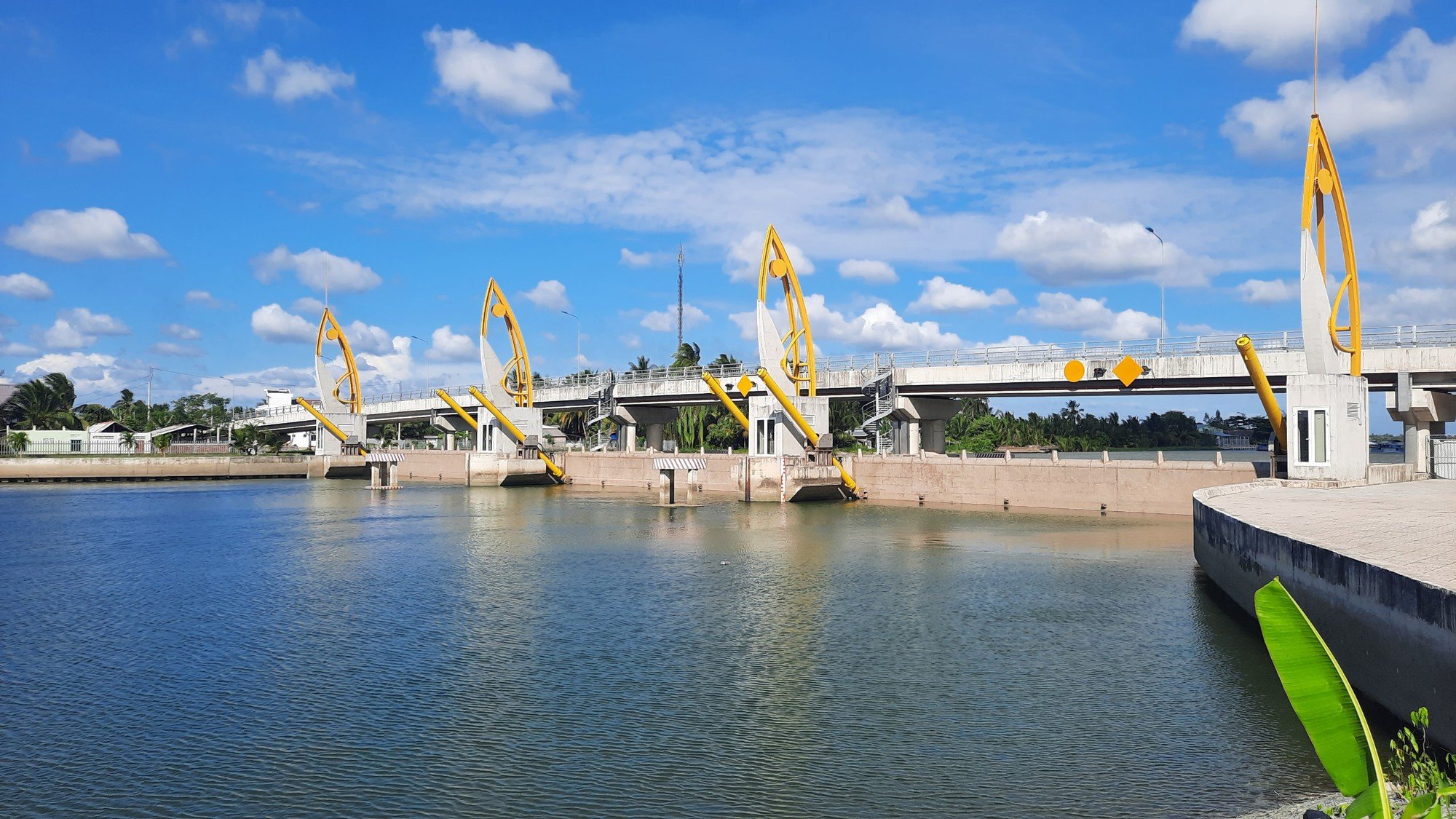
The saltwater intrusion prevention sluice gate in Vung Liem District (Vinh Long Province) helps protect irrigation water sources for local agriculture when salinity levels rise.
According to the National Center for Hydrometeorology, during the 2023-2024 dry season, the total flow from the upper Mekong River (Kratie station, Cambodia) to the lower Mekong Delta is likely to be 5-10% lower than the multi-year average. Water levels at the headwaters of the Mekong River will fluctuate with the tides, showing a gradual downward trend.
Therefore, saltwater intrusion during the 2023-2024 dry season will arrive earlier and be more severe than the average, potentially leading to localized water shortages at certain times due to deep saltwater intrusion. Saltwater intrusion in the Mekong Delta estuaries may begin in December 2023, with high levels concentrated in February and March 2024; specifically in the Vam Co and Cai Lon rivers, it will be in March, April, and May 2024.
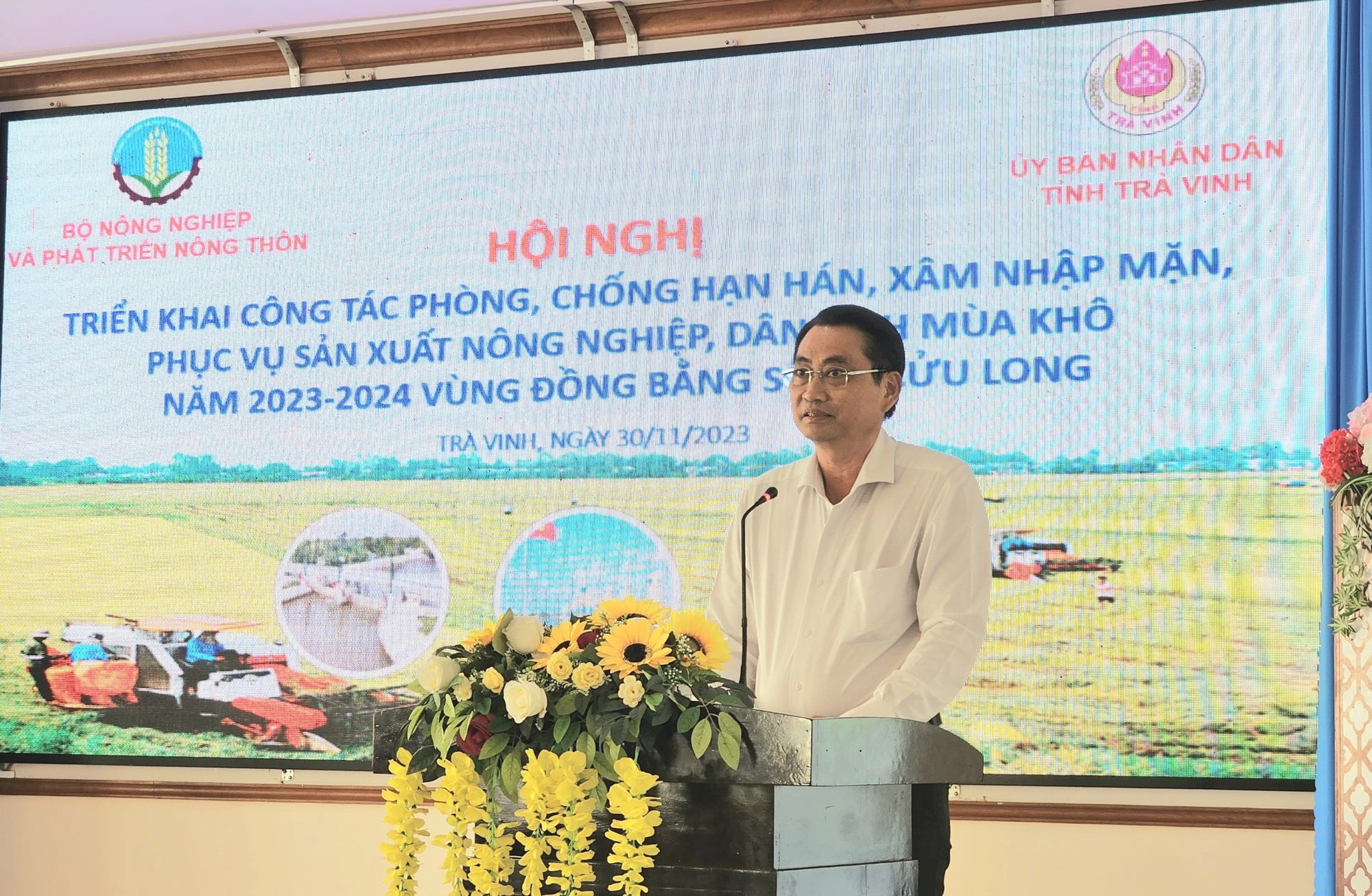
Mr. Nguyen Quynh Thien, Vice Chairman of the People's Committee of Tra Vinh province, delivered a speech at the conference.
Speaking at the conference, Mr. Nguyen Quynh Thien, Vice Chairman of the People's Committee of Tra Vinh province, said that in the face of increasingly complex drought and saltwater intrusion situations, the province has developed scenarios with a salinity boundary of 4‰, penetrating more than 50 km inland from the river mouth, in order to implement response solutions when situations occur.
Tra Vinh province is also promoting the transformation of crop structure, monitoring forecasts and developments of water resources from specialized agencies, building appropriate production schedules, mobilizing people to adhere to the schedules, planting simultaneously according to plan, and encouraging the selection of crop and livestock varieties suitable for the season and capable of coping with climate change. At the same time, it is strengthening the measurement and monitoring of salinity levels in rivers, canals, key waterworks, and water treatment plants to operate irrigation systems for rational and efficient water intake and storage, appropriate to each stage... As a result, people have become more active and proactive in preparing for drought and salinity intrusion from the beginning of the dry season, contributing significantly to reducing damage caused by saline intrusion.
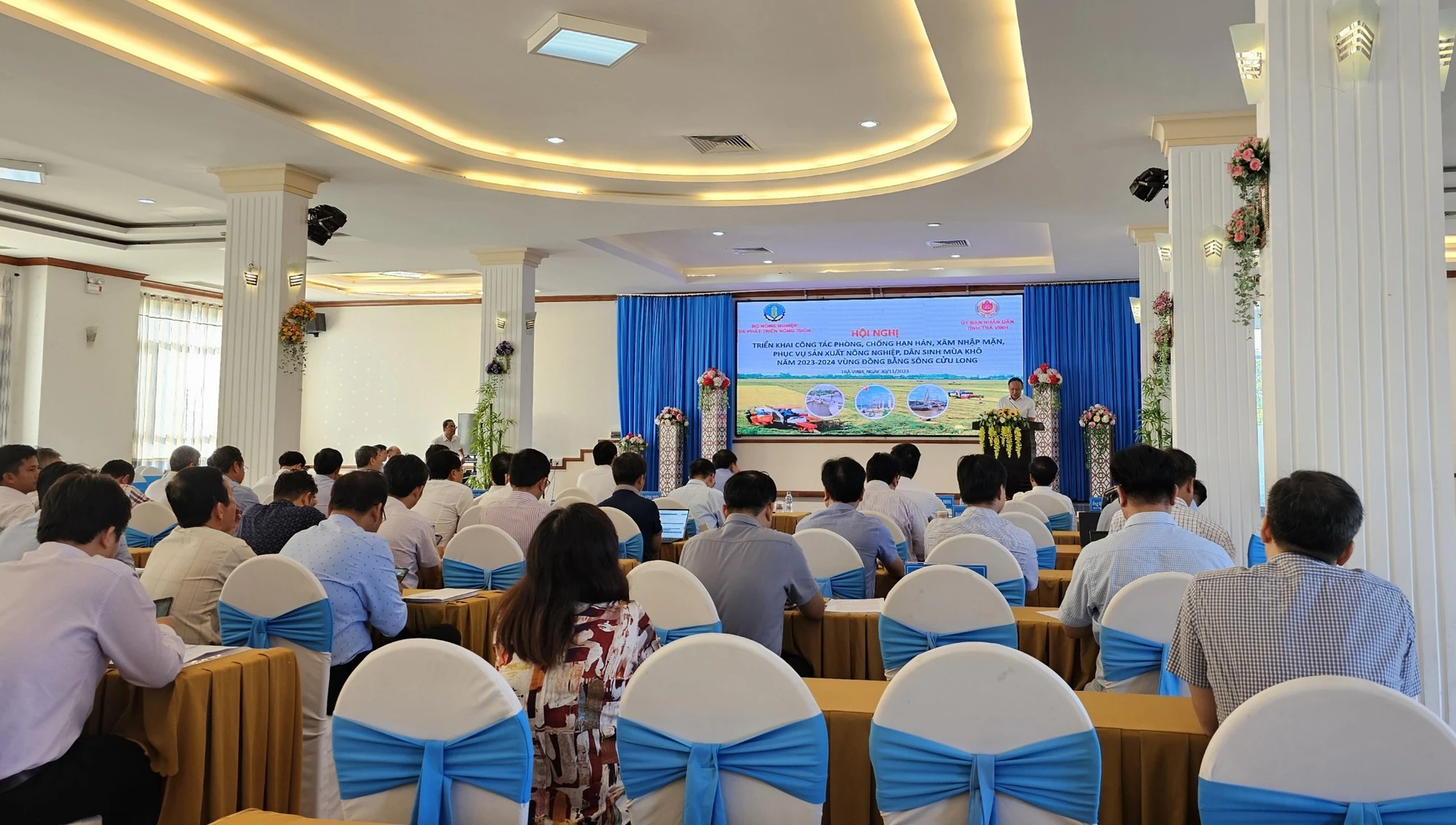
Conference on implementing measures to prevent and combat drought and saltwater intrusion, ensuring agricultural production and people's livelihoods during the 2023-2024 dry season in the Mekong Delta region.
Mr. Nguyen Hoang Hiep, Deputy Minister of Agriculture and Rural Development, urged localities to proactively implement specific solutions tailored to each area to minimize damage, protect agricultural production and people's lives, especially ensuring access to clean water for the population.
Besides urgent solutions to address the current drought and saltwater intrusion situation, long-term solutions should also be considered, recognizing drought and saltwater intrusion as a recurring characteristic of the region, in order to develop economic development scenarios that are appropriate to the water resource conditions. For projects currently under investment and construction aimed at drought and saltwater intrusion prevention, construction progress should be accelerated to bring them into operation and use during the 2023-2024 dry season.
Mr. Hiep also suggested that localities should do a better job of disseminating information to the people so that they have a full understanding of the serious impacts of drought and saltwater intrusion, proactively implement solutions to store water, especially household water storage, and at the same time raise awareness of using water economically and efficiently; support people in implementing the conversion of crop and livestock structures suitable for drought and water shortage conditions...
Source link
![[Photo] Prime Minister Pham Minh Chinh receives the Governor of Tochigi Province (Japan)](/_next/image?url=https%3A%2F%2Fvphoto.vietnam.vn%2Fthumb%2F1200x675%2Fvietnam%2Fresource%2FIMAGE%2F2025%2F12%2F16%2F1765892133176_dsc-8082-6425-jpg.webp&w=3840&q=75)
![[Image] Leaked images ahead of the 2025 Community Action Awards gala.](/_next/image?url=https%3A%2F%2Fvphoto.vietnam.vn%2Fthumb%2F1200x675%2Fvietnam%2Fresource%2FIMAGE%2F2025%2F12%2F16%2F1765882828720_ndo_br_thiet-ke-chua-co-ten-45-png.webp&w=3840&q=75)
![[Live] 2025 Community Action Awards Gala](/_next/image?url=https%3A%2F%2Fvphoto.vietnam.vn%2Fthumb%2F1200x675%2Fvietnam%2Fresource%2FIMAGE%2F2025%2F12%2F16%2F1765899631650_ndo_tr_z7334013144784-9f9fe10a6d63584c85aff40f2957c250-jpg.webp&w=3840&q=75)


![[Photo] Prime Minister Pham Minh Chinh receives Lao Minister of Education and Sports Thongsalith Mangnormek](/_next/image?url=https%3A%2F%2Fvphoto.vietnam.vn%2Fthumb%2F1200x675%2Fvietnam%2Fresource%2FIMAGE%2F2025%2F12%2F16%2F1765876834721_dsc-7519-jpg.webp&w=3840&q=75)
















































![[Live] Closing Ceremony and Award Presentation for the "Impressive Vietnam Tourism" Video/Clip Creation Contest 2025](https://vphoto.vietnam.vn/thumb/402x226/vietnam/resource/IMAGE/2025/12/17/1765974650260_z7273498850699-00d2fd6b0972cb39494cfa2559bf85ac-1765959338756946072104-627-0-1338-1138-crop-1765959347256801551121.jpeg)


















Comment (0)