


In Khanh Hoa province , for the past two months, nearly 1,000 households on Binh Ba island, Cam Ranh city, have been facing a severe water shortage, while a water supply project that has been underway for many years has yet to be implemented.
Binh Ba is one of two islands belonging to Cam Binh commune. Located in Cam Ranh Bay, the island has nearly 1,000 households with 4,000 people. More than 90% of households live by fishing, processing, and aquaculture. The shortage of fresh water on the island has been a long-standing problem, but it has recently worsened due to drought and increased population demand. Currently, most of the water on the island comes from drilled wells, but it is heavily contaminated with alum and salt, so it can only be used for bathing and washing clothes. Water for cooking must be purchased from the mainland.
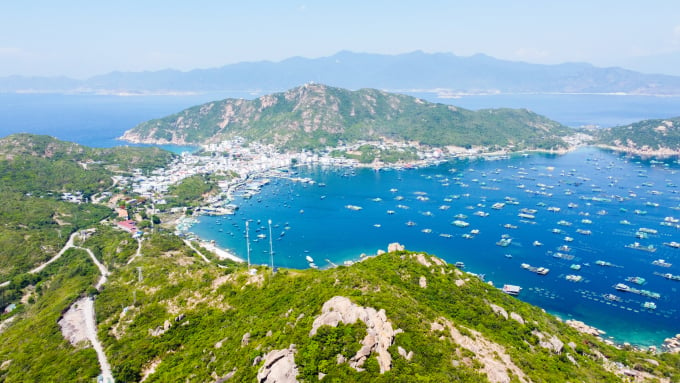
Binh Ba Island, Cam Binh commune, Cam Ranh city. Photo: Bui Toan
Ms. Vo Thi Xuan Lam, residing in Binh An village, stated that to conserve freshwater, her family uses brackish well water to wash rice, then drains it completely before adding freshwater to the pot for cooking. Additionally, laundry water is reused for flushing the toilet, and rainwater is saved for irrigation. "Even with such conservation efforts, a family of five still spends over a million dong on water each month," Ms. Lam said.
Mrs. Lam buys fresh water from traders who transport it from the mainland at a price of 7,000 VND per 30-liter can. When she runs out of water, she hires a tricycle to transport it from near the pier at a cost of 150,000 VND per trip, about 10 cans at a time. As for water for bathing, washing clothes, and sanitation, she has to buy it from a well drilled by another household on the island at a price of 60,000 VND per cubic meter.
About 700 meters from Mrs. Lam's house, Mr. Tran Van Kien, from Binh Ba Tay village, also has to conserve fresh water to have enough for his family of nine. Previously, he bought water from traders on the mainland at a price of 120,000 VND per cubic meter. However, since the beginning of the year, they have stopped bringing fresh water to the island for sale. The prolonged heatwave has also caused his family's rainwater storage tank to dry up. Mr. Kien has to buy 20-liter bottles of water for drinking and cooking. As for water for bathing and washing clothes, his family buys it from a household in the commune that has a well.
"Every day my family uses 2-3 water containers and about one cubic meter of well water specifically for bathing and washing," Mr. Kien said, adding that he also received a water supply system from a household with a well on the island, and when he needs to buy water, he just needs to notify them and it will be pumped. But for the past two months, water has been scarce, and sometimes he has to wait 3-4 hours for water.
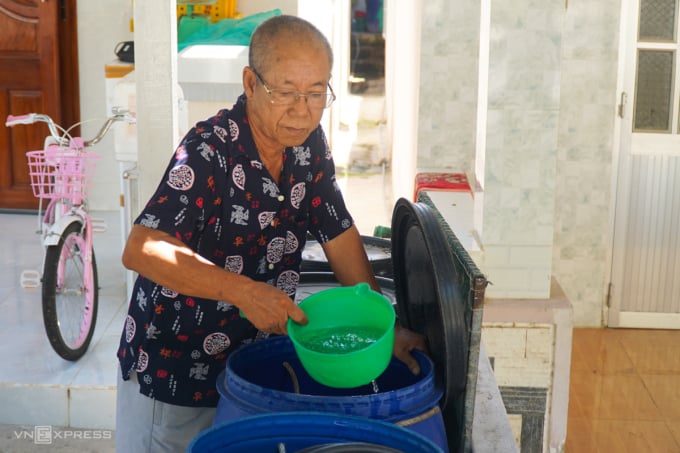
Mr. Kien collects rainwater in large plastic containers for irrigation. Photo: Bui Toan
Mr. Nguyen An, Chairman of the People's Committee of Cam Binh commune, said that only well-off households on the island invest in drilled wells because they have to drill to a depth of 100 meters to find water, which is very expensive. However, this water source is also unsuitable for drinking and cooking because the salinity is over 5 parts per thousand.
For the past six months, there have only been two heavy rainstorms on Binh Ba Island. The early-season rainwater is not clean, so people don't dare collect it for use. Most have to buy fresh water from the mainland through various means. "To date, Cam Binh island commune still lacks a clean and safe drinking water system," Mr. An said, adding that every time he meets with constituents, people raise the issue of the lack of fresh water, but it has yet to be resolved.
Mr. Quach Thanh Son, Director of the Project Management Board for Investment and Construction of Agricultural and Rural Development Projects in Khanh Hoa Province, said that the project to invest in a domestic water supply system for Binh Ba Island has a total capital of approximately 119 billion VND and was approved by the Provincial People's Committee in 2016. The project will invest in a pipeline system running from the mainland underwater to Binh Ba Island. However, due to the inability to secure funding from the central government, the project has not yet been implemented.
According to Le Ngoc Thach, Chairman of the People's Committee of Cam Ranh City, the Provincial People's Committee has requested a re-evaluation of the water supply plan for residents on Binh Ba Island to determine a suitable investment direction. Therefore, the city and relevant units have studied the option of investing in an open-air water pipeline system from the 4th Naval Region to Binh Ba Island to save costs.
Mr. Thach also said that recently, a company from Hanoi came to the island to survey the possibility of investing in a project using seawater desalination technology, but the investment required for this project is very large compared to the population of Binh Ba Island, so the return on investment is not guaranteed. "In the future, the city will continue to call for and research other water supply options to ensure the livelihoods of the people," Mr. Thach said.
Bui Toan
Source link

































![[Photo] Prime Minister Pham Minh Chinh inspects the readiness of personnel to ensure order, safety, and security.](https://vphoto.vietnam.vn/thumb/1200x675/vietnam/resource/IMAGE/2026/02/16/1771254005385_ndo_br_dsc-3981-jpg.webp)




























































Comment (0)