

(BGĐT) - Finally, I arrived at Bai Cao, a place many consider strange, located in the most remote and poorest commune of Thach An district in the highlands.
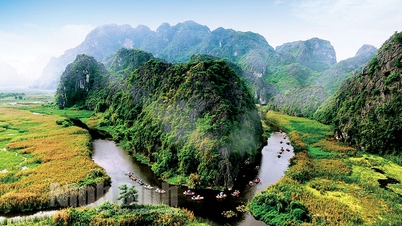
I was breathless when I finally reached the abandoned hut perched precariously on the mountain. Strangely, unlike what I had imagined, Bai Cao was a patch of land atop a towering mountain called Coc Mountain. Coc Mountain. Yes, the name of an ugly but tenacious creature. Even stranger, Bai Coc was devoid of bushes, covered only in soft, pale yellow grass, but scattered among it were many strangely shaped rocks, some looking hideous like monsters. Several rocks tilted precariously as if about to fall. A few hollow, distorted boulders formed archways. And then there was a smooth, pointed rock, like an arrowhead, standing upright. Unlike the summit, the area around the mountain was densely covered with acacia trees, while further down were fruit trees. In the distance, I could hear the chirping of birds and the murmur of flowing water. At the foot of the mountain was the Sai village of the Nung people, with over twenty houses. I had rested at a family's house before ascending this mountain.
 |
Illustration: China. |
The hut was built like a stilt house next to a wild tree, with a ladder leading up and down. The walls were made of bamboo panels. The floor was made of planks of wood joined together. A metal bar hung dangling from the doorstep. I didn't understand the purpose of this hut here. I had learned about its owner from someone in the village.
Through the sparse trees ahead, I caught a glimpse of a figure slowly approaching. It must be Old Man Vuot, the owner of this hut? He gradually came closer. He was a thin, frail old man with white hair, carrying a woven bag, wearing an indigo shirt, blue trousers, and cloth shoes.
I went down the steps to greet him. He looked at me indifferently, only nodding slightly when I politely greeted him, then silently went up to the village. "Coming up here to admire the scenery?" he asked, absentmindedly glancing at the camera I had on my backpack. "It's beautiful, take lots of pictures," he said, opening his cloth bag and pulling out a bottle of wine and a bottle of water.
- Are you from around here, sir/madam?
No. Down south
- Yes, which province?
- Thai Binh . I live in the district of…
As he spoke, the old man paused, pointing downwards towards the edge of the village where a group of soldiers with backpacks and rifles were marching. He sighed softly and bowed his head.
- Was he also a soldier fighting against the Americans?
"Yes," he said, pouring me two glasses of wine and offering them to me. "It's good wine." He lifted his glass, then put it down again, lost in thought. "It's so sad, let's not talk about it anymore."
I was intrigued by that statement. "Don't mention it again." Could it be about the war against America? Surely he had some hidden sorrow weighing on his heart.
After a moment of silence, the old man said softly:
- Here's the story...
So instead of going for a stroll and sightseeing at Bai Cao beach, I listened to the old man's story…
*
* *
More than fifty years ago, young Sang – who is now Mr. Vuot – carried a backpack full of stones, his AK rifle dangling sometimes across his chest, sometimes on his shoulder, marching through streams and along mountain slopes during his basic training in a highland area like this Coc Mountain.
On the day he saw his son off to join the army, Mr. Sung affectionately said:
- Once you've set out, you must complete your mission, living up to the traditions of your family and hometown. Remember that.
Sang grinned broadly and shouted loudly:
- Don't worry, Dad, when I go, I'll either end up buried in the ground or with my chest burned with blood.
- There's no such thing as green grass, only red chest.
Mr. Sung was a soldier from the anti-French resistance, having participated in the Border Campaign and the Dien Bien Phu Campaign . After his discharge, he was the head of the commune's militia and a few years later became the Chairman of the Committee, and is currently the Party Secretary of the commune. Mrs. Hoa stood behind her husband, her eyes filled with tears, which annoyed him.
Sang spent three years on the battlefield, from the Central Highlands to Quang Da, and several times he thought he was going to die. The letters he sent home became fewer and fewer, then disappeared completely. What haunted Sang for years on the front was witnessing a comrade die right beside him. That was Dong, nineteen years old, with a youthful face, the most mischievous in the platoon, who was hit by a bomb. That day, Sang and Dong were in the same trench during an enemy ambush. Sang was sitting there when he received orders to go see the company commander. He went for a while, then enemy planes dropped bombs. When he returned, he saw Dong's body in front of him. Then there was Le, with a face full of scars, frail limbs, quick as a squirrel, who shared the same bunker with Sang. Another artillery barrage and a series of enemy bombs, the bunker was dug up, the earth collapsed. The enemy soldiers swarmed in. Le and Sang were dragged out and led to a place. A soldier pointed his gun at Le and demanded to immediately reveal the unit lying in ambush. Le glared and shook his head. Immediately, the soldier fired. Le fell right next to Sang.
"And what about this guy? Is he going to say anything?" The soldier with the gun raised his chin and looked at Sang.
- I... I... - Sang stammered - I... I...
Shortly afterwards, he was taken to Saigon by the enemy.
Five months after the liberation of Saigon, he quietly returned to his hometown after completing his non-custodial re-education sentence imposed by the City Military Administration Committee. He felt a mix of excitement, joy, and worry. Upon reaching the beginning of the village, he encountered a couple of acquaintances.
- Sang just got back, right?
- I thought…
- What kind of soldiers are these? They're so fat and fair-skinned, unlike Tuong and Vinh.
- But someone reported...
Strange. Indifferent, ambiguous remarks. Inquisitive, suspicious glances. Absolutely no warmth, attentiveness, friendliness, or joy. Could it be…?
His mother, seemingly having been tipped off beforehand, rushed out of the house as soon as he reached the yard. "Oh my God, my son..."
She burst into tears. His father remained seated silently in the house.
- Dad. Sang's voice choked up.
Mr. Sung gave his son a cold look, nodded slightly, and then silently went inside the house…
Old Man Vuot paused his story, sipped the wine in his hand, and looked towards the staircase. His aged eyes seemed to gaze into some distant realm. His face now looked even more haggard. At only seventy-six years old, he looked like someone over eighty.
“Until the day I die, I will never forget my father’s eyes that day. Many nights, those eyes floated before me, staring at me, sending chills down my spine. The day my father died, I knelt before his picture, weeping and begging for his forgiveness. Yes, I was a wretched son, a disgrace, a traitor, a filthy wretch…” – The old man’s voice trailed off, fading like a gentle breeze. For days I lived in isolation at home, not daring to leave the village. It felt like a mountain weighed on my chest. That invisible mountain haunted me day and night. I suddenly became withdrawn, lonely, and increasingly depressed. You don’t know, and you don’t understand. People came to my house and told me, and then someone else told my mother. It was so humiliating, you know.
- My father is the Party Secretary, and I'm a former defector soldier.
Mr. Sung is no longer the Party Secretary.
- Well, when he left, he was the Party Secretary anyway.
- These women, now they call Sang a soldier, a liberation soldier, or a puppet soldier.
- Our village is a model resistance village, with a military hero and two outstanding soldiers in the entire army, yet we have this traitor, this disloyal person.
- Mr. Sung has stopped bragging now.
Sang must be really rich…
Old Man Vuot looked at me sadly, drained his glass of wine, his face expressionless.
It's true that Sang was recruited by the enemy into the Ministry of Civil Affairs and re-education after being subjected to various verification methods. He only did odd jobs there for about a month, and then they almost ignored him because they were in a state of frantic chaos after our troops liberated Da Nang and advanced en masse towards Saigon.
That's all I really knew, but the villagers and people in the commune understood it differently. It was because Linh, who was in the same unit as me, returned to his hometown and fabricated stories, claiming that I was on a helicopter calling on communist soldiers to join the national cause, that I pointed out the location of the regiment's encampment, and all sorts of other things I couldn't possibly have known. Sadly, Linh had already moved south with his wife and children before I returned home. He also recently passed away…
“I was in a deadlock, even though later on the villagers didn't pay attention to my problems. Only I tormented myself. But one day…” Yes, that day Sang had business in town. He met a bicycle repair shop owner who was a severely disabled war veteran, having lost a leg and an arm. His wife had a limp and was as thin as a dried fish. He had to raise two young children. Despite their difficult living conditions, he was very cheerful and joking, much to Sang's surprise.
Everyone has their own hardships after the war, but they must learn to overcome them. What distinguishes people is their willpower.
"You must learn to overcome obstacles." That sentence suddenly awakened Sang's long-dormant mind. Yes, overcome, you must overcome. Suddenly, he thought about the future…
He went to the commune committee to meet his uncle, who was the committee secretary…
- Uncle, please let me change my name. It's not Sang anymore, but Vuot.
- Oh dear, why choose such an ugly name? "Sang" means wealth, prosperity, or luxury, but what does "Vuot" mean?
Change your tone to a firm one.
- I want to overcome my pain:
The Commissioner stared intently at his unfortunate grandson.
- Well, I'll go along with your suggestion. Actually, the commune doesn't have the authority to handle this; it has to go through the district.
However, in the documents, the Commissioner still carefully wrote: Le Van Vuot (formerly Sang). So Sang quietly relinquished his house and land to his younger brother and moved to a remote district in the province. That was in mid-1980. He had inquired with many market vendors in Thach An district and, after much searching, finally decided to settle in Tu Son commune, the furthest from the district capital, with only about a thousand inhabitants, mostly Nung and Dao people scattered across nine villages. The Nung Chairman of the commune committee was surprised to see a young Kinh man requesting to settle in this remote place. After painstakingly reading the documents and asking a few questions, he calmly said:
- Are you really there?
- Really?
- How long has it been?
I'll stay until I die.
"Oh dear, about fifteen years ago, there were five or seven families from the lowlands who came up here, but they only stayed for a few years before leaving again. This village is very poor. Why don't you stay in one of the villages further up near the district?"
I like places far away.
Sang spoke truthfully. He wanted to escape the hustle and bustle and go to a secluded, quiet place to find peace of mind, without letting anyone know about his past mistakes. He wanted to overcome the mountain that weighed heavily on his heart. Tu Son was surrounded by mountains that were almost completely barren due to deforestation by people from all over. In those days, people everywhere were poor. The forest was their daily source of livelihood. Sang chose the village of Say at the foot of Mount Coc, and before long he found a wife he liked in the village. A beautiful and virtuous Nung girl.
"There are so many acacia trees here, more than on the other side," I said.
"Well, it was completely bare before, just a few wild bushes. I thought we should put some trees on it. At that time, the district launched a campaign to plant acacia trees, providing both seedlings and some money. I accepted the offer and told everyone in the village to follow suit, but they didn't listen. So it was just my wife and I. We planted a little each year, and after five years, we had a lot. Seeing this, the villagers gradually followed suit. It was also because the acacia trees could be sold, providing money after a few years of planting. The trees grew densely into a forest, and suddenly the stream, which had been dry for years, had water flowing down to the fields even in winter."
- The old man got rich because of his stinginess.
- That's quite a lot of money. More than half of the mountain on this side is owned by me. I'm not rich, though. I only spend a little money on myself and donate the rest to the commune to build a primary school. For many years, I've sent money back home for the commune to renovate the martyrs' cemetery and rebuild the health station. Both of my daughters work in the district and have enough to eat and wear. My wife and I don't have to worry about anything.
- Does your grandfather often go back to his hometown?
- I usually go back every year, and whenever I do, I always visit the martyrs' cemetery to light incense and bow my head in apology.
He turned to me and whispered:
You know what? I've finally overcome a mountain I've been carrying inside me for so long. What mountain? You already know, so why ask?
The old man wearily stood up and looked up at Bai Cao beach. I came up behind him.
- The old man built this hut both to rest and to enjoy the view…
He interrupted:
"It's also about watching the trees, the flowing water, and the birds. For over a year now, some people from somewhere have come here to illegally cut down trees, hunt birds, and even geckos. I've also released a few geckos to give to the disabled veterans in the village when I go back home. If anything bad happens in this mountain, I'll ring the bell. According to custom, some villagers will come up," the old man said cheerfully, patting my shoulder. "Have you gone to see the stream in the middle of the mountain? The water is very clear and cool. However, sometimes the water is blocked by fallen branches and leaves. I'll go take a look."
I slung my backpack over my shoulder. Mr. Vung busied himself putting a few cups and two plastic bottles into a cloth bag.
My grandfather and I strolled down the stairs. Just then, a group of people eagerly looked up from the foot of the mountain. They were probably a tour group.
Short stories by Do Nhat Minh
(BGĐT) - Thịnh sat down on the ground, grabbing his straw hat and fanning himself. Sweat dripped in streaks down his tanned face. The curly hair at his forehead matted into a question mark shape.

(BGĐT) - It's almost six o'clock in the evening, but it's still incredibly hot and humid. The air is stifling and uncomfortable! It looks like a storm is coming. It's been almost a month since the heavens gave us a single drop of rain.
Source link


![[Photo] Prime Minister Pham Minh Chinh attends the Conference on the Implementation of Tasks for 2026 of Vietnam Television.](/_next/image?url=https%3A%2F%2Fvphoto.vietnam.vn%2Fthumb%2F1200x675%2Fvietnam%2Fresource%2FIMAGE%2F2026%2F01%2F10%2F1768047311329_ndo_br_dsc-3214-jpg.webp&w=3840&q=75)





























![[Infographics] Resolution No. 79-NQ/TW of the Politburo on the development of the state-owned economy](https://vphoto.vietnam.vn/thumb/402x226/vietnam/resource/IMAGE/2026/01/10/1768038914679_chp_3-11-23.jpeg)































Comment (0)