

Vo Tran Tuan Kiet, a pomelo farmer in Luong Quan village, Thuy Bieu ward ( Hue City, Thua Thien Hue province), could not hide his sadness as this pomelo harvest suffered an unprecedentedly large loss in yield and production.
Having lived along the Perfume River for many years, Mr. Kiet's family's livelihood mainly depends on their pomelo orchard. All living expenses, raising children, and building a house come from the income and savings accumulated from successful pomelo harvests.
Mr. Kiet's family has rarely experienced severe crop failures in their more than 100 pomelo trees. There have been crop failures, but none have been as devastating as this pomelo crop.
His family, like many other households, grows 100 or more trees, yielding 3-5 tons of marketable fruit in many harvests. In 2023 alone, many households harvested an average of 3 tons per 100 trees. However, this year's pomelo yield has dropped unusually low, to only 4-5 quintals per 100 trees.
While in previous years, pomelo trees yielded an average income of 150-200 million VND/ha, this season the income is only a few tens of millions of VND.
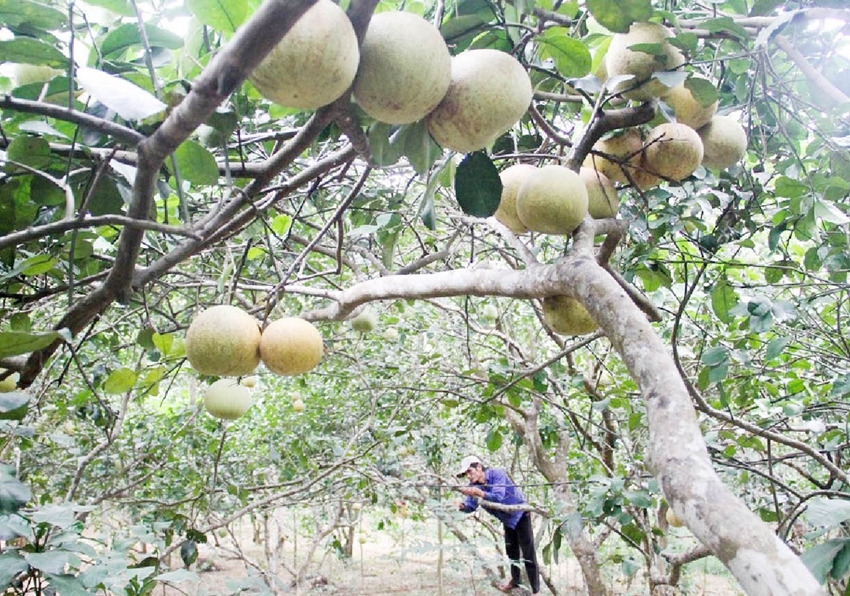
One of the few pomelo orchards bearing fruit in Thuy Bieu ward, Hue City, Thua Thien Hue province.
This meager income is only enough to buy fertilizer, pesticides, and labor costs for tending the orchards for the next season. To date, the people do not know the specific reason for the poor pomelo crop, but initial assessments suggest it is due to unusual weather patterns and prolonged periods of intense heat.
The poor pomelo harvest is a cause for concern for the people of Thuy Bieu in particular and the entire province in general. Losing income from pomelo means losing a source of livelihood for many households specializing in growing this specialty crop.
Mr. Kiet affirmed that the severe damage to the pomelo crop would greatly affect the lives of his family as well as the local people. With no other option, Mr. Kiet's family and the villagers are tending to and fertilizing their orchards in the hope that the next pomelo harvest will be bountiful, compensating for this loss.
Blessed with alluvial soil deposited annually by the Perfume River, the lands in many localities along this river are suitable for the growth of various fruit trees, yielding high productivity and economic efficiency, especially the pomelo tree. In Thuy Bieu ward alone, there are more than 120 hectares of pomelo trees.
Thanh Tra tea has long been a key economic crop in Thuy Bieu and many other localities along the Perfume River, Bo River, and O Lau River.
According to Mr. Vo Ba Binh, Vice Chairman of the People's Committee of Thuy Bieu Ward, in previous seasons, almost every pomelo harvest in Thuy Bieu Ward averaged 600-700 tons, generating an income of around 20 billion VND.
However, this year's pomelo harvest yielded only about 100 tons, considered the most unsuccessful harvest ever. Many orchards had almost no fruit, or very little fruit. The yield and production of pomelo this season were only 15-20% compared to the previous season.
Local authorities and the agricultural sector initially determined the cause to be the complex and erratic weather conditions, which resulted in a very low rate of flowering and fruiting. Despite farmers employing countermeasures, many orchards experienced fruit drop shortly after fruiting.
According to Mr. Vo Ba Binh, with the current complex weather conditions, there is no other way than to organize propaganda, mobilization, and guidance for people to implement comprehensive measures for caring for, fertilizing, and improving orchards so that the next crop can achieve high yields and production.
Mr. Ho Dinh, Head of the Department of Crop Production and Plant Protection of Thua Thien Hue province, affirmed that this is a province-wide crop failure in pomelo cultivation, not just in Thuy Bieu but also in many other localities in the province.
Besides the unpredictable weather patterns, several dangerous pests and diseases are damaging crops, such as gumming disease, sooty mold, and other harmful organisms like stem borers and citrus greening.
The Sub-Department is coordinating with local authorities to guide people in strengthening plant care, applying balanced fertilizers, and increasing the use of well-rotted manure to help plants grow and develop healthily, and resist pests and diseases. Of particular note is the management and control of gumming disease, and continued monitoring of other harmful organisms to implement timely management and control measures.
Source: https://danviet.vn/vuon-thanh-tra-qua-dac-san-o-tp-hue-nguoc-mat-len-thay-trai-lua-thua-co-cay-toan-la-that-thu-20240623010550176.htm















































































Comment (0)