

Still waiting for instructions right before the "D-Day"
Excited to send information to partners and create products suitable for the new policy to offer for the peak season at the end of this year and next year, immediately after the National Assembly passed the policy extending visa-free stays in June, Mr. Tran The Dung, General Director of Vietluxtour Travel, said that even close to the "deadline," companies were still unclear which countries would be included in the 90-day visa extension; which countries would be granted a 45-day temporary stay; whether only those applying for e-visas would be eligible for the 90-day visa or if those applying for tour visas through consulates would also be included; whether the list of countries with unilateral visa exemptions would continue to be expanded, and if so, which markets would be added…
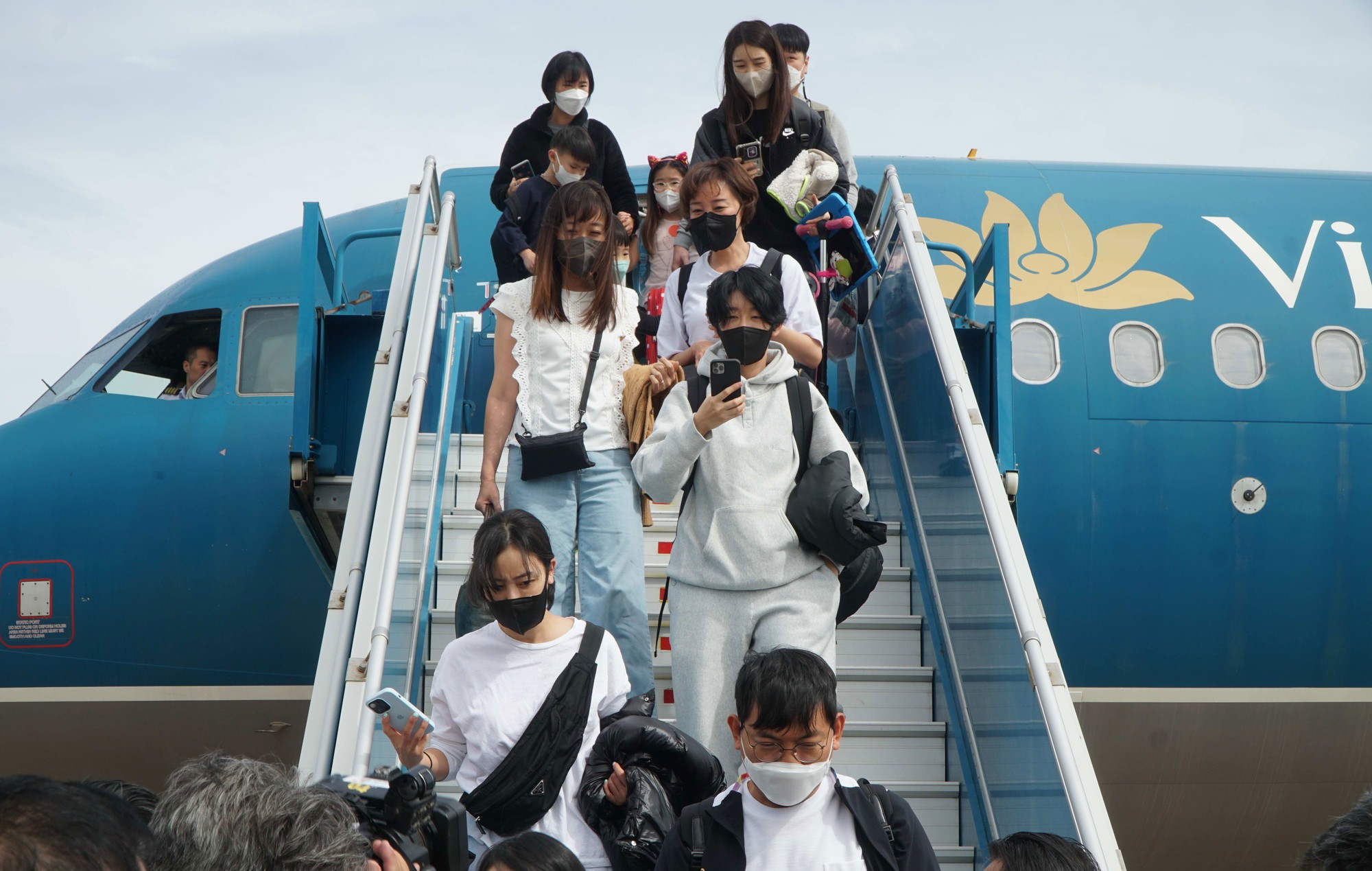
International tourists arrive at Cam Ranh Airport, Khanh Hoa.
"We need detailed and specific guidelines before we can promote and sell our products to customers. Initially, we've identified the target market: tourists staying for more than 14 or 30 days, mostly from Europe, Australia, and the US. These markets usually plan their trips very early. If we receive information in June, travel companies can start developing new, longer tour programs, contacting airlines, booking services, etc., which takes about 3-4 months. At the earliest, the new policies won't really take effect until October or November. Now it's already the second half of August, and the longer it drags on, the more opportunities will be missed," said Mr. Tran The Dung.
Similarly, Vietnam Tourism Company also sent information to its partners very early so that they could proactively prepare the appropriate steps when the new visa policy is applied. However, a representative of the company said that the company has not yet been able to finalize the tour group as planned because there has been no official announcement and guidance from the Ministry of Culture, Sports and Tourism. The procedures must be completed before tour prices can be determined, and partners also have to wait for detailed instructions to know what procedures they need to follow.
While awaiting official information from authorities regarding the details of the e-visa registration procedure for customers, Mr. Nguyen Thien Phuc, Product Director of Vidotour Indochina Travel, stated that although only a general policy has been sent out, Vidotour has already received many positive signals from its partners. Mainly organizing tours for group travelers from 13 European countries that have been granted unilateral visa exemptions, Vidotour's partners have requested adjustments to their tours, extending them from a maximum of 14-15 days to an average of 21 days. Most customers want to dedicate more time to beach activities and restructure their Indochina travel programs with more generous durations.
"Previously, tourists coming to Vietnam who wanted to go to Laos or Cambodia had to leave immediately and couldn't return. French tourists were the most 'unfortunate' because finding international flights back to France from Laos was very difficult. With the new policy, they can travel from Vietnam to Laos, then return to Hanoi for another 1-2 nights, and fly back more easily, so they really like it," Mr. Phuc cited as an example. However, the Vidotour leader also predicted that the new visa policy would only truly create a breakthrough in the number of international tourists by the second quarter of 2024, as tour groups have already finalized their travel plans for the period from now until the first quarter of 2024.
According to the Vietnam National Tourism Administration, the guidelines for the new visa policy have been specifically issued in Article 2 of the Law on Entry, Exit, Transit, and Residence of Foreigners in Vietnam. This morning (August 15), the Ministry of Culture, Sports and Tourism will hold a conference to disseminate and explain the application of the new policy to local tourism departments and relevant state management agencies.
Once you've welcomed guests, what do you do to keep them coming back?
According to Mr. Nguyen Thien Phuc, not only has the visa policy eased, but it has also provided an opportunity for Vietnam's tourism industry to restructure its product system and improve the quality of tourism growth.
For example, there are currently traditional tourism product lines such as beach and island tourism, ecotourism, etc., but due to limitations on the length of stay, tourism businesses cannot fully promote them. A 14-day tour can only include 2 nights at the beach. However, with current policies, it is possible to diversify product lines, creating 5-6 day beach programs, taking tourists from Ho Chi Minh City to Long Hai or Phu Quoc. The system of restaurants, hotels, and destinations will benefit more. Simultaneously, more new products can be developed depending on the target customer group. Tourists who like to explore local culture, previously, if they spent 2 nights in Hoi An, they could only spend 1 night in Hue, or vice versa. Now, they can stay in both places for 2-3 nights.
Instead of worrying about rushing to catch flights as before, travelers can now travel across Vietnam by train without being cut off at mid-journey destinations like Nha Trang and Quy Nhon. Destinations previously inconvenient for air travel, such as the Central Highlands provinces, will now have more opportunities for tour development as travelers will have more time to explore more places. With this approach, visa policies encourage longer stays, leading to higher spending, and many localities that were not previously major tourist centers will have the opportunity to unlock their potential and develop more strongly.
"However, it should be noted that the new visa policy will create opportunities for visitors to Vietnam to visit many places and explore many aspects in one trip, which means new pressure to encourage repeat visits. Therefore, the tourism industry needs to focus on product development, always offering new and attractive programs and products. At the same time, it is necessary to improve the linkages between elements in the tourism ecosystem, from travel agencies to transportation (including air, rail, road, and water), accommodation, restaurants, etc., to create good value packages and increase the competitiveness of destinations," Mr. Nguyen Thien Phuc emphasized.
The director of Nam Phuong Tourism Company, Ly Viet Cuong, also affirmed that consistency is extremely important in the tourism development strategy. We open our doors to welcome tourists and create conditions for them to stay for longer periods, but there must be "something" to offer for tourists to stay and spend money. Nam Phuong's customers are mainly from the US, Australia, New Zealand, etc., and they are no longer unfamiliar with the open visa policies of tourist countries.
Therefore, they weren't overly enthusiastic or surprised by Vietnam's new visa policy. On the contrary, what customers were interested in was what new and attractive destinations Vietnam now has, what unique products are available, and whether you can guarantee enough places to visit and spend money to sustain their extended stay. Simply suggesting more destinations and using Ho Chi Minh City as the center would be like combining two or three tours, which wouldn't be appealing enough.
"For example, previously, tourists would stay in Ho Chi Minh City for 3 days, visiting 5 tourist attractions and 5 shopping destinations. Now, if we extend the tour to 5 days, what will they do or where will they go on the remaining 2 days? We are only offering existing products. We need to diversify or expand. For example, the river tour, which used to be completed in one day, should now include more destinations and activities over 1-2 days; or we should create shopping areas and high-quality entertainment products to encourage tourists to spend more money… Only then will tourism improve in quality and visa policies truly be effective," Mr. Ly Viet Cuong suggested.
From August 15th, the temporary stay period for citizens of 13 countries will be extended to 45 days.
The government has just issued Resolution No. 128/NQ-CP dated August 14, amending Resolution No. 32/NQ-CP on visa exemption for citizens of certain countries. Accordingly, visa exemption will be granted to citizens of the following countries: Germany, France, Italy, Spain, the United Kingdom and Northern Ireland, Russia, Japan, South Korea, Denmark, Sweden, Norway, Finland, and Belarus, with a temporary stay period of 45 days from the date of entry, regardless of passport type or purpose of entry, provided they meet all entry requirements. Previously, the National Assembly passed a law amending and supplementing several articles of the Law on Exit and Entry of Vietnamese Citizens and the Law on Entry, Exit, Transit, and Residence of Foreigners in Vietnam. Accordingly, the temporary stay period for citizens of countries unilaterally exempted from visa requirements by Vietnam has been extended to 45 days, an increase of 30 days compared to the previous regulation.
Mai Ha
Source link

![[Photo] General Secretary To Lam receives President of the European Council Antonio Costa](/_next/image?url=https%3A%2F%2Fvphoto.vietnam.vn%2Fthumb%2F1200x675%2Fvietnam%2Fresource%2FIMAGE%2F2026%2F01%2F29%2F1769697816651_a1-bnd-5216-9741-jpg.webp&w=3840&q=75)


![OCOP during Tet season: [Part 3] Ultra-thin rice paper takes off.](/_next/image?url=https%3A%2F%2Fvphoto.vietnam.vn%2Fthumb%2F402x226%2Fvietnam%2Fresource%2FIMAGE%2F2026%2F01%2F28%2F1769562783429_004-194121_651-081010.jpeg&w=3840&q=75)


![OCOP during Tet season: [Part 2] Hoa Thanh incense village glows red.](/_next/image?url=https%3A%2F%2Fvphoto.vietnam.vn%2Fthumb%2F402x226%2Fvietnam%2Fresource%2FIMAGE%2F2026%2F01%2F27%2F1769480573807_505139049_683408031333867_2820052735775418136_n-180643_808-092229.jpeg&w=3840&q=75)
![OCOP during Tet season: [Part 1] Ba Den custard apples in their 'golden season'](/_next/image?url=https%3A%2F%2Fvphoto.vietnam.vn%2Fthumb%2F402x226%2Fvietnam%2Fresource%2FIMAGE%2F2026%2F01%2F26%2F1769417540049_03-174213_554-154843.jpeg&w=3840&q=75)



Comment (0)