

STEM education is an interdisciplinary teaching concept that combines the arts with traditional STEM subjects (science, technology, engineering, and mathematics). It is considered a key area requiring priority attention, with a training scale reaching 35%.
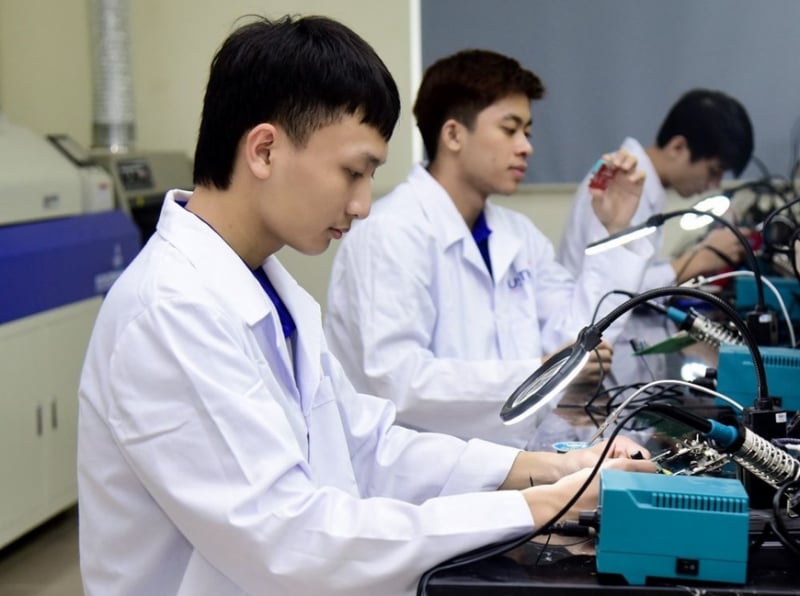
The plan sets the goal of developing a synchronized and modern network of higher education and teacher training institutions by 2030, with a rational scale, structure, and distribution; establishing an open, fair, equitable, high-quality, and efficient higher education system; and better meeting the learning needs of the people and the requirements for national development to achieve breakthroughs and prosperity in the new era, based on high-quality human resources, science, technology, and innovation. Specifically, the target is to have over 3 million learners, with 260 undergraduates and 23 postgraduate students per 10,000 people; the percentage of people aged 18-22 with a university education rate of 33%, with no province having a rate lower than 15%. The structure of training levels will be in line with the requirements of developing a knowledge-based economy and modern industry. The proportion of master's degree training (and equivalent qualifications) reached 7.2%, doctoral training reached 0.8%, and teacher training at the college level reached 1%; the proportion of STEM training reached 35%. With a network of schools training in STEM fields, the plan aims to develop a network with over 1 million learners, of which approximately 7% will be at the master's level (and equivalent qualifications) and 1% at the doctoral level. The State focuses on investing in upgrading and developing 5 leading public higher education institutions with top-tier capacity and prestige in training and research in key and cutting-edge engineering and technology fields. The goal is to help these universities become national key educational institutions in engineering and technology, with quality and prestige on par with the region, with Hanoi University of Science and Technology being ranked among the leading higher education institutions in Asia…
Sharing his views on this matter, Deputy Minister of Education and Training Hoang Minh Son stated: The reason for focusing on STEM fields alongside teacher training and health-related fields stems from the Party and State's policy. Recently, the Party and State have consistently emphasized science, technology, and innovation as the driving force for development. Therefore, STEM training programs are prioritized and considered key areas in the planning process.
According to Deputy Minister Hoang Minh Son, besides key sectors, there are also key higher education institutions. When drafting the plan, some suggested that criteria should be included to designate universities as key institutions. However, this would make selection difficult, and time is running out. Therefore, the plan has selected a number of universities for priority investment. The criteria for selection are reputation and quality in relevant fields. The plan does not list key universities across all sectors, but only at the national, regional, STEM, and teacher training levels. For the health sector, the plan only requires the selection of 3-5 key universities; the Ministry of Health will choose which ones and develop development plans. Other sectors will be selected and invested in by the relevant ministries…
Many also believe that planning to increase the proportion of STEM education in the country plays a crucial and decisive role in the development of society and the nation in the current era of rapidly developing Industry 4.0. This creates a high-quality workforce in engineering and technology to meet the requirements of national development as outlined in Resolution No. 57-NQ/TW of the Politburo on breakthroughs in science, technology, innovation, and national digital transformation. Through STEM fields of study, learners have the opportunity to apply interdisciplinary knowledge and integrated skills to practical situations to solve problems in modern technology.
According to Associate Professor Dr. Le Dinh Hai, Deputy Head of the Faculty of Economics and Development, University of Economics, Vietnam National University, Hanoi, STEM fields provide a highly capable workforce capable of solving complex problems in science, technology, environment, and society. As the scale of training in these fields expands, society will have a sufficient workforce of skilled, creative, and innovative individuals, contributing to the country's development. STEM fields not only teach knowledge but also encourage critical thinking and creativity. Scientific research in these areas frequently yields breakthrough solutions, helping to address urgent issues such as climate change, epidemics, or the development of advanced technologies. STEM fields play a crucial role in industrial development and economic modernization. Advanced technology and engineering are the foundation for producing high-quality products, thereby creating significant added value for the economy and enhancing national competitiveness internationally.
Source: https://cand.com.vn/giao-duc/vi-sao-stem-duoc-quy-hoach-la-linh-vuc-trong-diem--i761328/
![[Photo] Prime Minister Pham Minh Chinh holds a phone call with the CEO of Russia's Rosatom Corporation.](/_next/image?url=https%3A%2F%2Fvphoto.vietnam.vn%2Fthumb%2F1200x675%2Fvietnam%2Fresource%2FIMAGE%2F2025%2F12%2F11%2F1765464552365_dsc-5295-jpg.webp&w=3840&q=75)


![[Photo] Closing Ceremony of the 10th Session of the 15th National Assembly](/_next/image?url=https%3A%2F%2Fvphoto.vietnam.vn%2Fthumb%2F1200x675%2Fvietnam%2Fresource%2FIMAGE%2F2025%2F12%2F11%2F1765448959967_image-1437-jpg.webp&w=3840&q=75)







































![[OFFICIAL] MISA GROUP ANNOUNCES ITS PIONEERING BRAND POSITIONING IN BUILDING AGENTIC AI FOR BUSINESSES, HOUSEHOLDS, AND THE GOVERNMENT](https://vphoto.vietnam.vn/thumb/402x226/vietnam/resource/IMAGE/2025/12/11/1765444754256_agentic-ai_postfb-scaled.png)












































Comment (0)