

 |
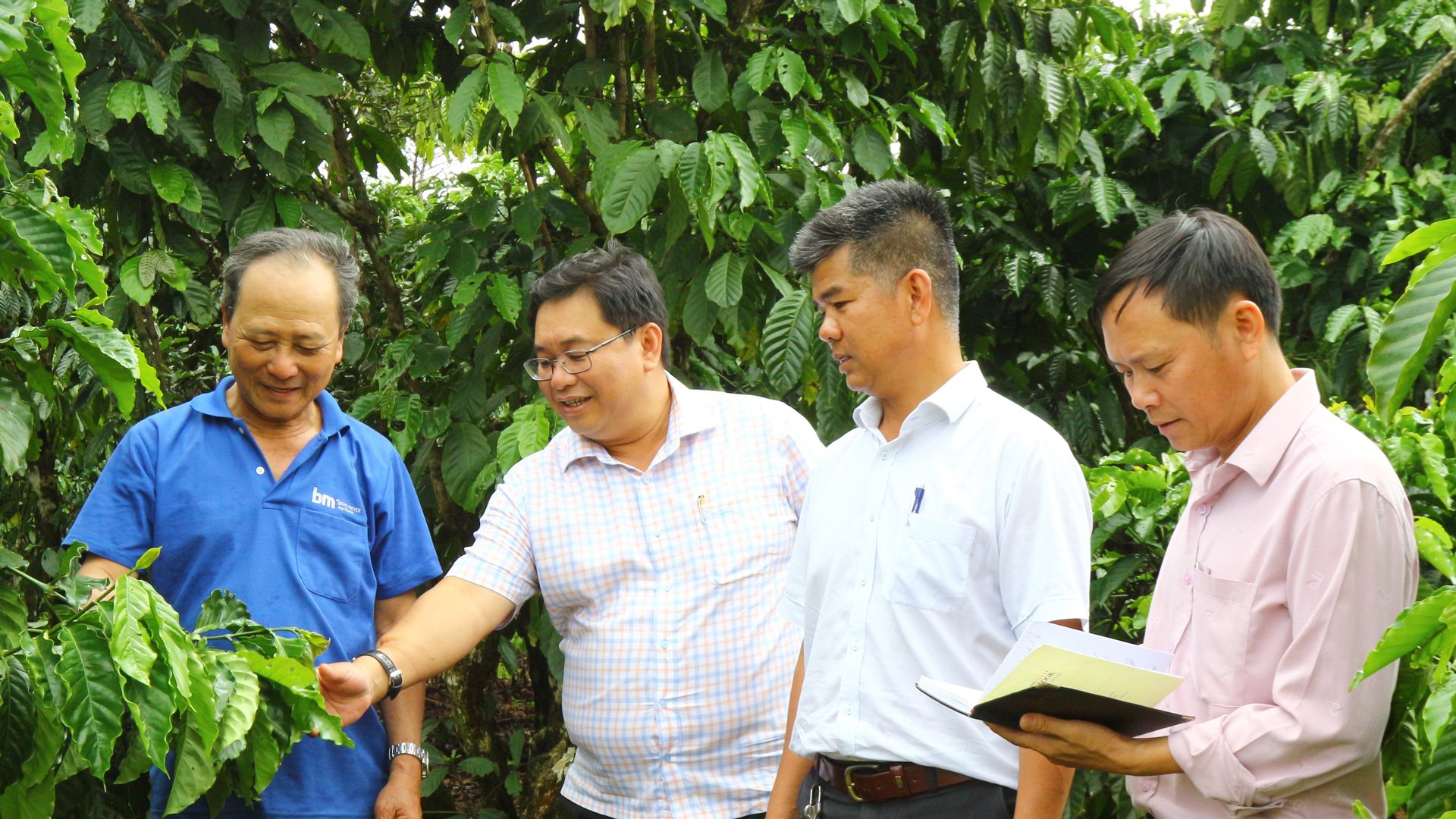
| A 300-hectare high-tech coffee production area in Loc Duc commune. |
• RECOGNIZING 300 HECTARES OF HIGH-TECH APPLICATION
Currently, the high-tech coffee production area has 3 cooperatives (HTXs): Loc Duc Organic Agricultural Production, Trade and Service Cooperative, Loc Duc Agricultural Service Cooperative, and Nong Duc Thinh Agricultural Cooperative, which purchase coffee, and 10 agents supplying fertilizers and pesticides to serve coffee production for the people. In addition, the Loc Duc Organic Agricultural Production, Trade and Service Cooperative has signed production and consumption contracts accounting for approximately 80% of the region's total output.
The coffee plantations in the commune consist of the main varieties: TR4, TS5, TS1, Thien Truong, and Huu Thien, purchased from qualified seed suppliers. These varieties are suitable for the local climate and soil conditions, have a competitive advantage in the market, and meet consumer preferences and demands. 100% of the coffee beans in the region meet quality, morphology, and packaging standards for use as raw materials for processing and export; 255 households cultivating 300 hectares of coffee have signed commitments to produce safe agricultural products. The average coffee yield in the region reaches 6-7.8 tons/ha, which is 79%-132% higher than the provincial average.
300 hectares of the region's production utilize mechanized land preparation and semi-automatic sprayers for pest and disease control; 86.6% of the area applies technologies in harvesting, sorting, preserving, and processing agricultural products. 120 hectares utilize sprinkler or drip irrigation systems, mist irrigation, or infiltration irrigation with automatic control equipment. 150 hectares use natural predators already present in the orchards, supplemented with microbial strains from microbial products to prevent pests and reduce damage caused by insects and diseases.
Mr. Bui Hoang Giang, Chairman of the People's Committee of Loc Duc commune, said that the commune's high-tech coffee production area was recognized on February 25, 2025. This serves as a foundation for farmers to aim for high-quality coffee production; investing in specialized cultivation in the direction of high-tech agriculture and clean coffee, to improve product quality. This is also an opportunity to elevate the local coffee product to domestic and international markets, bringing higher income to coffee growers.
As a successful farmer and businessman recognized by the Central Committee of the Vietnam Farmers' Association , Mr. Le Quang Linh, who currently cultivates 9 hectares of coffee in a high-tech coffee production zone, believes that participating in the zone brings many advantages to his family, especially access to and application of science and technology in production to enhance product value and protect the environment. Currently, his family has purchased a drone for spraying pesticides to care for the coffee plants.
• PROTECT THE ENVIRONMENT IN THE PRODUCTION AREA
In Loc Duc commune, Bao Lam district, a high-tech coffee production area, 50% of the annual crop is produced using biological pesticides to control existing natural enemies in the garden. This is supplemented with microbial strains from microbial products to prevent pests and reduce damage caused by diseases and pests, contributing to a 50% reduction in pesticide packaging waste.
Every year, the People's Committee of Loc Duc commune, together with the Youth Union, conducts propaganda, mobilization, and coordination with local people to collect, sort, and process waste according to regulations. Currently, 100% of used pesticide packaging waste is collected by households and returned to agricultural supply dealers and stores for collection and processing according to environmental regulations, aiming to minimize environmental pollution in the production area. 100% of farming households use well-rotted manure and properly clean their orchards before the next planting season, such as pruning, weeding, and general sanitation.
Approximately 250 hectares out of 300 hectares (83.3% of the region's area) are intercropped with high-value economic crops such as avocados, durians, and Laba bananas in coffee plantations to diversify crop structure, increase value per unit of cultivation, and provide shade for the coffee plants. Farmers are also guided to intercrop with trees like black acacia to create ground cover, protecting soil resources while providing shade for the coffee plants, acting as windbreaks, and preventing soil erosion. Solutions are being implemented to restore and expand coffee production areas, and to replicate sustainable landscape coffee production models. In addition, the commune People's Committee continues to promote and guide people in replanting and grafting coffee varieties on old, low-yielding coffee plantations, and to apply sustainable and efficient production processes.
In particular, in 2020, the Bao Lam District Agricultural Center invested in and built a model to support the installation of a microclimate monitoring sensor system in Loc Duc commune, Bao Lam district. The microclimate monitoring sensor system includes one independent weather monitoring station connected via 3G; three central receiving devices; and 20 wireless long-range soil moisture sensors. These devices will directly monitor the climate situation and report it to the central station for users to access. Additionally, 20 soil samples were collected for soil texture analysis. A smartphone application and website serve 100% of farming households in the area. The model includes the installation and operation of internet-controlled monitoring equipment, solar panels, automatic weather monitoring via the internet, and independent moisture measuring devices and weather stations.
A key feature of smart technology application models is that, through sensors, devices, and systems, environmental indicators are continuously collected and sent to microprocessors for forecasting and recommendations to farmers in the region. This helps farmers streamline production processes, improve quality, meet market demands, and gradually change farming practices to adapt to climate change.
With the decisive involvement and numerous support solutions from the government and farmers in innovating production methods, the development of high-tech coffee growing areas will contribute to improving the quality and value of coffee products in Loc Duc commune, meeting the requirements of domestic and international markets.
Source: https://baolamdong.vn/kinh-te/202504/ve-vung-ca-phe-cong-nghe-cao-dd94899/


![[Photo] General Secretary To Lam receives the Special Envoy of General Secretary and President of China Xi Jinping](/_next/image?url=https%3A%2F%2Fvphoto.vietnam.vn%2Fthumb%2F1200x675%2Fvietnam%2Fresource%2FIMAGE%2F2026%2F01%2F30%2F1769759383835_a1-bnd-5347-7855-jpg.webp&w=3840&q=75)


![OCOP during Tet season: [Part 3] Ultra-thin rice paper takes off.](/_next/image?url=https%3A%2F%2Fvphoto.vietnam.vn%2Fthumb%2F402x226%2Fvietnam%2Fresource%2FIMAGE%2F2026%2F01%2F28%2F1769562783429_004-194121_651-081010.jpeg&w=3840&q=75)

![OCOP during Tet season: [Part 2] Hoa Thanh incense village glows red.](/_next/image?url=https%3A%2F%2Fvphoto.vietnam.vn%2Fthumb%2F402x226%2Fvietnam%2Fresource%2FIMAGE%2F2026%2F01%2F27%2F1769480573807_505139049_683408031333867_2820052735775418136_n-180643_808-092229.jpeg&w=3840&q=75)



Comment (0)