

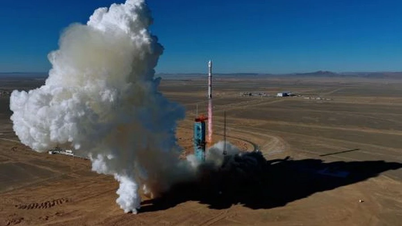
The reason is that the Epsilon-S launch vehicle failed during a test launch on November 26, 2024. Japan is considering whether to continue using the Epsilon-S after repairs or switch to a different type of rocket.
The Vietnam Space Center is coordinating with Japanese partners to determine a new launch date, ensuring the satellite operates stably after launch as soon as possible.
Associate Professor Pham Anh Tuan added that a team of Vietnamese engineers and experts was sent to Japan to monitor the entire process of designing, assembling, and testing the satellite in a simulated environment, from the launch phase to its operation in space.
|
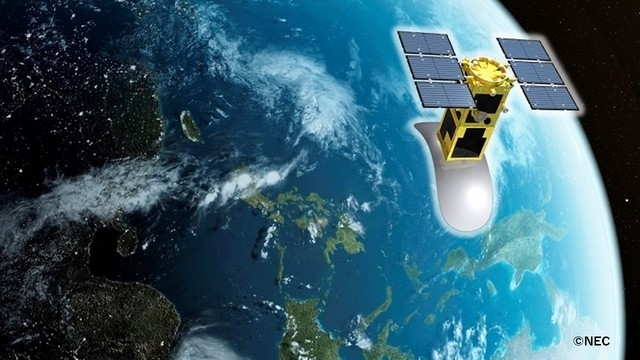
Simulated image of the LOTUSat-1 satellite. Photo: NEC |
In Vietnam, the ground system is built at the Hoa Lac High-Tech Park in Hanoi , including a 9.3-meter diameter ground antenna for signal reception, a satellite control and operation center, and a satellite data processing center. The Vietnam Space Center has received technology from Japan to operate this system.
Previously, the Vietnam Space Center and Sumitomo Corporation (Japan) signed a contract for the "LOTUSat-1 satellite, equipment and personnel training" package, part of the Vietnam Space Center Project. This is the first Earth observation satellite project coordinated by a Japanese company using ODA loan capital under the Special Terms for Economic Partnership (STEP) from the Japan International Cooperation Agency (JICA).
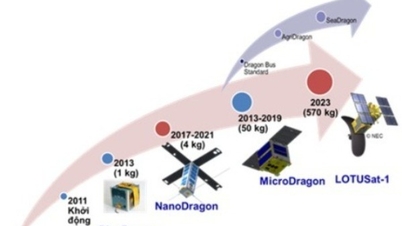
The LOTUSat-1 satellite weighs approximately 600kg and utilizes the latest radar technology, offering advantages such as detecting objects as small as 1 meter on the ground and the ability to observe both day and night. LOTUSat-1 can operate in all weather and climate conditions. This is particularly significant in Vietnam and Southeast Asia in general, given the tropical climate where most of the time is covered by clouds and fog.
Satellite imagery data will contribute to meeting the demand for image sources, providing accurate information to respond to and mitigate the impacts of natural disasters and climate change, manage natural resources, and monitor the environment...


![[Photo] Two flights successfully landed and took off at Long Thanh Airport.](/_next/image?url=https%3A%2F%2Fvphoto.vietnam.vn%2Fthumb%2F1200x675%2Fvietnam%2Fresource%2FIMAGE%2F2025%2F12%2F15%2F1765808718882_ndo_br_img-8897-resize-5807-jpg.webp&w=3840&q=75)



























































































Comment (0)