

Now, the people of Da Han village (Gia Hoa commune, Gia Vien district) can rest assured of a relatively prosperous life. Behind this peace of mind, however, remains the aspiration to get rich, the dream of awakening the potential of this rapidly transforming land...
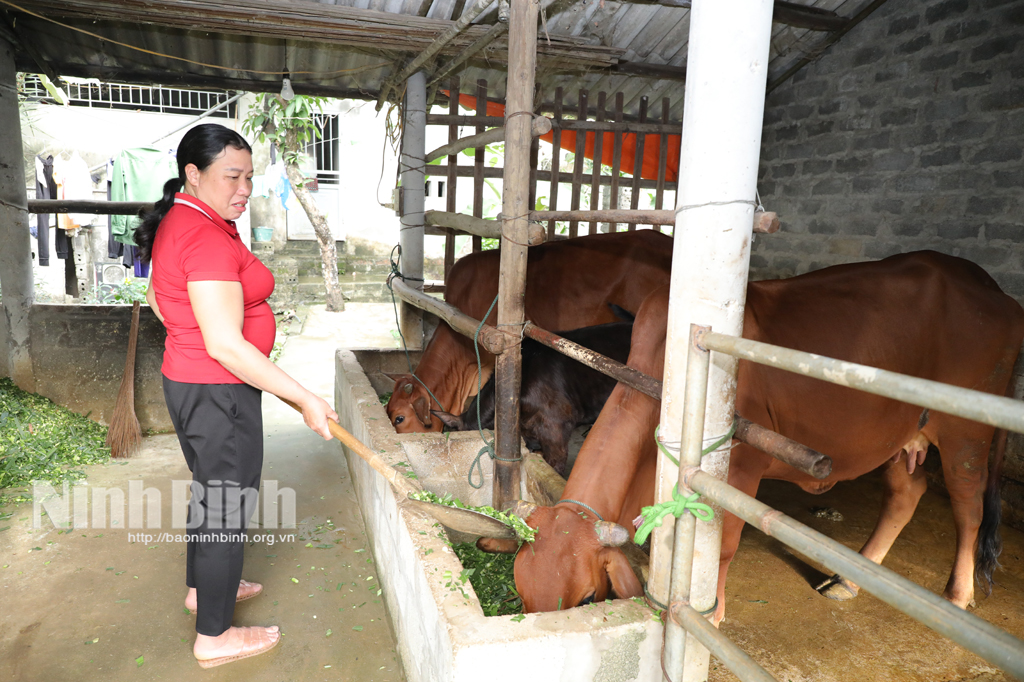
Welcoming us on a cold, rainy day, village head Dinh Van Hong said that with this weather, most villagers stay home, taking care of their livestock. Cattle don't need to graze as much as before because they are now mostly raised in barns. Elephant grass is grown right in the gardens, enough to feed the animals throughout the cold winter.
"In 1993, the Provincial People's Committee approved the plan to establish and develop the new Da Han economic zone in Gia Hoa commune, Gia Vien district. At that time, Da Han was barren, difficult land. I am also a resident of Gia Hoa commune, but I only came to Da Han to start a new life in 2000. Back then, the whole village only had a few dozen households, and some families couldn't bear the hardship and left to work elsewhere. Those who stayed, like me, were determined to conquer this difficult land. Being hardworking and diligent, we believed we could make a good living here," Mr. Hong recalled.
Owning a garden spanning over 3 acres, Mr. Hong's family diligently cultivated fruit trees, cassava, corn, papaya, and other crops to improve their livelihood and provide feed for their livestock. He initially raised pigs, then gradually transitioned to raising animals with higher economic value. In 2010, Mr. Hong proactively learned about and introduced porcupines – a completely new animal to raise in Da Han. From an initial 5 pairs of porcupines, Mr. Hong has now expanded his herd to hundreds of porcupines.
Leading us on a tour of his hedgehog enclosure, where about 200 animals were thriving, Mr. Hong explained that the COVID-19 pandemic had somewhat impacted hedgehog consumption. However, he added that raising hedgehogs remains a highly profitable economic activity, well-suited to the Da Han area. Hedgehogs are easy to raise, rarely get sick, and their food is readily available—even supplied at home.
In addition, Mr. Hong also raises wild boars and hundreds of free-range chickens... The income from livestock farming brings his family about 200 million VND per year. He helps many people in the village with breeding stock and experience to raise porcupines. Currently, the entire Da Han village has 6 households raising porcupines with a total of nearly 500 animals.
Village head Dinh Van Hong said that in Da Han, if you work hard and know how to do business, you don't have to worry about not having enough to eat and save. Near Mr. Hong's house is the family of Mr. Ta Van Long. Mr. Long's household has only recently escaped poverty. Even so, with the current economic development conditions, he and his wife are full of confidence that they can strive to become a well-off household in the village.
"I grow cassava on this garden land, both for sale and to supply my livestock. I also have a plot for growing vegetables to sell, to cover daily expenses; I also set aside land to grow elephant grass for livestock. In Da Han, if you work hard, you don't have to worry about hunger. Each season brings its own produce; the fields here are never idle. The driving force that helped my family escape poverty and rise above it all is our healthy herd of cattle. With the advantage of having barns, manpower, and a garden for growing grass, my family has developed a herd of nearly ten cows, " Mr. Long said enthusiastically.
Village head Dinh Van Hong happily stated: "In Da Han now, many large-scale livestock farming models are developing, yielding high economic efficiency. Many households are dynamic, creative, and boldly applying new models to production. A prime example is the earthworm farming model of Ms. Tran Thi Lan's family. Since Ms. Lan started raising earthworms, livestock waste in the village has become valuable, because she buys it to feed the worms. This provides a little extra income while also keeping the environment and landscape of the village clean. Therefore, everyone supports it, and many households have even started learning and following suit on a smaller scale."
Ms. Lan recounted that before starting her earthworm farming business, she spent a lot of time researching, learning, and conducting experiments with several households in Dong Anh district ( Hanoi ). After realizing this was the right direction, in 2015, she decided to return to her hometown to implement an earthworm farming model on over 4,000 square meters in Da Han village. Initially, her family invested over 300 million VND to buy 20 tons of earthworm breeding stock.
"When I started raising earthworms, I also thought about a closed-loop clean agricultural production chain. That means only a portion of the earthworms I raise will be sold to the market, while the majority will be used to feed my own family's livestock and crops. From there, I will provide a source of clean food to the market," Ms. Lan shared about her future plans.
Da Han village currently has 118 households with 420 inhabitants. Originally a remote village in the district, facing many difficulties in economic development, in recent years the villagers have turned these difficulties into advantages, utilizing natural conditions to strongly develop livestock farming.
The entire village currently has a professional association for raising porcupines and cattle in pens, with 25 participating households. By joining the club, people receive support in sharing experiences, marketing, breeding stock, capital, etc., thus the club has been very effective. From relying on experience and natural methods in livestock farming and cultivation, the people of Da Han have now strongly applied science and technology, introducing high-yield and efficient livestock and crops into production. Currently, the number of cattle raised in Da Han has reached over 200.
With its advantageous terrain and experience, the locality was also selected to implement a project supporting breeding cows for poor and near-poor households. The poor and near-poor have also taken advantage of this opportunity to improve their lives and achieve stability. While at the end of 2022, the village had 5 poor households and 7 near-poor households, according to the review conducted in November 2023, the village now has only 1 near-poor household and no poor households remaining.
Dao Hang - Minh Quang
Source

![[Photo] General Secretary To Lam working with Ambassadors and Heads of Vietnamese representative offices abroad attending the 14th National Congress of the Party](/_next/image?url=https%3A%2F%2Fvphoto.vietnam.vn%2Fthumb%2F1200x675%2Fvietnam%2Fresource%2FIMAGE%2F2026%2F01%2F25%2F1769334314499_image.jpeg&w=3840&q=75)




Comment (0)