


Researcher Bui Van Tieng, Chairman of the Da Nang City Historical Science Association, used the term "couplet" to refer to An Hai Citadel located on the right bank of the Han River in the "complete couplet" formed by Dien Hai Citadel on the left bank. An Hai Citadel still retains quite clear traces.
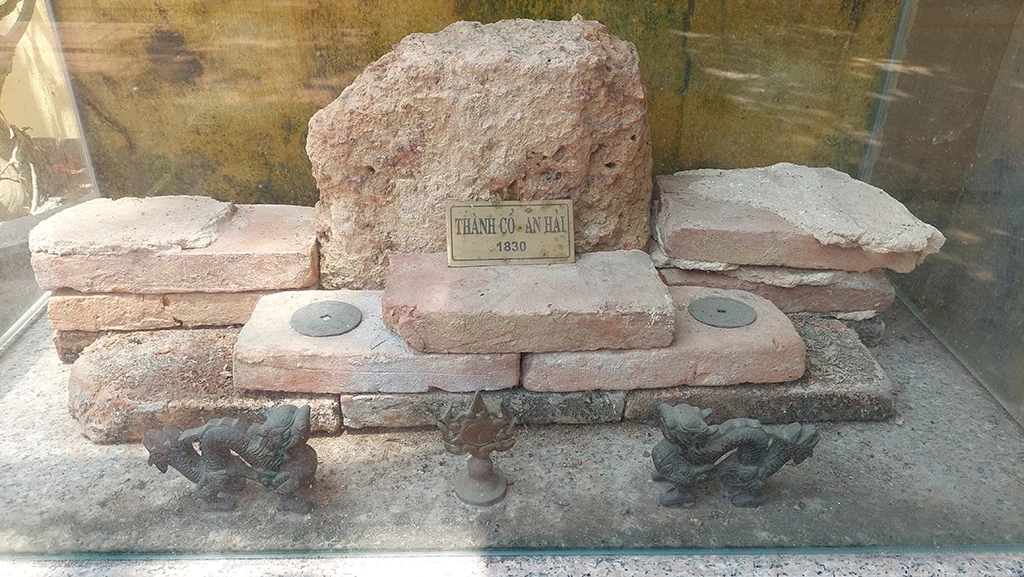
The bricks, stones, and ancient coins displayed at the temple of Lady Than Ha Xu (located in An Don coastal village) are believed to have originated from the An Hai citadel.
A TOP-RATED DEFENSE STRUCTURE
Researcher Nguyen Quang Trung Tien, former Head of the History Department at Hue University of Science, meticulously researched and compared documents to extract the locations of defensive structures along the Da Nang Bay perimeter based on a map from the Tu Duc dynasty confiscated by the French at the Quang Nam military headquarters (September 15, 1859). From this extract, Mr. Tien further numbered the structures from 1 to 17; in which the An Hai citadel was numbered 11, located almost symmetrically to the Dien Hai citadel on the left bank of the Han River.
According to this researcher, An Hai Fortress, located near the sea on the right bank of the Han River, was built of earth in 1813 and called An Hai Fortress; in 1830, it was converted to brick and renamed An Hai Tower; and in 1834, it was upgraded and renamed An Hai Fortress. An Hai Fortress was 1 trượng 2 thước high, surrounded by a moat 1 trượng deep, with a circumference of 41 trượng 2 thước, two gates, a flag tower, and 22 artillery emplacements. An Hai Fortress, along with Dien Hai Fortress, formed two of the most important military structures in the defense system of Da Nang's coastal port.
Mr. Bui Van Tieng analyzed that the name Dien Hai Citadel doesn't evoke any association with the geographical location where this ancient citadel was situated, but the name An Hai Citadel might suggest the village of An Hai (the birthplace of Thoai Ngoc Hau). Thus, An Hai Citadel was primarily located within the territory of An Hai village (according to the administrative boundaries of the year Quy Dau 1814, the 12th year of the Gia Long reign). Secondly, An Hai Citadel had a function that Dien Hai Citadel lacked: directly observing ships entering and leaving the Da Nang harbor, including: statistically recording the number of ships entering and leaving, classifying the nationality of each ship, and displaying this information on the flagpoles of the citadel.
"To achieve that, An Hai Fortress must be located near Da Nang Bay, at the confluence of the sea and the river, at least at the same latitude as Dien Hai Fortress. In the map of Da Nang's defense system during the Nguyen Dynasty , provided by researcher Vo Van Dat, An Hai Fortress is identified slightly towards Da Nang Bay compared to Dien Hai Fortress. This identification is correct," Mr. Tieng stated.
X DETERMINING RELATIVE POSITION
According to Mr. Bui Van Tieng, studies suggest that four years after the French-Spanish coalition withdrew from Da Nang (1860), An Hai Fortress was renamed An Hai Fort to reduce the burden on troops and equipment, and continued to be considered by the Nguyen Dynasty as an important defensive position in the Da Nang seaport defense system. So when did An Hai Fort disappear? To this day, this question remains unanswered.
Based on maps, relevant documents, and suggestions from researchers, we conducted a survey and attempted to locate the remains of An Hai Citadel after it had been obscured for the past 200 years. In Da Nang City, on the right bank of the Han River, near the estuary, there still exists a place called An Hai associated with three wards: An Hai Bac, An Hai Dong, and An Hai Tay. According to map number 11 of An Hai Citadel, the location of this ancient citadel is most likely in the area belonging to An Don village (with a facade facing the Han River on Tran Hung Dao Street, near the Han River Bridge).
During our field research, we visited the sacred temple of Lady Than Ha Xu, a revered figure in the coastal village of An Don, and witnessed within its grounds a small glass case containing several large bricks and two ancient coins. According to historical documents, in 1830, An Hai was still called a fortress and had not yet been upgraded to a city wall, and it was built of brick. Many local residents said that years ago, during house construction, some households discovered ancient bricks and brought them to the temple for display. Mr. Huynh Dinh Quoc Thien, Director of the Da Nang Museum, believes that the fishing village area with the temple of Lady Than Ha Xu is located near the site of the An Hai city wall.
Mr. Bui Van Tieng said he suggested organizing a "search for lost historical sites" activity for high school students and history students. The aim was to search archives and conduct field surveys to pinpoint the exact locations of defensive bases from the same period as Dien Hai Citadel that no longer exist, such as An Hai Citadel in Son Tra District. This would serve as a basis for the city's heritage management agency to erect memorial plaques.
Mr. Tiếng believes that, regardless of whether the exact location of An Hải citadel can be determined or not, future generations can still show respect to their ancestors by relying on the two principles mentioned above, along with the map provided by researcher Võ Văn Dật, to determine a relatively suitable location for promotion and to erect a memorial plaque for An Hải citadel. (to be continued)
A defense system of 17 structures in Da Nang Bay.
According to researcher Nguyen Quang Trung Tien, the defensive perimeter in Da Nang Bay during the Nguyen Dynasty was a complex system of 17 structures built at different times, spanning from the reign of Emperor Gia Long in the early 19th century to 1857, the beginning of Emperor Tu Duc's reign. The starting point was the Phong Hoa Dai (fire tower) on the east side of the bay, and the end point was the Dinh Hai fortress on the west side of the bay (numbered 1-17 on a map from the early reign of Emperor Tu Duc).
Source link































































































Comment (0)