

The research team drew inspiration from dragonflies and cicadas for the new material, as these animals have nano-spikes on their wings that can kill bacteria and fungi.
To the naked eye, the material's surface resembles a flat, black mirror, but in reality, researchers have designed nano-spikes that kill viruses on it. Using ion currents to cut sections of a thin silicon sheet, the research team created a surface with spikes only 290 nanometers high and spike tips only 2 nanometers thick—about 30,000 times thinner than a human hair.
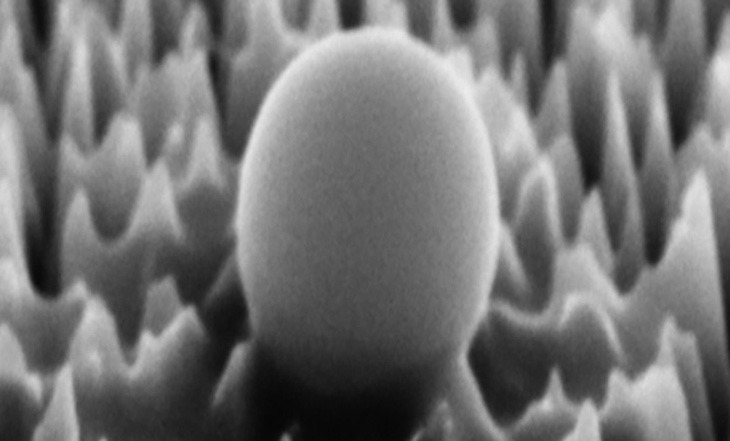
A virus on the surface of a material with nano-spikes when magnified 65,000 times. (Image: RMIT)
The research team claims that the microscopic spikes can kill up to 96% of viruses, enough to protect most healthy people from many pathogens that can be transmitted through surface contact. This material could be used in hospitals, scientific laboratories, and other places requiring sterility.
Scientists tested the material with four different types of influenza virus (hPIV-3), which cause illnesses such as bronchitis, pneumonia, and laryngotracheitis. "This material can be integrated into common devices and surfaces to prevent the spread of viruses and help reduce the use of disinfectants. After six hours, there was virtually no viral activity on the surface of the new material," said Natalie Borg, a molecular biologist at RMIT.
If this material is mass-produced and applied in healthcare settings, it could make a huge difference because hPIV is responsible for one-third of acute respiratory illnesses, especially in children. The research team plans to continue testing other configurations of the material and on other viruses.
Source: https://nld.com.vn/vat-lieu-moi-co-the-tieu-diet-96-virus-196240413204546673.htm

































![[Photo] Prime Minister Pham Minh Chinh attends the Conference on the Implementation of Tasks for 2026 of the Industry and Trade Sector](/_next/image?url=https%3A%2F%2Fvphoto.vietnam.vn%2Fthumb%2F1200x675%2Fvietnam%2Fresource%2FIMAGE%2F2025%2F12%2F19%2F1766159500458_ndo_br_shared31-jpg.webp&w=3840&q=75)




































































Comment (0)