

2025 is a year with many major national anniversaries.
On September 2, 1945, the Democratic Republic of Vietnam was established. Immediately afterward, the fledgling state had to embark on a nine-year resistance war against French colonialism. Then, after the Geneva Accords in July 1954, Vietnam was divided at the 17th parallel, and the entire country embarked on a long struggle against American imperialism that lasted more than 20 years. During that time, although the Paris Agreement was signed in 1973, opening up opportunities for peace , it was not until April 30, 1975, that the war truly ended, ushering in an era of peace and national reunification!
Fifty years have passed, more than double the time that families who relocated endured "North days and South nights," and the families who migrated still yearn for "winter nostalgia"... My generation was born and raised during the war and the subsidy period, and matured during the period when the country "opened up" and began to develop. Therefore, our deepest memory is the day when "the country was united." That was the day so many people returned to their homeland, so many families reunited, so many smiles in those early days of peace. But there were also so many tears shed for those who never returned, for those who would leave for various reasons...
However, war, no matter how long it lasts, is merely an abnormal phenomenon that must and must end! Peace in the country is the first and most important condition for everyone to live a peaceful and normal life. In the early years after reunification, despite the numerous difficulties and the turmoil in people's hearts, a life of "peace and unity" still holds the greatest meaning for each individual and for the entire nation.
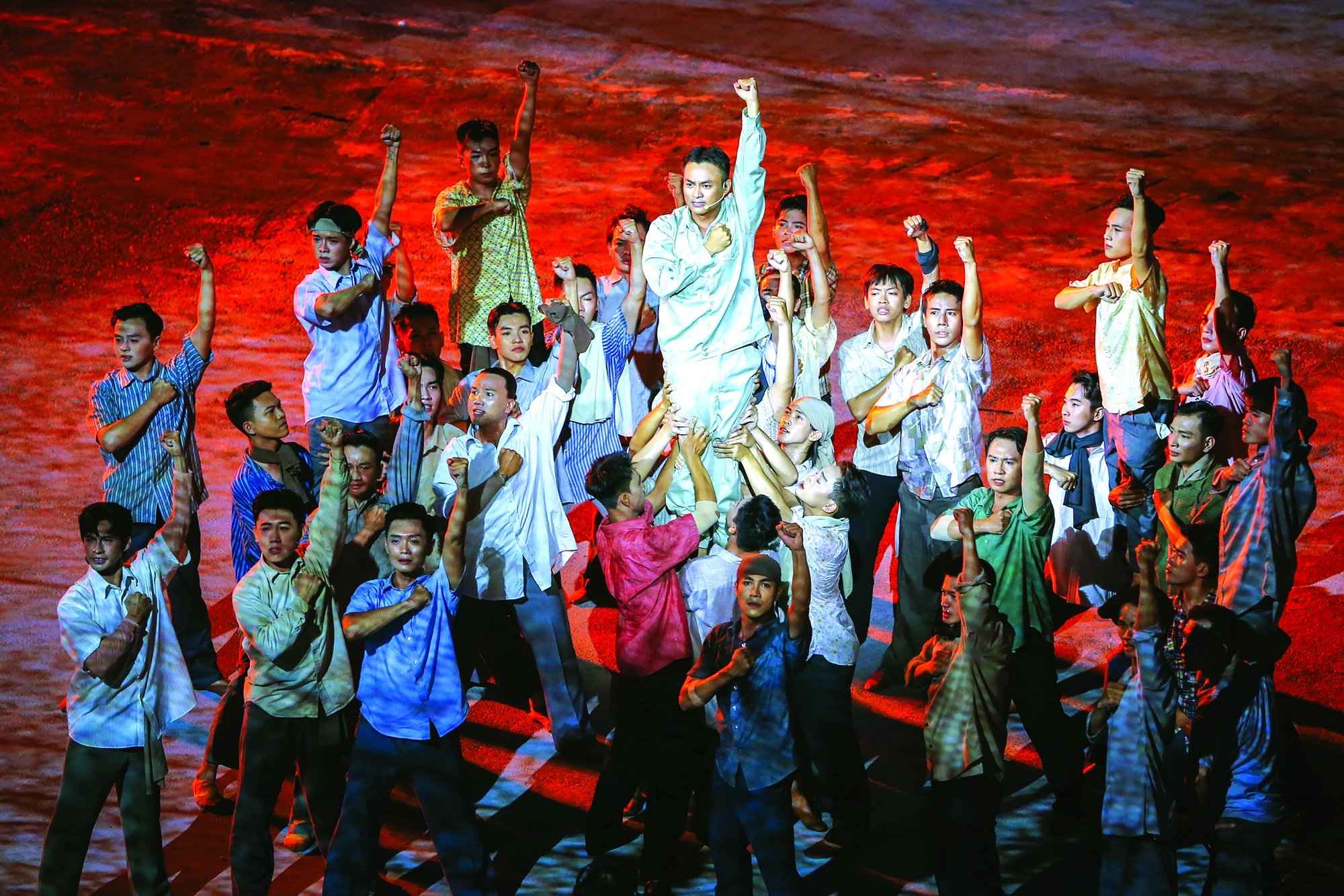
The musical "Legendary Train Journey" opened the Ho Chi Minh City River Festival 2024. Photo: Hoang Trieu
The experience of the Vietnam War showed that a country at war will cause instability throughout the world . A "small" war can leave long-lasting consequences not only for those involved, but can even create major changes on a global scale. A peaceful, developing country that does not harm or invade other countries, where nations respect and cooperate with each other, will create world peace.
Peace is a state of social harmony, compassion, and the absence of conflict. Peace is the bond that connects people and communities because it provides humanity with stable conditions for invention, creativity, and development in all aspects of material and spiritual life, enhancing understanding of different cultures and cooperation with all nations. Peace facilitates economic , social, and humanistic development at the regional and global levels.
Those who experienced the brutal years of war truly understand the profound meaning of the word "peace" that resonated after 1975. Peace is also the most important prerequisite for the reunification of the country, for harmony and unity of the entire nation. A country that has gone through more than 200 years of history with its divisions into "the North and the South," nearly 100 years of being divided into three regions (North, Central, and South), and more than 20 years of being divided into North and South... all the more deeply understands the need for reunification, as expressed in President Ho Chi Minh's poem "Spring 1969," "North and South reunited in spring."
It can be said that the highest goal of our nation's wars against foreign invaders was to unify the country; peace must go hand in hand with unification to be truly complete! Unification is not only about territorial and maritime integrity, but most importantly, it is about the solidarity of over one hundred million Vietnamese people at home and abroad, sharing the common goal of building a democratic and just society, where the people are prosperous and happy, and the country is strong and "stands shoulder to shoulder with the great powers of the world".
At noon on April 30, 1975, the entire capital city of Hanoi poured into the streets, sharing in the joy of the "liberation of the South" amidst the blaring loudspeakers playing the song "As if Uncle Ho were present on the day of great victory." After May 1975, I traveled from Hanoi to Saigon, on a company vehicle that my mother used to transport cadres to the South to take over. My family moved to my grandparents' house in Phu Nhuan and have lived there ever since.
Fifty years of peace, and no matter how much the city changes, Ho Chi Minh City's geo-cultural and geo-economic position remains unchanged. From Nha Be, where the two great rivers Dong Nai and Saigon meet, a "heaven-sent" location chosen by "people" to build Gia Dinh and then Saigon, creating the distinctive characteristics and identity of the Southern region.
How is that position maintained today? Ho Chi Minh City is now the "central crossroads" of many important transportation routes: leading to Central and Northern Vietnam, to the Eastern and Central Highlands regions, and down to the Mekong Delta. From there, it is possible to travel further inland to many Asian countries and beyond... Not only is it strategically located for road connections, but the unique riverine character of a Southern Vietnamese city is also elevated to a higher level in Ho Chi Minh City.
This is a coastal city, evidenced by its modern port system, among the best in Southeast Asia. Currently, along with the existing seaport system in the Southeast region, the Can Gio transshipment port will become a new center of Southeast Asia in the future. Saigon - Ho Chi Minh City continues to develop its open, flexible, and innovative character, absorbing and developing new economic, cultural, and scientific and technological achievements from around the world.
Ho Chi Minh City currently has development projects along both banks of the Saigon River, aiming for the ultimate goal of sustainable benefits for the community. The Saigon River can be considered a symbol of the city's historical flow. It was once the birthplace and foundation of the city, with iconic landmarks such as Ben Thanh Market, Bach Dang Wharf, and streets like Nguyen Hue, Ham Nghi, Dong Khoi, and Le Duan. Further towards the sea, the Saigon River also bears the evidence of the fierce battles in the "Rung Sac War Zone" during the war. Furthermore, the "World Biosphere Reserve" is a testament to the arduous task of replanting mangrove forests and opening access to the sea for the coastal district in those days.
"No one bathes twice in the same river," because no river is willing to be turned into a "stagnant pond." Clearing the Saigon River, the Dong Nai River, and the canals in the city also means clearing the thinking, will, and actions of "Saigon - Ho Chi Minh City people" - people who don't let the past hold them back, who dare to think, dare to act, and dare to take responsibility.
This city has always been a confluence of demographic, economic, and cultural currents. In 2025 – the 50th anniversary of reunification – and with only 20 years left – 2045 – marking a century of democratic republicanism, Ho Chi Minh City must become a modern and civilized city, a symbol of peace and harmony. How I long for that!
Ho Chi Minh City is the center of practices that demand nationwide "reform." It is also a place where "good land attracts good people," with residents from all regions coming here to contribute to the city's transformation.
Source: https://nld.com.vn/uoc-mong-cua-mot-the-he-196250121135103387.htm


![[Photo] General Secretary To Lam working with Ambassadors and Heads of Vietnamese representative offices abroad attending the 14th National Congress of the Party](/_next/image?url=https%3A%2F%2Fvphoto.vietnam.vn%2Fthumb%2F1200x675%2Fvietnam%2Fresource%2FIMAGE%2F2026%2F01%2F25%2F1769334314499_image.jpeg&w=3840&q=75)


Comment (0)