

According to agricultural statistics, Thanh Hoa province has over 200 units involved in the production and trading of plant seeds, and approximately 20 units from outside the province operating in the area. On average, the districts, towns, and cities in the province need about 11,000 tons of high-quality rice seeds, 1,000 tons of corn seeds, 2,000 tons of peanut seeds, and 300 tons of soybean seeds annually.
Driven by market demand, through various programs, schemes, and projects, many units and businesses in the province have participated in researching, selecting, breeding, producing, or importing plant varieties to serve production. Most of these are advantageous varieties that have been widely applied, contributing to increased productivity, quality, value, and competitiveness for the agricultural sector.
Thanh Hoa province has identified the development of sustainable agriculture and the application of science and technology (S&T) in the selection and breeding of crops and livestock as an urgent task. From 2019 to the present, the Thanh Hoa Agricultural Institute has researched, applied, and developed 16 technological processes in the fields of crop cultivation (3 fields), forestry (2 fields), livestock (3 technologies), aquaculture (2 technologies), and biotechnology (6 technologies). In addition, the institute has received and mastered 4 new technological processes from outside sources, including: Invitro rapid propagation technology for Dendrobium nobile orchids; technology for producing Compost Maken preparations to treat agricultural waste into organic microbial fertilizer; technology for producing hybrid acacia seedlings using tissue culture; and technology for producing Biogreen preparations to treat soil contaminated with pesticides.
Through the application of existing technologies, the Institute of Agriculture has researched and developed three new rice varieties (Sao Vang, Viet Thanh 30, VNN10), of which Sao Vang is a high-quality purebred rice variety recognized by the Department of Crop Production ( Ministry of Agriculture and Rural Development ) for circulation in the northern midland and mountainous regions; three new tomato varieties (large-fruited tomato VNN10, black tomato VNN16, cherry tomato VNN39); and conducted surveys, evaluations, and selections of 183 superior trees for forestry purposes, including major timber species and rare, native species with scientific and economic value.
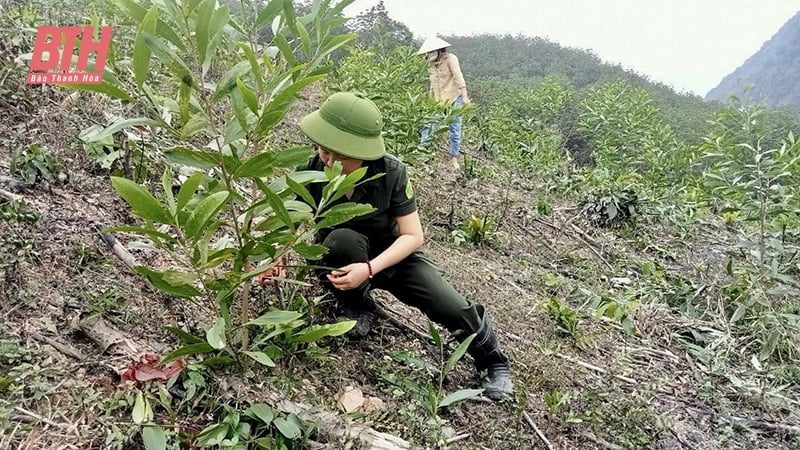
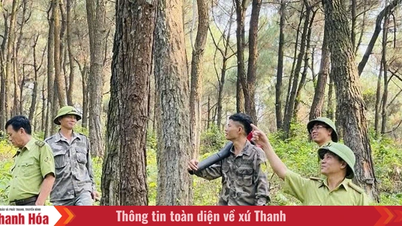
With financial and technical support from the VFBC project, the Thach Thanh Protective Forest Management Board (BQLRPH) has developed many tissue culture models to cultivate large timber forests, aiming to improve the quality and value of planted forests and contribute to increased productivity and quality. As a result, from 2023 to the present, the Thach Thanh Protective Forest Management Board has provided technical guidance, supplied seedlings, and planted over 45.5 hectares of tissue-cultured acacia trees and new eucalyptus varieties such as GLGU9, GLSE9, GLU4, and Cu Vi DH32-29 in the communes of Thanh My, Ngoc Trao, and Van Du town... In addition, the BQLRPH has also conducted trials of several tree species such as grafted seed-bearing mahogany (10 hectares), macadamia (over 90 hectares), and some areas of high-economic-value forestry trees such as rosewood, Dalbergia tonkinensis, and camphor... initially yielding positive economic results.
As one of the leading agricultural seed production enterprises in the province, Thanh Hoa Seed Company Limited is always at the forefront of research, development, and application of science and technology to bring to the market many new plant varieties with high yield and quality, recognized by the Ministry of Agriculture and Rural Development as national varieties and commercially available. Accordingly, the company actively learns from, approaches, and cooperates with scientists from leading research units in the field of new varieties, applying molecular biotechnology to select and create new rice varieties with high yield, good quality, and resistance to and adaptation to climate change. Typical examples include the Lam Son 8 and Thanh Huong pure rice varieties, which have the advantages of short growth periods, good resistance to pests and diseases and unfavorable external conditions, wide adaptability, and suitability to many ecological regions from the northern provinces, central provinces, and the South Central coastal region, bringing high economic efficiency. Every year, the company supplies the market with approximately 100 tons of Thanh Huong rice seeds. Currently, these rice varieties have been officially recognized by the Ministry of Agriculture and Rural Development as new crop varieties and are being circulated in the northern provinces...
In addition, the company has also registered intellectual property rights for its science and technology products and has been granted plant variety protection certificates by the Department of Crop Production (Ministry of Agriculture and Rural Development) for Lam Son 8 rice variety, DT80 rice variety, Thuan Viet 1 rice variety, Thanh Huong rice variety, etc. The results show that the rice varieties developed by the company itself, as well as those received from the aforementioned units, are all varieties with short growing seasons, high yields, good quality, wide adaptability, suitable for many ecological regions, and have been included in the annual rice production structure by the Departments of Agriculture and Rural Development of various provinces.
According to Nguyen Dinh Hai, Director of the Thanh Hoa Agricultural Institute: "Thanh Hoa province needs to allocate significant resources to scientific research projects on new plant and animal breeds, and projects on the conservation of native plant and animal breeds; while also cooperating with research institutes and universities to transfer technology. In particular, linking with businesses to promote the commercialization of research results should also be emphasized. In addition, it is necessary to build smart agricultural models, develop farms using automation, robotics, and artificial intelligence in the production process, helping to minimize manual labor, improve efficiency, and ensure the sustainability of agricultural production."
Mr. Hai also affirmed, "The application of advanced technology in breeding has helped create high-yielding, superior-quality plant and animal varieties with good resistance to adverse weather conditions and diseases... Therefore, the application of science and technology in research and breeding of plants and animals will be an important foundation to help Thanh Hoa develop sustainable, modern agriculture and meet the requirements of the international market in the 2025-2030 period."
Text and photos: Tran Hang
Source: https://baothanhhoa.vn/ung-dung-khoa-hoc-va-cong-nghe-trong-chon-tao-giong-cay-trong-239940.htm


![[Photo] Prime Minister Pham Minh Chinh receives Lao Minister of Education and Sports Thongsalith Mangnormek](/_next/image?url=https%3A%2F%2Fvphoto.vietnam.vn%2Fthumb%2F1200x675%2Fvietnam%2Fresource%2FIMAGE%2F2025%2F12%2F16%2F1765876834721_dsc-7519-jpg.webp&w=3840&q=75)
![[Image] Leaked images ahead of the 2025 Community Action Awards gala.](/_next/image?url=https%3A%2F%2Fvphoto.vietnam.vn%2Fthumb%2F1200x675%2Fvietnam%2Fresource%2FIMAGE%2F2025%2F12%2F16%2F1765882828720_ndo_br_thiet-ke-chua-co-ten-45-png.webp&w=3840&q=75)
![[Live] 2025 Community Action Awards Gala](/_next/image?url=https%3A%2F%2Fvphoto.vietnam.vn%2Fthumb%2F1200x675%2Fvietnam%2Fresource%2FIMAGE%2F2025%2F12%2F16%2F1765899631650_ndo_tr_z7334013144784-9f9fe10a6d63584c85aff40f2957c250-jpg.webp&w=3840&q=75)
![[Photo] Prime Minister Pham Minh Chinh receives the Governor of Tochigi Province (Japan)](/_next/image?url=https%3A%2F%2Fvphoto.vietnam.vn%2Fthumb%2F1200x675%2Fvietnam%2Fresource%2FIMAGE%2F2025%2F12%2F16%2F1765892133176_dsc-8082-6425-jpg.webp&w=3840&q=75)














































![[Photo] Prime Minister Pham Minh Chinh attends the Vietnam Economic Forum 2025](https://vphoto.vietnam.vn/thumb/402x226/vietnam/resource/IMAGE/2025/12/16/1765893035503_ndo_br_dsc-8043-jpg.webp)

























Comment (0)