

Prior to 2021, the retirement age for male workers was 60 and for female workers was 55. However, since 2021, Government Decree 135/2020 on retirement age has come into effect, and the retirement age has gradually increased.
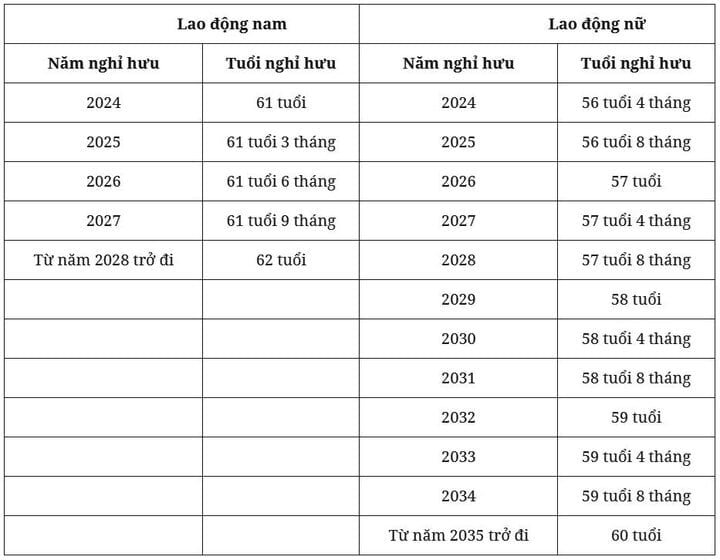
According to Article 4 of Government Decree 135, from January 1, 2021, the retirement age for workers under normal conditions is 60 years and 3 months for male workers and 55 years and 4 months for female workers.
Subsequently, the retirement age will increase by 3 months each year for male workers, until it reaches 62 years old in 2028, and by 4 months each year for female workers, until it reaches 60 years old in 2035.
According to the retirement age increase roadmap, the retirement age in 2023 for male workers will be 60 years and 9 months, and for female workers will be 56 years.
Therefore, starting in 2024, the retirement age for male workers will be 61 years old, and for female workers it will be 56 years and 4 months old.
The roadmap for increasing the retirement age for workers under normal working conditions.
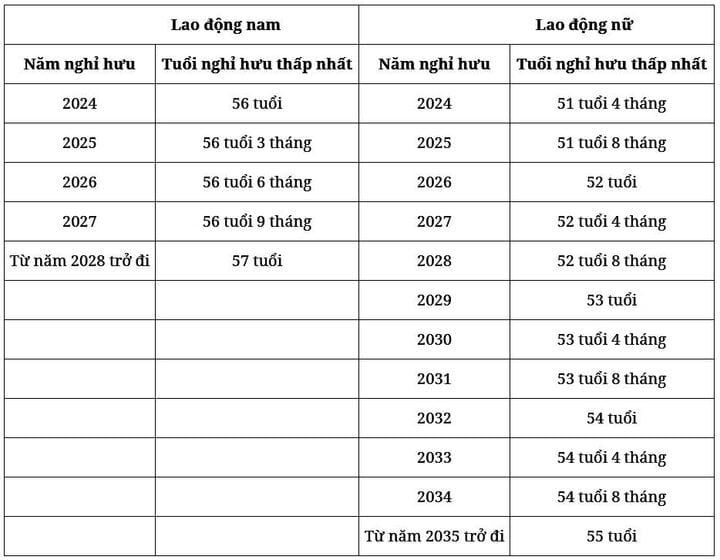
Decree 135 also stipulates cases of retirement at an age lower than the normal retirement age under working conditions. Accordingly, workers in exceptional circumstances may retire at an age lower than, but not more than 5 years lower than, the normal retirement age.
These cases include: workers with 15 years or more of experience in strenuous, hazardous, or exceptionally strenuous or hazardous occupations or jobs listed in the catalog issued by the Ministry of Labor, Invalids and Social Affairs ; workers with 15 years or more of experience working in areas with particularly difficult socio-economic conditions, including time working in areas with a regional allowance coefficient of 0.7 or higher before January 1, 2021; and workers with a reduction in working capacity of 61% or more.
The lowest retirement age for workers will start in 2024.
According to Government Decree 135, employees can retire at an age higher than the normal retirement age under working conditions. Retiring at an older age depends on the agreement between the employee and the employer.
According to Article 54 of the 2014 Social Insurance Law, as amended by point a, clause 1, Article 219 of the 2019 Labor Code, employees participating in compulsory social insurance under normal working conditions are entitled to a pension if, upon retirement, they have contributed to social insurance for 20 years or more and meet the retirement age requirements.
Due to the increase in the retirement age in 2024 compared to 2023, the conditions for receiving a pension for workers have also changed. That is, from 2024, workers participating in compulsory social insurance under normal working conditions will be entitled to a pension if, upon retirement, they have contributed to social insurance for 20 years or more and are at least 61 years old for men and 56 years and 4 months old for women.
Japanese
Source


![[Photo] Prime Minister Pham Minh Chinh attends the Conference summarizing and implementing tasks of the judicial sector.](/_next/image?url=https%3A%2F%2Fvphoto.vietnam.vn%2Fthumb%2F1200x675%2Fvietnam%2Fresource%2FIMAGE%2F2025%2F12%2F13%2F1765616082148_dsc-5565-jpg.webp&w=3840&q=75)
































































































Comment (0)