


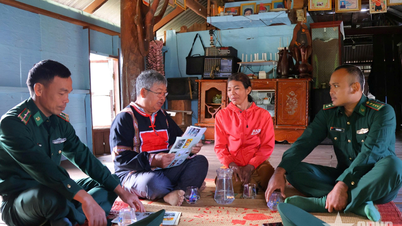
After the harvest or during the Lunar New Year, two families who have become sworn brothers in two different villages or communes often have the custom of visiting each other. The purpose of these visits is to help both sides understand each other's circumstances, economic development, and the upbringing of their children and grandchildren. This is also an opportunity to reconcile any conflicts or disagreements that may arise between the two families; thereby, encouraging and reminding the children of both sides to unite, love, support, and help each other.
After the harvest season, when the granaries are full of rice, people can take some out to exchange, visit relatives, and arrange marriages. Women thresh the rice and raise pigs to have food ready to give to relatives.
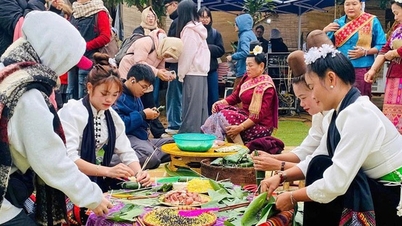
Traditionally, to prepare for visiting their daughter and son-in-law, the girl's parents steam sticky rice in a basket, then wrap it in 3-5 square packages of banana leaves and about 20-30 small triangular packages. Once finished, they put them in a basket; they also pack fish and frogs and bring all these things to the in-laws' house. The son-in-law receives from the bride's parents fabrics and mats made by the local people or floral mats from the Kinh people...
Parents receive gifts from their daughters and sons-in-law such as bottles of wine, trousers, shirts, mats, stone necklaces, gongs, buffaloes, cows, money, gold, etc. Men give gifts to their wives' relatives, and women give gifts to their husbands' relatives. If the people harvest corn and cucumbers, they divide and give each household a small amount, about two or three ears.
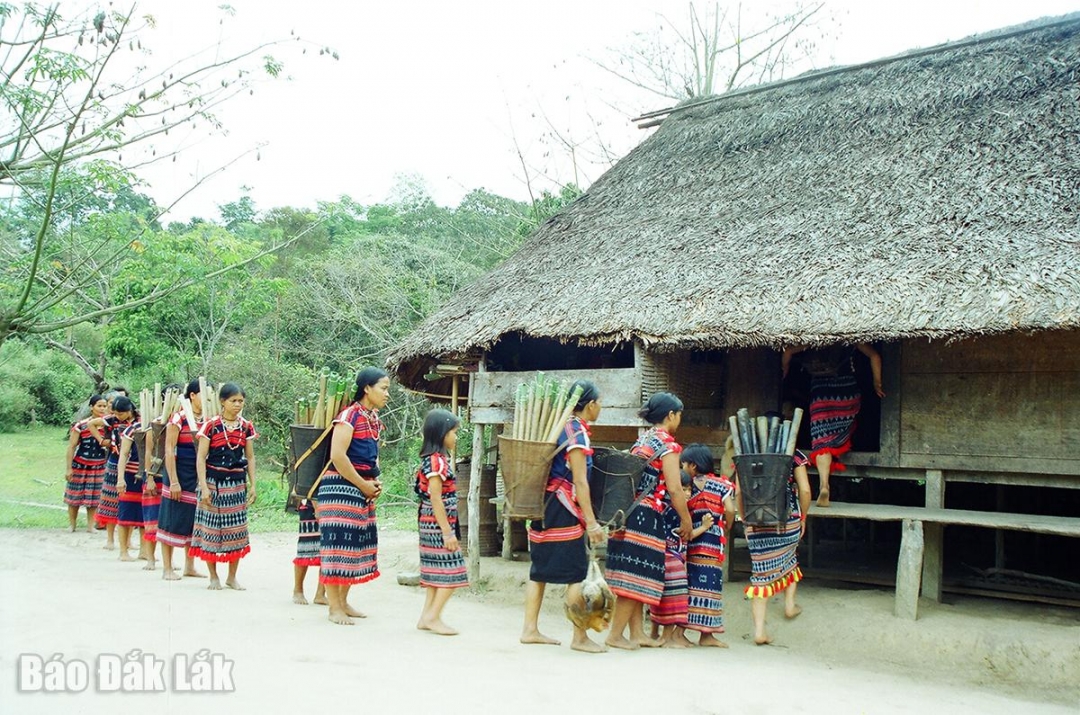 |
| The bride's family carries bamboo-cooked rice as a gift to the groom's family during a Katu wedding ceremony. |
For people in mountainous regions, firewood is extremely important in life. Every house has a hearth (rơ pang) or a wood storage area to ensure a year-round supply of fuel. They highly value the hearth and view fire as a deity that protects and shelters their family and community.
The hearth fire is not only used for cooking, preserving food, and processing meals, but also helps to safeguard seeds for the next season, keep warm during the cold winter months, and protect building materials from damage by insects and the ravages of time. Because firewood is considered precious, it is also chosen as a gift, especially to in-laws, which the Co Tu people call "dao ooi".
During Tet (Vietnamese New Year), the bride's family goes into the forest to gather firewood to give to the groom's family as a gift. The firewood given as a gift is usually fresh, finely chopped, and visually appealing. They choose types of wood with good charcoal properties and that burn easily, such as rambutan or rosewood. Depending on the family's circumstances, wealthy families may give more than 30 bundles, while poorer families may give fewer.
The groom's family receives the firewood and neatly stacks it to dry on racks in their kitchens, to be used for cooking and to give some to their relatives. The groom's family provides food, drinks, and a few gifts for the bride's family, such as jars, pots, mats, cups, and bowls.
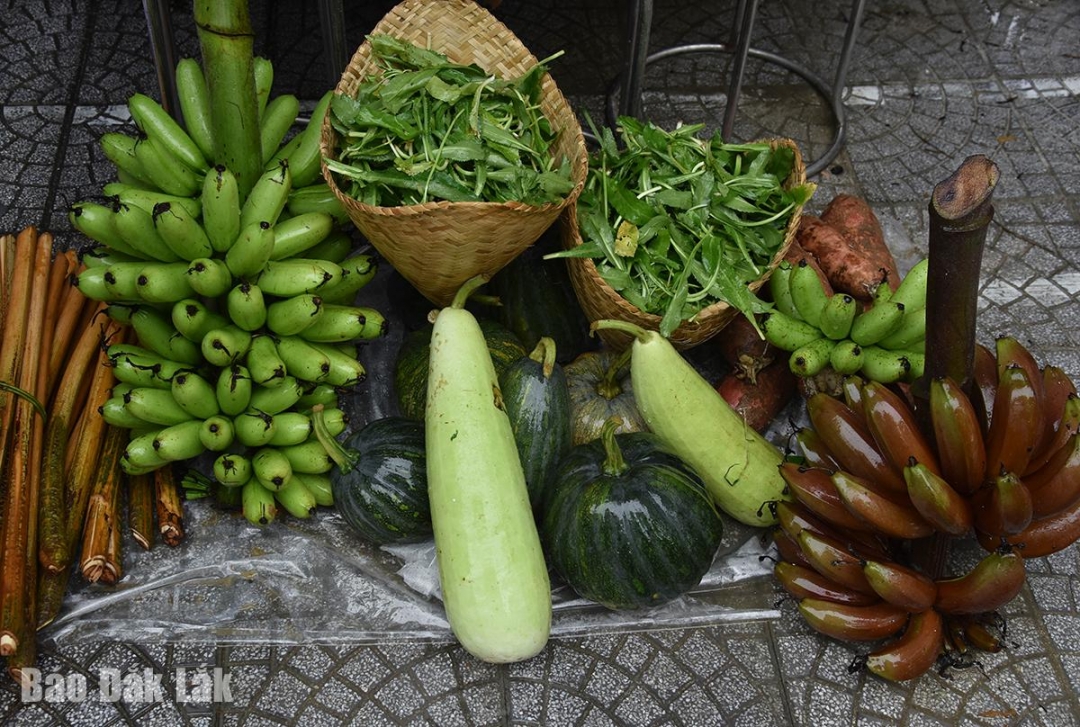 |
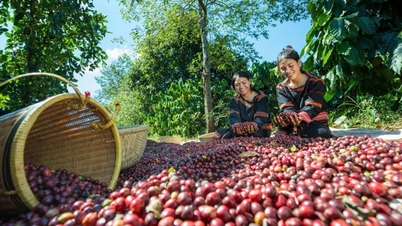
| Agricultural products from slash-and-burn farming are one of the gifts exchanged among the Co Tu people. |
The gifts exchanged between the two families are not mandatory in terms of quantity, nor are there any comparisons between the two sides; they depend on the circumstances of each family. The gifts exchanged between the two families are then distributed to relatives of each family. If the groom's family can afford to slaughter a pig or a cow, the bride's family always sets aside a portion of the best meat to give to the bride's village.
Conversely, the groom's family also sets aside a portion of fish, chicken, and sticky rice for the groom's village. This is a very humane cultural tradition that demonstrates sharing and expresses deep gratitude to the communities of both villages for providing support and assistance to both families.
The meat was divided equally among the households in the village, especially the elderly, unborn babies, and those who had recently passed away within the last six months, as a way of sharing, encouraging, and helping to strengthen the bonds of community. If the villages were nearby, they would visit each other two or three times a year; if they were far apart, visits would only be organized every few years.
Source: https://baodaklak.vn/van-hoa-du-lich-van-hoc-nghe-thuat/202504/tuc-tham-vieng-cua-nguoi-co-tu-7b5183d/
















































Comment (0)