

It's not just threatening.

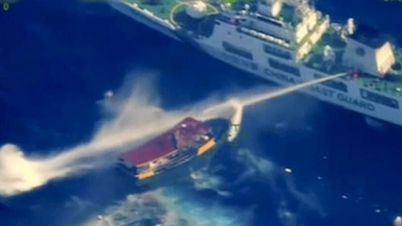
Similar to the 2021 China Coast Guard Law, this regulation grants the CCG broad powers to interfere in the legitimate activities of neighboring countries. However, this new regulation allows the CCG to arrest foreign fishermen and detain them for up to 60 days without trial. That level of detail may indicate that Beijing genuinely intends to do this, unlike the more threatening nature of the 2021 law.
Mr. Gregory Poling
(Director of the Southeast Asia Program, Director of the Asia Maritime Transparency Initiative - Center for Strategic and International Studies (CSIS), USA)
Beijing's message

This is how China wants to assert its jurisdiction in the South China Sea. To strengthen its claims at the international level, China is reinforcing its domestic laws regarding the South China Sea. The timing of this shows that China will not back down even as the Philippines strengthens its strategic ties with the US and other like-minded nations such as Japan.
Associate Professor Kei Koga
(Program on global issues and public policy,
School of Social Sciences , Nanyang Technological University, Singapore
New trick

This is a new tactic by China following a series of moves in recent times: consolidating various forces to unify different agencies into the CCG, passing laws allowing the CCG to use force, handing over old Chinese navy escort ships to the CCG, commissioning landing ships for the CCG, and expanding the CCG's gray zone and hybrid warfare tactics.
In theory, China has the largest number of military vessels in the world. However, there are limitations to undertaking long-distance voyages. Furthermore, China disperses its ships across many locations: the Bohai Sea, the East China Sea, the Taiwan Strait, the South China Sea, the Ream naval base (Cambodia), the Djibouti naval base, etc. Therefore, China is increasing the militarization of the CCG and developing its maritime militia.
Expert Benjamin Blandin
(Specializing in geopolitics , Catholic University of Paris, France)
Illegal act

If the CCG arrests foreigners in the South China Sea, it is an illegal act. But China still allows it in an attempt to assert its sovereignty over vast areas of the South China Sea. By allowing these arrests, China is signaling its intention to enforce its claims more forcefully.
Given the strategic importance of the shipping lanes through the South China Sea, China may seek to control or monitor activities in this region. In the past, China has used its maritime militia as a way to increase its influence in the area. This trend is likely to continue as China attempts to expand its influence in the region.
Professor Prakash Panneesselvam
(Programme for International Security and Strategic Studies, National Institute for Advanced Studies, India)
Falsifying administrative records

China's authorization of the CCG to arrest foreigners at sea, such as in the South China Sea, demonstrates that Beijing is applying domestic law to areas it claims sovereignty over, even when those claims are illegal.
By carrying out such an arrest, China creates an administrative record to establish a database that legitimizes the enforcement of (albeit illegal) laws in the region. Through this, Beijing expands its control without resorting to force. Other stakeholders need to find ways to mitigate this Chinese strategy. Regional powers should support other parties in enhancing their maritime awareness to maintain autonomy.
Professor Stephen Robert Nagy
(International Christian University - Japan, scholar at the Japan Institute for International Studies)
It could be used to arrest fishermen.

Not long ago, China allowed the CCG to fire on foreign vessels. However, this is unlikely to happen as it could easily escalate tensions beyond the gray zone, where China is demonstrating considerable tactical flexibility. This time, with the new change, the CCG could, in the short term, arrest Filipino fishermen in disputed waters to intimidate the government of President Ferdinand Marcos Jr.
Negotiations aimed at establishing a Code of Conduct in the South China Sea (COC) were intended to control behaviors such as the handling of foreign ships and crews in disputed waters. However, it should also be noted that in the early 1990s, Japan and China signed an agreement to enforce fishing laws on each other's flag vessels in overlapping territorial waters in the East China Sea. Nevertheless, despite this agreement, CCG vessels continued to enter the territorial waters surrounding the disputed islands.
Professor Yoichiro Sato
(Expert in international relations, Ritsumeikan University of Asia-Pacific, Japan)
Source: https://thanhnien.vn/trung-quoc-lai-them-chieu-tro-de-kiem-soat-bien-dong-185240524230911162.htm
![[Photo] Prime Minister Pham Minh Chinh presides over a meeting on private sector economic development.](/_next/image?url=https%3A%2F%2Fvphoto.vietnam.vn%2Fthumb%2F1200x675%2Fvietnam%2Fresource%2FIMAGE%2F2025%2F12%2F20%2F1766237501876_thiet-ke-chua-co-ten-40-png.webp&w=3840&q=75)





















































































Comment (0)