


(NLĐO) - Several icy meteorites that fell to Earth have helped scientists rediscover the original shape of the solar system. It's a shocking result.
A research team led by planetary scientist Bidong Zhang from the University of California, Los Angeles (UCLA) analyzed iron meteorites from the far reaches of the solar system and uncovered the mystery of the "cradle" where Earth was born.
Surrounding young stars—including our Sun 4.6 billion years ago—is a giant protoplanetary disk.
It is a disk filled with gas and dust, where protoplanets conceived, collided, broke apart, and then gradually coalesced into larger, stable masses that formed the planets we see today, including Earth.
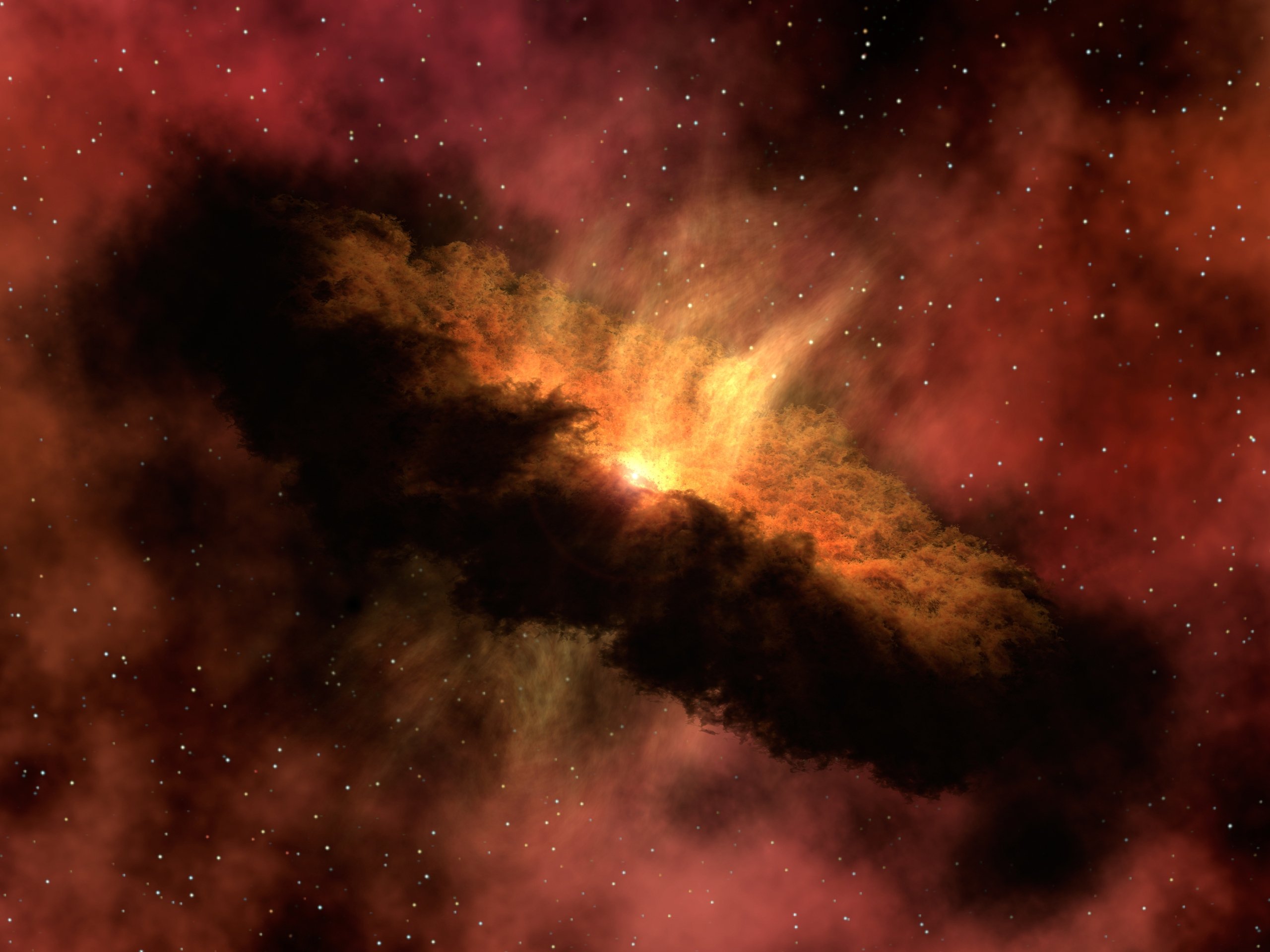
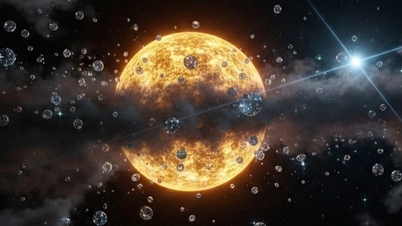
This graphic depicts a star with an unusually thick, almost toroidal protoplanetary disk that scientists believe the early Solar System possessed - Image: NASA
Previously, descriptions of the protoplanetary disk of the Solar System were often based on a few observations from some young star systems that humanity could only faintly perceive through telescopes.
From then on, this disk was described as a large, thin, flat, ring of dust and gas.
However, the iron meteorites that Dr. Zhang and his colleagues analyzed tell a different story.
According to a paper published in the journal Proceedings of the National Academy of Sciences , these rocks have traveled a long distance to Earth from the outer reaches of the Solar System, that is, the region beyond Jupiter's orbit dominated by massive gas planets.
These meteorites are richer in refractory metals than those found in the inner solar system, the home of Mercury, Venus, Earth, and Mercury.
Analysis of the composition suggests that these meteorites could only have formed in very hot environments, such as those near a developing star.
This means they were initially formed in the inner regions of the solar system, and then gradually moved outward.
But there's a catch: If the Sun's protoplanetary disk were like the disks we've seen in other young stars, there would be a lot of empty space. That's because when planets begin to form, it will transform the disk into a multi-ring concentric structure, with each gap being where rings of gas and dust coalesce into planets.
The aforementioned asteroids have no way of traversing that gap. There is only one possibility: the Sun's protoplanetary disk must be different.
According to models, the migration of this type of asteroid is most likely to occur if the protoplanetary structure is toroidal, that is, like a donut.
This would bring metal-rich objects toward the outer edge of the forming solar system.
Much later, as the protoplanetary disk cooled, it began to flatten. This was also when Jupiter—the first and largest planet—had formed relatively completely, creating a large void that prevented metals like iridium and platinum from entering.
These metals were then incorporated into meteorites that had already drifted outward. These meteorites, due to the presence of large planets, were also trapped in this frigid region.
However, some of them did find a way to land on Earth.
Source: https://nld.com.vn/trai-dat-ra-doi-tu-the-gioi-mang-hinh-chiec-banh-196240701082534505.htm
![[Image] Fifth meeting of the Steering Committee for National Projects in the Railway Sector](/_next/image?url=https%3A%2F%2Fvphoto.vietnam.vn%2Fthumb%2F1200x675%2Fvietnam%2Fresource%2FIMAGE%2F2026%2F01%2F06%2F1767712857541_ndo_br_dsc-0581-jpg.webp&w=3840&q=75)
![[Photo] Prime Minister Pham Minh Chinh attends the Conference on the Implementation of Tasks for the Finance Sector in 2026](/_next/image?url=https%3A%2F%2Fvphoto.vietnam.vn%2Fthumb%2F1200x675%2Fvietnam%2Fresource%2FIMAGE%2F2026%2F01%2F06%2F1767699638245_ndo_br_dsc-0196-jpg.webp&w=3840&q=75)
![[Photo] Standing Committee member of the Party Central Committee Tran Cam Tu inspects preparations for the 14th Party Congress.](/_next/image?url=https%3A%2F%2Fvphoto.vietnam.vn%2Fthumb%2F1200x675%2Fvietnam%2Fresource%2FIMAGE%2F2026%2F01%2F06%2F1767695749033_image1122-1262-jpg.webp&w=3840&q=75)


![[Photo] Prime Minister Pham Minh Chinh receives Canadian Minister of International Development Randeep Sarai](/_next/image?url=https%3A%2F%2Fvphoto.vietnam.vn%2Fthumb%2F1200x675%2Fvietnam%2Fresource%2FIMAGE%2F2026%2F01%2F06%2F1767708661052_image123-3433-jpg.webp&w=3840&q=75)









































































Comment (0)