

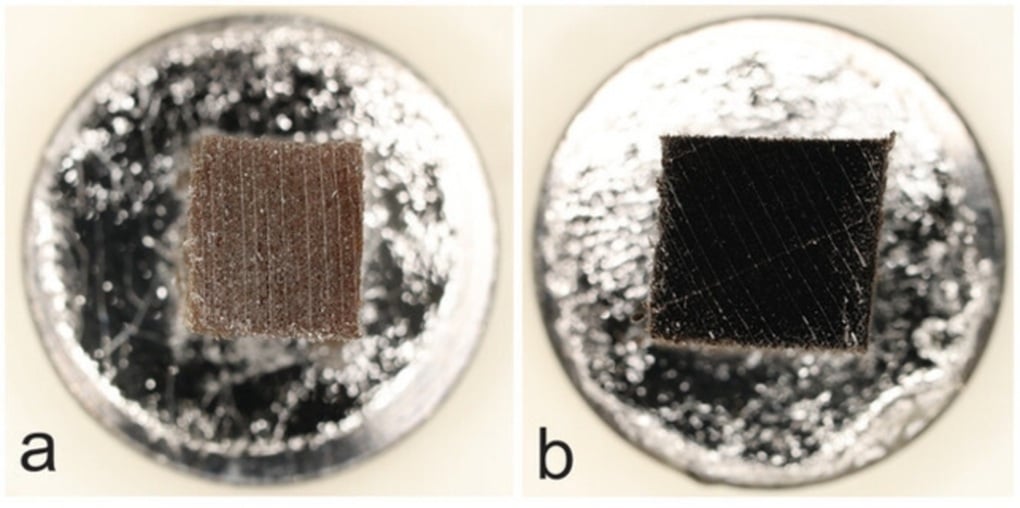
Plasma-modified wood samples retained their black color after being coated with gold metal. This demonstrates that light absorption is structural (Image: UBC).
A research team from the University of British Columbia (UBC) in Canada has successfully created a super-dark material capable of absorbing up to 99.3% of light.
Remarkably, scientists accidentally discovered the formula for creating this material while researching waterproofing for wood using high-energy plasma.
They found that using this gas caused the wood cells to turn completely black, with almost absolute light absorption properties. The material was named Nxylon, inspired by Nyx – the Greek goddess of night.
"Nxylon's composition combines the benefits of natural materials with unique structural characteristics, making it lightweight, strong, and easy to cut into complex shapes," said Philip Evans, a materials scientist at UBC.
In their research report, scientists stated that the material's light-absorbing ability comes from the indentations on its surface. These are said to absorb up to 99.3% of light and minimize any reflections.
Even when coated with a gold alloy, the material retains its black color. This indicates that the wood, after transformation, has truly undergone a fundamental restructuring of the material.

The prototype watch is made from ultra-dark material (Photo: UBC).
According to Science Alert , ultrablack materials are valuable in industries such as astronomy, solar energy, and optics. They help devices operate more accurately or efficiently by reducing unwanted light reflections.
This type of material is also popular in art and design, as "super black" creates a striking visual effect with sharp contrast against any other lighter tones when viewed up close.
Although science has discovered even darker materials capable of absorbing more light, the new material shows great promise for large-scale production.
According to the research team, the new material has several advantages. First, it uses wood (specifically linden wood), which is a renewable material. It also does not require complex pre-processing, thus reducing costs and making the material more feasible to produce.
Researchers believe that Nxylon could replace rare and expensive dark woods such as ebony and rosewood. Additionally, it could also replace precious stones like onyx.
Source: https://dantri.com.vn/khoa-hoc-cong-nghe/tinh-co-tim-thay-vat-lieu-sieu-toi-co-kha-nang-hap-thu-993-anh-sang-20240805110805961.htm

![[Photo] Prime Minister Pham Minh Chinh receives Lao Minister of Education and Sports Thongsalith Mangnormek](/_next/image?url=https%3A%2F%2Fvphoto.vietnam.vn%2Fthumb%2F1200x675%2Fvietnam%2Fresource%2FIMAGE%2F2025%2F12%2F16%2F1765876834721_dsc-7519-jpg.webp&w=3840&q=75)
![[Image] Leaked images ahead of the 2025 Community Action Awards gala.](/_next/image?url=https%3A%2F%2Fvphoto.vietnam.vn%2Fthumb%2F1200x675%2Fvietnam%2Fresource%2FIMAGE%2F2025%2F12%2F16%2F1765882828720_ndo_br_thiet-ke-chua-co-ten-45-png.webp&w=3840&q=75)
![[Live] 2025 Community Action Awards Gala](/_next/image?url=https%3A%2F%2Fvphoto.vietnam.vn%2Fthumb%2F1200x675%2Fvietnam%2Fresource%2FIMAGE%2F2025%2F12%2F16%2F1765899631650_ndo_tr_z7334013144784-9f9fe10a6d63584c85aff40f2957c250-jpg.webp&w=3840&q=75)

![[Photo] Prime Minister Pham Minh Chinh receives the Governor of Tochigi Province (Japan)](/_next/image?url=https%3A%2F%2Fvphoto.vietnam.vn%2Fthumb%2F1200x675%2Fvietnam%2Fresource%2FIMAGE%2F2025%2F12%2F16%2F1765892133176_dsc-8082-6425-jpg.webp&w=3840&q=75)


























































































Comment (0)