

Spanish scientists have just discovered several islands off the coast of Spain that sank millions of years ago, some still retaining their surrounding beaches.
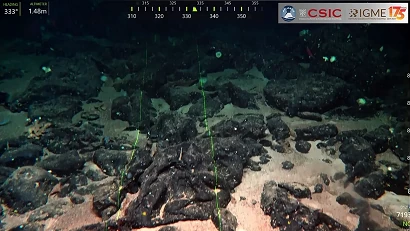 |
| The seabed where the newly discovered underwater mountain is located has been named Los Atlantes Mountain. (Source: IGME-CSIC) |
Luis Somoza, head of a research project on volcanic activity off the coast of the Canary Islands (Spain), told Live Science : "This could be the origin of the legend of Atlantis."
From the story recounted by the ancient Greek philosopher Plato more than 2,300 years ago, Atlantis remains a subject of debate in the scientific community. The existence of this supposedly vanished island is still a question mark.
According to Plato's description, Atlantis was a large island that existed approximately 9,000 years before his time. It possessed favorable conditions in terms of both weather and terrain. Thanks to these factors, Atlantis developed an incredibly advanced civilization. The Atlantis army was extremely powerful, especially in naval warfare. They conquered vast territories of other countries.
Despite its vast size and highly developed civilization, the end of Atlantis was surprisingly sudden and swift. In a single night, around 9600 BC, a massive flood accompanied by a devastating earthquake submerged Atlantis to the bottom of the ocean, causing it to disappear forever.
The complete disappearance of a vast fortress and its civilization has raised many questions for researchers.
Recently, Luis Somoza's research team discovered islands situated on an underwater mountain range, at a depth of approximately 2.3 km below the ocean surface. These islands contain three now-inactive volcanic craters.
Scientists named the newly discovered mountain Los Atlantes, after the legendary story told by the philosopher Plato about the island of Atlantis, a mythical civilization that was submerged by the gods as punishment for the immorality of its inhabitants.
Somoza, a geologist at the Spanish Institute of Geology and Mining (IGME-CSIC), said: “They were once islands in the past and they sank, as the legend of Atlantis tells.”
Scientists discovered Mount Los Atlantes while exploring the seabed off the east coast of Lanzarote, the easternmost point of the Canary Islands, using remotely operated vehicles (ROVs) at depths ranging from 100 to 2,500 meters. This dive was part of IGME-CSIC's Atlantis project, aimed at better understanding the activity of underwater volcanoes.
The Los Atlantes mountains may have formed between 56 million and 34 million years ago. When the volcanoes stopped erupting, the lava solidified, causing the islands to sink into the ocean.
"We have identified beaches, cliffs and sand dunes in some parts of the underwater mountain," said Somoza, adding that the islands are still sinking.
During the last ice age, when sea levels were much lower than they are today, dormant volcanoes were once islands. He explained, "These islands may have been home to wildlife. When sea levels rose at the end of the ice age, the islands sank back underwater."
The research team will analyze rock samples collected from Mount Los Atlantes to determine the age of the volcano and when the islands began to sink. They also plan to return to the submerged volcanoes in the Canary Islands on an expedition next year.
Source: https://baoquocte.vn/tim-thay-noi-co-the-la-dao-atlantis-huyen-thoai-282402.html




































































































Comment (0)