

(NLĐO) - A multinational research team has just discovered the origin of these extremely rare "cosmic bombs": Type Ic supernovae.
A project led by astronomers Martín Solar and Michał Michałowski of Adam Mickiewicz University in Poland has discovered that the precursors to Type Ic supernovae – the universe's leading metal-forging furnaces – are not solitary monsters.
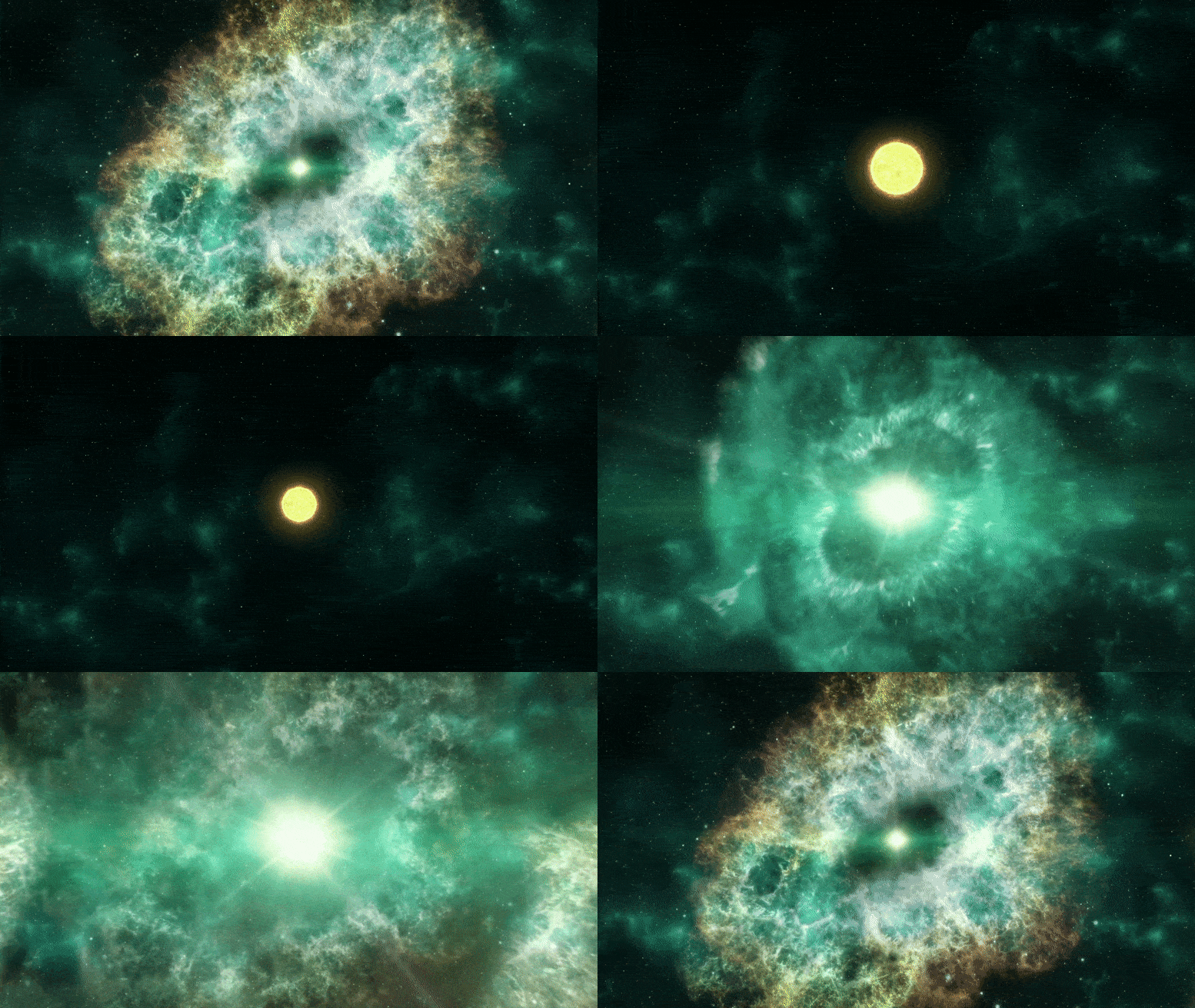
A supernova explosion helps enrich the universe with chemical elements - Photo: ESO/SCITECH DAILY
According to Science Alert, one of the greatest mysteries of the universe is the true origin of all metals.
They didn't exist immediately after the Big Bang. The universe at that time was simply composed of the lightest elements like hydrogen and helium.
The cores of stars are the furnaces of the universe, where simple elements are forged into heavier elements through extreme conditions of temperature, pressure, and more.
When a star dies, it explodes as a supernova, releasing a belly full of metals much heavier than what made it up into space, providing the raw material for subsequent generations of stars to forge even heavier materials.
In particular, the Type Ic supernova was the explosion of one of the most advanced forges.
They are caused by the core collapse of massive stars that have reached the end of their life cycle, with all the hydrogen in the stellar core having fused into heavier elements.
At that point, the star had reached a point where its core elements were so dense that further mergers would require a greater energy source than previous mergers had released.
This sudden loss of energy causes the external pressure to drop drastically, subjecting the stellar core to immense gravitational forces, leading to its collapse into an extremely dense neutron star or black hole.
Meanwhile, the outer reaches of the star will explode into space, but this will require hydrogen and helium—the fundamental elements that every star must possess.
But Type Ic supernovae have puzzled scientists for years because they often explode without hydrogen and helium.
Now, scientists have discovered that this type of supernova may be created by something so powerful that as matter is ejected, heavier metals continue to be forged, blowing away all the hydrogen and helium.
A possible scenario has been presented.
The first scenario involves a star with a mass about 20-30 times that of the Sun, large enough to generate stellar winds strong enough to blow away hydrogen and helium.
The second scenario involves the appearance of a companion binary star system, a type Ic supernova – a pair of exploding stars consisting of a giant star and a smaller one with a mass 8-15 times that of the Sun.
Researchers examined the molecular gas left behind by Type Ic supernovae and compared it to the molecular gas left behind by Type II supernovae—which originate from stars 8-15 times more massive than the Sun.
The results suggest that the second scenario is plausible.
This discovery provides a crucial piece in our understanding of cosmology. Because, without these "monsters" that helped the universe evolve chemically so rapidly, Earth itself would not have been formed 4.54 billion years ago with such a rich composition.
Source: https://nld.com.vn/tim-ra-nguon-goc-vat-the-no-khien-vu-tru-tien-hoa-vuot-bac-196241022111324218.htm


























































![[Photo] General Secretary To Lam meets with voters in Hanoi.](https://vphoto.vietnam.vn/thumb/402x226/vietnam/resource/IMAGE/2025/12/15/1765783098527_image.jpeg)





























Comment (0)