

The Ho Chi Minh City People's Committee has issued a plan for the development of the pharmaceutical industry in Ho Chi Minh City until 2030, with a vision to 2045. This plan outlines the construction of a pharmaceutical industrial park in the Le Minh Xuan 2 Industrial Park (Binh Chanh District) covering 338 hectares for drug production. The plan is expected to help ensure pharmaceutical security for the city and contribute to socio -economic development.
What kind of drugs are you focusing on producing?
Speaking to Thanh Nien newspaper, Associate Professor Pham Khanh Phong Lan, a National Assembly representative, Director of the Ho Chi Minh City Department of Food Safety, and also an expert in the pharmaceutical field, stated that Ho Chi Minh City's greatest strength lies in its position as a trading hub in the southern region, facilitating the transportation and supply of medicines to other areas, and concentrating many research, training, production, and business facilities. The production, business, and import/export of pharmaceuticals in Ho Chi Minh City consistently experience high growth and account for a large proportion of the country's pharmaceutical economy. She expressed hope that the city will successfully develop a pharmaceutical manufacturing industrial park to ensure a proactive supply.
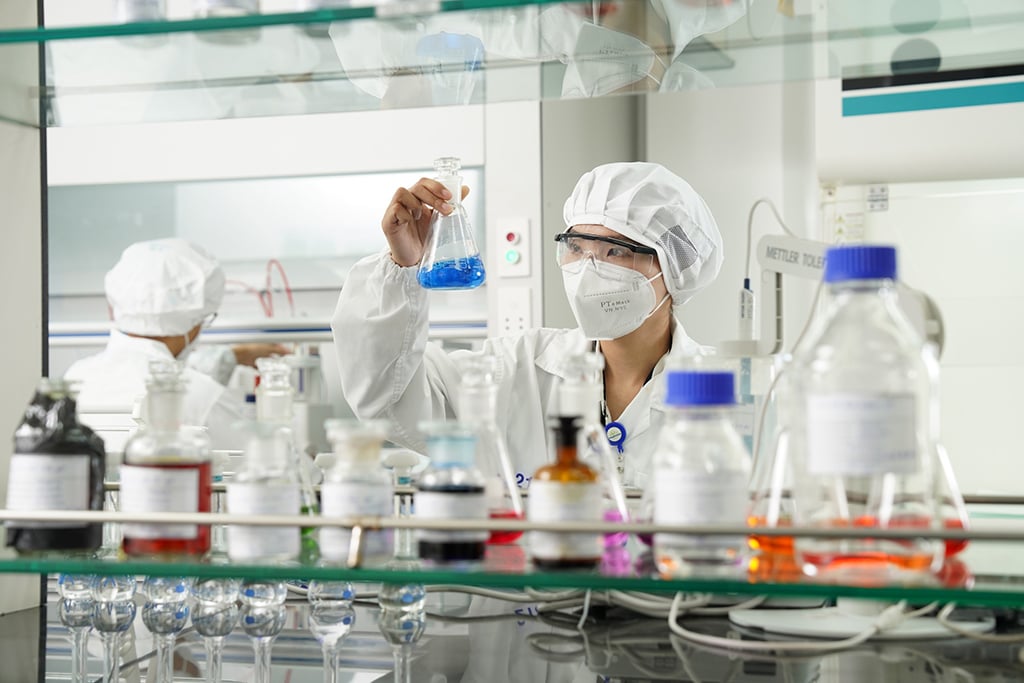
Inside the research lab of a pharmaceutical factory in Ho Chi Minh City.
However, according to Associate Professor Pham Khanh Phong Lan, it must also be acknowledged that there are two groups of drugs: branded drugs and generic drugs (those whose patent protection has expired). Both groups have difficulties that need to be addressed, and these are not solely dependent on the city.
"The first group consists of original branded drugs. No one brings these drugs here to manufacture in the city or anywhere else. Because they are proprietary drugs and are imported from abroad, related to registration policies and insurance pricing. And we are pursuing a strategy of increasingly tightening control over these drugs because they are expensive, and it's not easy for insured patients to use them," Ms. Lan analyzed.
Regarding generic drugs, Ms. Lan stated that this is the target market for Ho Chi Minh City when building industrial parks and pharmaceutical factories. In this aspect, Ho Chi Minh City does not lack pharmaceutical factories, but is hampered by production strategies and investors.
"The advantage lies in the fact that hospitals use this group of drugs, but with the current bidding mechanism in hospitals, there's only one option: the cheaper the drug, the better. Therefore, the drug's output is hampered by the price competitiveness of factories in Ho Chi Minh City when compared to factories in other provinces. For example, in other provinces, land rent is cheaper, production costs are lower, so the drug prices are also cheaper than in Ho Chi Minh City," Ms. Lan said.
According to Dr. Lan, a phenomenon that has been occurring for many years is that everyone "follows the crowd," meaning that as soon as a drug becomes popular or when foreign drugs' patents expire, various parties rush to buy the raw materials and press them into tablets for sale. This is called "counterfeit drugs," and how can they create differentiation? She pointed out that there are countless types of cold medicine on the market, but only a handful of businesses in Ho Chi Minh City focus on developing their own products or at least researching bioequivalence of these drugs.
Ho Chi Minh City's pharmaceutical production orientation has a very high intellectual content and is in line with the trend of scientific and technological development, especially for a city with a large consumer market. In addition, the hospital system has a large number of doctors, nurses, and patients, which can yield good research results. However, careful consideration is needed regarding what to invest in, where to invest, and which areas should be encouraged.
"We shouldn't chase after the idea that every company produces dozens of generic pharmaceutical products. If we can do something different, then we should. For example, investing in injectable drugs, infusions, vaccines—types we're lacking—or high-tech drugs. Initially, we should focus on cooperating with major pharmaceutical companies, and only when we're strong enough should we branch out," Ms. Lan suggested.
There must be direction.
According to Associate Professor Phong Lan, Ho Chi Minh City's allocation of land for pharmaceutical production is very welcome, but it needs clear direction. It's important to note that this direction shouldn't be decided solely by Ho Chi Minh City; the Pharmaceutical Law itself must establish a strategic direction: if we want to develop the domestic pharmaceutical industry, we must at least achieve the same level as foreign countries. She cited a simple example: we shouldn't import what we can already produce ourselves.
Associate Professor Phong Lan suggested that Ho Chi Minh City should calculate in advance the quantity needed, determining approximately how many branded drugs and how many generic drugs are required. From there, they can assess whether the production capacity of businesses can meet the demand. Priority will be given to domestic production of generic drugs for businesses, and no more registrations will be accepted once the quota is reached, unless a company returns its registration number.
Associate Professor Phong Lan raised the issue of needing to resolve procedural and regulatory issues related to registration numbers, especially in the bidding mechanism. According to her, the goal of bidding is to save money, combat corruption, and prevent negative practices, but ultimately it wastes time, effort, and money, and no one is able to bid effectively.
An independent research center is needed.
Speaking to Thanh Nien newspaper , the director of a pharmaceutical business in Ho Chi Minh City said he is considering whether or not to move into the city's pharmaceutical industrial park, as he needs to see what the specific mechanisms are.
However, according to him, the draft of the new Pharmaceutical Law has overlooked a fundamental issue in the development of the pharmaceutical industry: the establishment of independent drug research centers. Experience shows that each factory and enterprise establishing its own center leads to fragmentation and hinders development. The pharmaceutical industry abroad has developed thanks to independent research centers that transfer technology to factories. If we have independent research centers, it will help businesses reduce investment costs, because if every factory has to invest nearly hundreds of billions of dong in a research center, but only to produce a few products, it is very wasteful.
Next, it is necessary to establish bioequivalence testing centers (for testing the equivalence of original branded drugs) that meet international standards. Currently, Vietnamese centers do not meet these standards and are not internationally recognized. A drug manufactured in Vietnam that needs to prove bioequivalence for export must be tested abroad, which is very costly. This is also the most fundamental foundation for the development of the pharmaceutical industry, the director affirmed.
The third issue he mentioned was business policy. Currently, many businesses invest in factories in neighboring provinces, making relocation to Ho Chi Minh City difficult. Therefore, it is necessary to clarify what benefits businesses will receive when moving into the city's pharmaceutical industrial park, such as tax incentives, priority in registration, export opportunities, etc.
The human factor is equally important; training institutions must provide sufficient human resources and train specialists in pharmaceutical research and development. And finally, infrastructure comes last, according to this expert.
It is advisable to link up existing factories.
A pharmacy lecturer in Ho Chi Minh City also commented that researching new drugs (new active ingredients) in Vietnam is quite difficult because it involves pharmaceutical chemistry technology. However, Vietnam, especially the South, has strengths in researching new dosage forms and new excipients. This is an issue that Ho Chi Minh City needs to research and develop policies for.
According to this lecturer, if a pharmaceutical industrial park is opened with normal production methods, the prices will be dependent on (or even higher than) existing factories, making it similar to factories in other locations and difficult to attract investment without good policies. Currently, factories in the provinces have completed their depreciation period, so their production costs have decreased compared to products from newly built factories.
"Currently, there are many pharmaceutical factories, but they are not fully utilized, while the volume of imported drugs is very high. Therefore, Ho Chi Minh City needs to consider using existing resources, which is to link factories and take the lead (establishing research, operation, and distribution centers) to share drug manufacturing responsibilities, as each factory has different production lines and strengths. This is a very effective approach," the pharmacy lecturer suggested.
Source link
![[Image] The tenacious fighting spirit of Vietnamese women's football](/_next/image?url=https%3A%2F%2Fvphoto.vietnam.vn%2Fthumb%2F1200x675%2Fvietnam%2Fresource%2FIMAGE%2F2025%2F12%2F17%2F1765990260956_ndo_br_4224760955870434771-copy-jpg.webp&w=3840&q=75)
![[Live] 2025 Community Action Awards Gala](/_next/image?url=https%3A%2F%2Fvphoto.vietnam.vn%2Fthumb%2F1200x675%2Fvietnam%2Fresource%2FIMAGE%2F2025%2F12%2F16%2F1765899631650_ndo_tr_z7334013144784-9f9fe10a6d63584c85aff40f2957c250-jpg.webp&w=3840&q=75)
![[Photo] Prime Minister Pham Minh Chinh receives the Governor of Tochigi Province (Japan)](/_next/image?url=https%3A%2F%2Fvphoto.vietnam.vn%2Fthumb%2F1200x675%2Fvietnam%2Fresource%2FIMAGE%2F2025%2F12%2F16%2F1765892133176_dsc-8082-6425-jpg.webp&w=3840&q=75)

![[Image] Leaked images ahead of the 2025 Community Action Awards gala.](/_next/image?url=https%3A%2F%2Fvphoto.vietnam.vn%2Fthumb%2F1200x675%2Fvietnam%2Fresource%2FIMAGE%2F2025%2F12%2F16%2F1765882828720_ndo_br_thiet-ke-chua-co-ten-45-png.webp&w=3840&q=75)
![[Photo] Prime Minister Pham Minh Chinh receives Lao Minister of Education and Sports Thongsalith Mangnormek](/_next/image?url=https%3A%2F%2Fvphoto.vietnam.vn%2Fthumb%2F1200x675%2Fvietnam%2Fresource%2FIMAGE%2F2025%2F12%2F16%2F1765876834721_dsc-7519-jpg.webp&w=3840&q=75)













































![[Live] Closing Ceremony and Award Presentation for the "Impressive Vietnam Tourism" Video/Clip Creation Contest 2025](https://vphoto.vietnam.vn/thumb/402x226/vietnam/resource/IMAGE/2025/12/17/1765974650260_z7273498850699-00d2fd6b0972cb39494cfa2559bf85ac-1765959338756946072104-627-0-1338-1138-crop-1765959347256801551121.jpeg)















Comment (0)