


Japanese scientists have developed a method that significantly restores the original capacity of batteries after they have degraded due to undergoing many charge-discharge cycles.
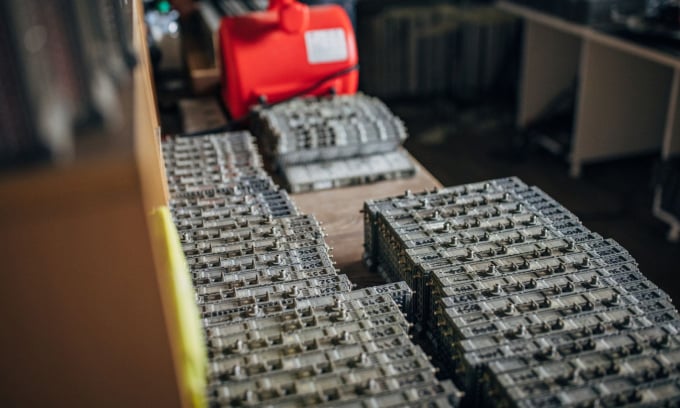
Lithium batteries used in electric cars. Photo: South_agency/iStock
Currently, lithium-ion batteries are the most common type of rechargeable battery, powering everyday devices and appliances such as electric cars, laptops, and smartphones. However, over time, they gradually lose their ability to hold a charge, becoming less efficient and less reliable. This is because they lose the charge carriers, or ions, that store and release energy within the battery.
A team of experts at Toyota's Central Research and Development Laboratory in Japan has found a way to replenish these ions and significantly restore the battery's original capacity, Interesting Engineering reported on March 10. The new research was published in the journal Joule.
Specifically, they injected a special substance called a recovery reagent into the battery. This substance triggers a chemical reaction that produces more electrons and lithium ions. These are two types of charged particles that help the battery store energy. By adding these particles, the research team was able to reverse the battery's degradation process and restore 80% of its original capacity. The restored battery can maintain performance for 100 charge-discharge cycles.
The research team tested the new method on various types of batteries, both large and small, including those used in automobiles. "The effectiveness has been verified not only with small batteries in the laboratory but also with large batteries used in automobiles," said Nobuhiro Ogihara, the lead scientist of the study.
The new method could extend the lifespan of lithium-ion batteries, allowing them to be reused in electric vehicles or other devices instead of being discarded or undergoing complex disassembly and recycling processes. This saves costs and resources, while also protecting the environment, as lithium-ion batteries contain rare earth metals like cobalt and nickel, which are often mined in unsustainable ways.
However, the new method is not suitable for all types of degraded batteries; it is only effective for batteries that have lost ions due to repeated charge-discharge cycles, not for batteries with structural damage or other forms of degradation. Furthermore, an accurate diagnostic method is needed to determine the battery's condition and whether it is suitable for chemical injection.
According to Jacqueline Edge, a battery degradation expert at Imperial College London, long-term studies are needed to better understand the potential side effects and safety of injecting chemicals into batteries. The research team has filed a patent application for the new method, attracting interest and funding from several companies and government agencies.
Thu Thao (According to Interesting Engineering )
Source link































































































![[Photo] Coc Ly market bustling on the eve of Tet](https://vphoto.vietnam.vn/thumb/402x226/vietnam/resource/IMAGE/2026/02/14/1771062261424_baolaocai-br_img-6457-jpg.webp)





Comment (0)