

 |
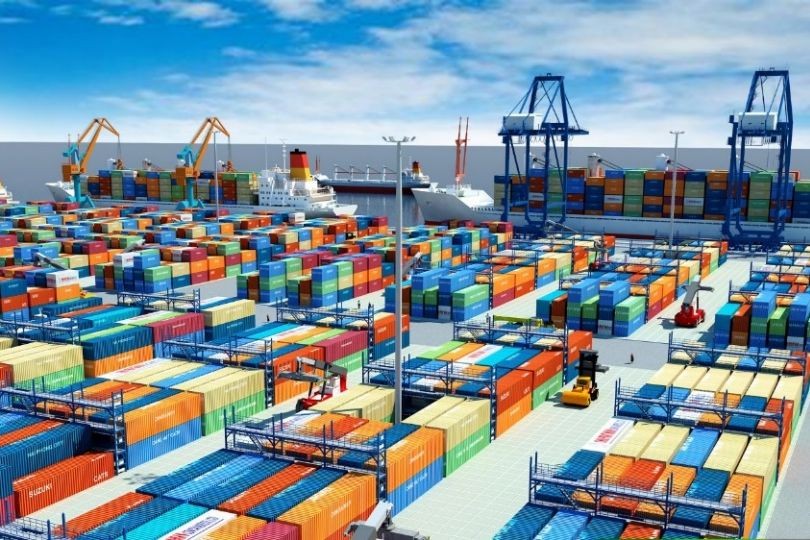
| Vietnam's logistics sector faces pressure to transition to a green system. (Photo: TCCT). |
(PLVN) - A large portion of Vietnam's export turnover goes to demanding markets. These markets are increasingly stringent, and customers are now requiring green production processes. This is posing a significant challenge for logistics.
Many favorable conditions for the development of green logistics.
Dr. Tran Thi Thu Huong, Head of the Logistics and Supply Chain Department at the University of Commerce, believes that Vietnamese logistics businesses have many advantages when transitioning to green. The first advantage worth mentioning is that the green economy is receiving special attention in Vietnam, and in recent years, Vietnam has achieved certain successes in this area. For example, the growth rate of the green economy in Vietnam from 2018 to 2021 reached 10-13% per year, and the green economy has contributed approximately 2% to Vietnam's GDP.
Furthermore, several sectors of the economy have shown particular interest in developing a green economy, and among the 6-8 sectors that the government is investing in, some are particularly related to green logistics, such as transportation.
Ms. Dang Hong Nhung, representative of the Import-Export Department ( Ministry of Industry and Trade ), stated that priority policies in the logistics sector are currently being implemented. For example, the project to build a logistics center is included in the list of investment incentives and will receive all incentives as stipulated in the Investment Law and its guiding documents.
Furthermore, the government is focusing on supporting businesses in transitioning their vehicles. This means encouraging businesses to switch to low-emission vehicles, with electric vehicles being the primary mode of transport currently in use. Specifically, the government has implemented notable policies such as: waiving registration fees for the first three years for battery-powered electric trucks and reducing registration fees by 50% for the following two years. In addition, the Ministry of Industry and Trade also has projects to support businesses, especially small and medium-sized enterprises, in the process of energy-saving transitions.
Notably, Ms. Nhung stated that the Ministry of Industry and Trade is currently undertaking the task assigned by the Prime Minister to develop a draft Strategy for the Development of Vietnam's Logistics Services for the period 2025-2035 and a vision to 2045. In this draft strategy, the development of green logistics is also one of the top priorities.
…but the pressure is also great.
According to Dr. Tran Thi Thu Huong, a survey revealed that approximately 66% of Vietnamese logistics businesses have begun incorporating green goals into their business development strategies. However, in practice, only a small percentage have actually implemented them. For example, only about 33% of businesses have adopted ISO 14000 standards. This indicates a significant gap between strategy and actual implementation within businesses.
According to Ms. Dang Hong Nhung, the green trend will create both pressure and opportunities for the logistics industry. Ms. Nhung analyzed that the pressure lies in the fact that businesses will have to comply with new regulations from governments and international organizations regarding green transition in reducing waste and saving energy consumption. For example, the International Maritime Organization is tightening regulations on maritime fuel, and these regulations will impact the entire global maritime industry, and Vietnam is not immune to them.
In addition, pressure also comes from customers. Major importers of Vietnamese goods, such as the United States, the EU, and Japan, are very demanding. They have very high requirements regarding green criteria. “Previously, these criteria only applied to the product itself – meaning only the product had to be green – but now they apply to the entire production process. The entire production process must be green. Logistics, as the activity connecting the entire production process, also faces the demand for greening, and if we cannot meet these requirements, we will be left out of the game,” Ms. Nhung said.
Dr. Tran Thi Thu Huong also believes that transitioning to green logistics will be a major challenge because the initial phase will certainly require businesses to invest heavily in terms of costs.
Moreover, Vietnam has only participated in a portion of the global logistics chain. This will create pressure on Vietnamese businesses because when large corporations and logistics companies act as operators of global logistics chains, they strongly embrace green transformation and require Vietnamese logistics businesses, when participating in their chains, to also meet the requirements to green their entire logistics chain. However, according to Ms. Huong, this pressure will also create opportunities and encourage Vietnamese logistics businesses to transform and accelerate their logistics processes.
At the same time, major logistics businesses in Vietnam, facing competitive pressure from foreign logistics companies operating in Vietnam, will be forced to accelerate their greening efforts in order to compete and gain market share from foreign logistics companies.
Source: https://baophapluat.vn/thuc-day-phat-trien-logistics-xanh-post525209.html


![[Photo] Golden season of organic farming under the canopy of the vast Mang Den forest.](/_next/image?url=https%3A%2F%2Fvphoto.vietnam.vn%2Fthumb%2F1200x675%2Fvietnam%2Fresource%2FIMAGE%2F2026%2F01%2F24%2F1769247398190_ndo_br_cam-15-jpg.webp&w=3840&q=75)





Comment (0)