

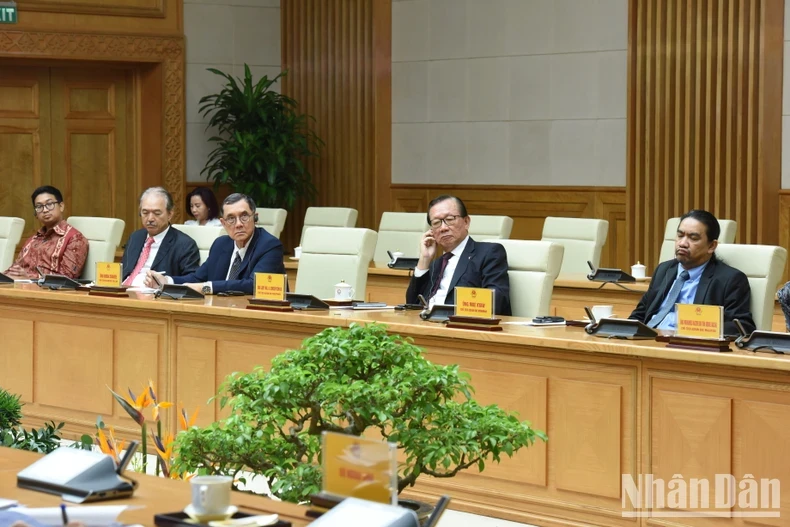
On the afternoon of September 13th, at the Government Headquarters, Prime Minister Pham Minh Chinh received the delegation of Chairmen of the ASEAN Business Advisory Councils (ASEAN BAC) from various countries, led by ASEAN BAC Chair 2024 Oudet Souvannavong, who is also the President of the Lao Chamber of Commerce and Industry, on the occasion of their visit to attend the 101st ASEAN BAC Meeting in Hanoi .

ASEAN BAC Chair Oudet Souvannavong and the ASEAN BAC Chairs of other countries shared their condolences regarding the loss of life and property suffered by Vietnam due to Typhoon No. 3 and the recent heavy rains and flooding; congratulated Vietnam on its socio -economic development achievements in recent years; and highly appreciated Vietnam's role in contributing to building a resilient and cohesive ASEAN; and its responsible role in the Greater Mekong Subregion cooperation.
Chairman Oudet Souvannavong stated that ASEAN BAC has been striving to promote trade, investment, and integration within ASEAN and with partners. The focus is on cooperation in digital transformation, green and sustainable development; self-reliance in healthcare and food security. In particular, it aims to connect supply chains in the Mekong and Greater Mekong countries, including Laos and Vietnam; and to strengthen cooperation in finance, infrastructure, and digital transformation.
The Chairman stated that later this year, ASEAN BAC will organize the ASEAN Business and Investment Summit (ASEAN BIS) in Vientiane, Laos; and expressed his hope that the Vietnamese Government will support this and that Prime Minister Pham Minh Chinh will personally attend and make a significant contribution to the success of the Summit.

Informing the ASEAN BAC Chairs about the damage caused by Typhoon No. 3 and the recent heavy rains and flooding in the northern provinces of Vietnam, Prime Minister Pham Minh Chinh expressed his sincere gratitude to the ASEAN BAC Chairs for their sharing and contributions to Vietnam's efforts to overcome the consequences; affirming that Vietnam will continue to work with ASEAN countries to support Laos in successfully organizing the 44th and 45th ASEAN Summits and related meetings, contributing to building an increasingly united and strong ASEAN Community.
The Prime Minister congratulated the success of the 101st ASEAN BAC Meeting recently held in Hanoi and the proposals and recommendations in the report on the ASEAN BAC program for 2024; he hoped that the priority areas that the Council is implementing will contribute to strongly promoting the process of innovation, improving institutions and policies, facilitating trade and investment, digital transformation, sustainable and inclusive development of ASEAN, especially new growth drivers… Thereby helping businesses overcome difficulties and take advantage of opportunities for development.

The Prime Minister stated that the crucial role of the business community is indispensable in contributing to this positive outcome. ASEAN governments have always considered businesses to be the backbone of the ASEAN economy and the foundation for long-term and sustainable economic growth in the region.
In their role as facilitators, ASEAN governments consistently support and create the most favorable conditions for the business community and entrepreneurs to develop based on shared vision, healthy competition, and the spirit of "harmonious benefits, shared risks," "working together, sharing the rewards, winning together, and developing together."

Welcoming the ASEAN BAC Chairs' view that ASEAN needs a policy prioritizing ASEAN businesses investing and operating in ASEAN countries, and a separate flow for goods from ASEAN countries through border crossings, Prime Minister Pham Minh Chinh proposed that ASEAN BAC, together with the governments and people of ASEAN countries, implement the five principles of cooperation.
Firstly, it is crucial to collaborate in institution and policy building, as institutions are the resources of development, "resources stemming from thinking, motivation from innovation, and strength from the people." Therefore, ASEAN BAC needs to promote a proactive, creative, and pioneering spirit, closely coordinating with ASEAN's specialized agencies to promptly identify policy bottlenecks, and provide appropriate proposals and recommendations for ASEAN governments to further improve institutions; standardize investment and business regulations; streamline procedures through digital transformation; further improve the investment and business environment; and minimize trade barriers.

Secondly, we must work together to connect the economy in terms of infrastructure, especially transportation, culture, society, health, education, and human resources. Connectivity is the foundation for building a unified, diverse, strong, and resilient ASEAN Community. Connectivity requires a people-centered, comprehensive, regional, and global approach. Connectivity must be inclusive across all economic, cultural, social, health, and education sectors, based on the principle of "people-centered, as the goal, driving force, and resource for development." The connectivity agenda must aim to support regions and sub-regions within ASEAN in narrowing the development gap, ensuring that no one is left behind, and that all citizens, regions, and countries can participate in and benefit from ASEAN's shared development achievements.
In particular, it is necessary to strengthen the connection of strategic infrastructure, both hard infrastructure in transportation, energy, etc., and soft infrastructure in digitalization, innovation, etc., among ASEAN countries, based on a focus on public-private partnership models, thereby creating interconnectedness and promoting rapid and sustainable growth for the entire region.
Thirdly, ASEAN BAC needs to collaborate in mobilizing resources, renewing traditional growth drivers, and promoting new growth drivers in the digital economy, green economy, and knowledge economy. Accordingly, ASEAN BAC should research, understand, and advise businesses to focus on renewing traditional growth drivers such as investment, exports, and consumption, and promoting new growth drivers such as digital transformation, green transformation, circular economy, knowledge economy, and sharing economy. These are inevitable trends that will help ASEAN develop rapidly and sustainably.
Fourth, we must work together to build a high-quality workforce, especially in the fields of digital transformation, green transformation, and high technology, with common standards for training, assessment, and mutual recognition among competency-based qualification systems currently used by ASEAN countries. This is key to enhancing labor productivity and the region's competitiveness globally.
Fifth, we must work together in building and managing smart, modern, and innovative businesses. Accordingly, we need to further promote the application of the achievements of the Fourth Industrial Revolution, such as digital platforms, cloud computing, digital institutions, digital data, digital workforce, digital skills, cybersecurity, big data, and artificial intelligence (AI), into business management to reduce costs, save time, enhance competitiveness, and improve production and business efficiency, thereby "catching up, keeping pace with, and surpassing" the region and the world.
Stating that he would call on ASEAN leaders to adopt preferential policies for ASEAN businesses, Prime Minister Pham Minh Chinh expressed his hope and belief that businesses would innovate their thinking and methods, mobilize resources for mutual development, and especially promote solidarity and unity within ASEAN BAC with the aspiration to build a united and diverse ASEAN, with its own path, but absorbing the best of humanity, applying it creatively and flexibly, in accordance with the traditional values crystallized within ASEAN; ASEAN BAC members will continue to play a pioneering role, making ASEAN a leading attractive destination for investors and contributing to promoting ASEAN's rapid and sustainable development.
In the spirit of "Governments creating and supporting businesses," Prime Minister Pham Minh Chinh accepted the invitation to attend the ASEAN Business and Investment Summit (ASEAN BIS) to be held later this year in Vientiane, Laos.
Source





































































Comment (0)