

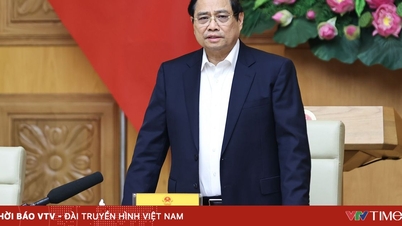
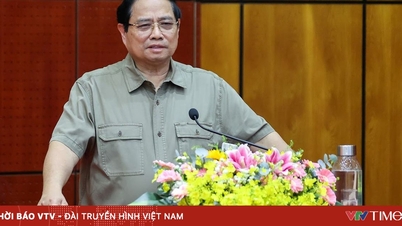
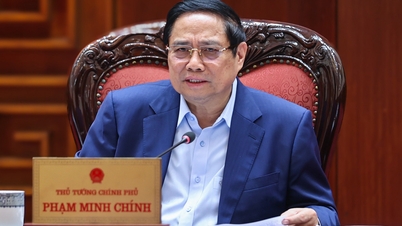
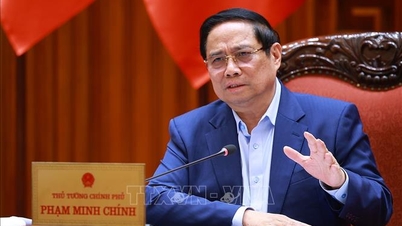
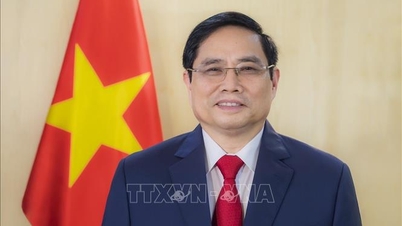
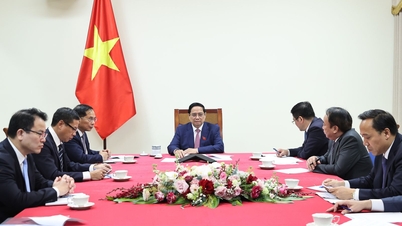
Presiding over the 5th meeting of the National Steering Committee for the Implementation of Vietnam's Commitments at COP26 (COP26 Steering Committee) on the morning of October 2nd, Prime Minister Pham Minh Chinh , Head of the Steering Committee, urged the prompt completion of institutional and policy mechanisms to mobilize resources, especially public-private partnerships, for green development.
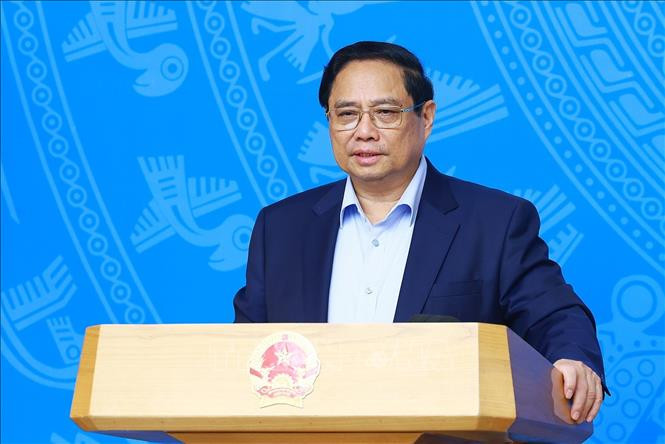
Strongly change awareness and actions on green development
At the meeting, the Steering Committee focused on assessing the implementation of Vietnam's commitments at COP26, especially the results of the tasks set out at the 4th session of the Steering Committee, the results of the implementation of the Just Energy Transition Agreement (JETP) and the Asian Zero Emission Community (AZEC)...
Along with assessing what has been done and what has not been done; difficulties and obstacles; objective and subjective causes; proposing tasks and solutions in the coming time to effectively implement Vietnam's commitments at COP26.
The Steering Committee proposed that it is necessary to continue focusing on perfecting the institutions serving digital transformation, green transformation, green growth, and low-carbon economic development; perfecting mechanisms to attract resources for green transformation; researching and developing new technologies to reduce emissions and facilitate energy transition; and developing high-quality human resources to serve green transformation.
In addition, we will continue to vigorously implement the tasks related to Vietnam's commitments at COP26 as outlined in Decision No. 888/QD-TTg of the Prime Minister; as well as effectively implement approved strategies, programs, and projects; effectively implement JETP and AZEC; and continue to promote international cooperation, especially mobilizing international support for Vietnam to serve green development, energy transition, and climate change adaptation.
In particular, with the viewpoint that "people and businesses are the center, subject, driving force and resource of development", members of the Steering Committee believe that implementing Vietnam's commitments at COP26 in particular and responding to climate change in general requires mobilizing the active and strong participation of people and businesses.
Concluding the meeting, Prime Minister Pham Minh Chinh emphasized that climate change is increasingly extreme, with profound impacts worldwide, and responding to climate change for green development and low greenhouse gas emissions is an irreversible trend of humanity.
According to the Prime Minister, in recent times, in a difficult context, Vietnam has still promoted growth, controlled inflation and promoted the development of the digital economy, green economy, and circular economy; the macro economy is stable, major balances are ensured, and monetary and fiscal policies are gradually greening. The country's overall achievements include contributions from green development, energy transition, and response to climate change.
Reviewing Vietnam's implementation of its commitments at COP26, the Prime Minister stated that the awareness and actions of the entire political system and the whole population have been raised and have actively participated in responding to climate change, aiming for safety against natural disasters, reducing greenhouse gas emissions, and bringing net emissions to "zero" as committed. In particular, there has been a clear change in awareness, increased responsibility, and active participation of each citizen in environmental protection, emission reduction, and climate change response.
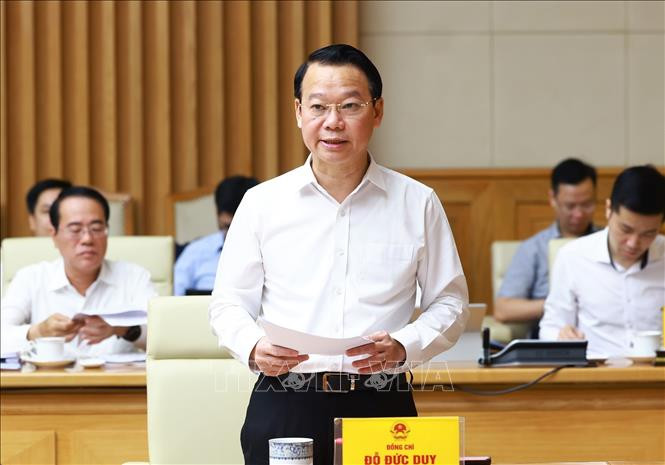
Vietnam has become a shining example in fulfilling international commitments on climate change response; the commitments and their implementation at COP26 have been quickly integrated and concretized into legal documents, policies, strategies, and plans for synchronized implementation; international cooperation in green development and energy transition has been strengthened, making Vietnam more attractive to foreign investors in climate change response and energy transition with specific projects.
Besides acknowledging, appreciating, and commending the efforts of the Ministry of Natural Resources and Environment, the members of the Steering Committee, ministries, sectors, localities, the business community, and individual citizens in implementing specific tasks and responsibly, effectively, and practically fulfilling Vietnam's commitments at COP26, the Prime Minister also pointed out some limitations such as uneven implementation of climate change response and energy transition, slow implementation of some tasks, especially the development of green development policies, particularly the implementation of regulations identified in the Plan on tasks and solutions to implement the results of COP26, and the implementation of JETP which have not met the requirements...
The Prime Minister reiterated the view that responding to climate change, including green transition, energy transition, and greenhouse gas emission reduction, is an inevitable and irreversible trend; making commitments at COP26 and participating in the JETP Declaration are correct policies and opportunities for Vietnam's development.
Therefore, it is necessary to combine national strength with the strength of the times to fulfill commitments on reducing greenhouse gas emissions for the goal of sustainable national development, for a prosperous and happy life of the people; must act with higher determination, greater efforts, mobilize all resources, the whole society, the whole people to participate, in which connecting and mobilizing resources from international sources, green financial flows, technology transfer, knowledge, and experience of countries and international organizations.
"Climate change is a global issue, affecting all people and businesses. Therefore, a global, people-to-people approach is needed; promoting multilateralism and international cooperation; mobilizing the participation of people and businesses; and building policies that are people- and business-oriented so that people and businesses can enjoy the benefits; for the goal of sustainable national development, for the prosperity and happiness of the people," the Prime Minister emphasized.
Urgently complete the mechanism for mobilizing resources for green development
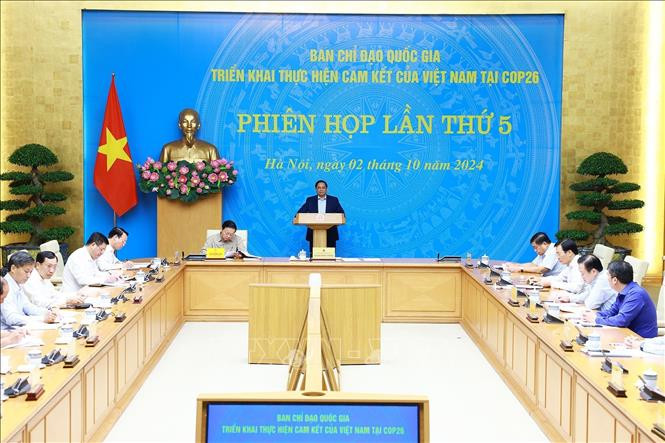
In that spirit, the Prime Minister requested that in the coming period, focus should continue on perfecting institutions, policies, and laws serving digital transformation, green transformation, green growth, and low-carbon economic development towards a circular economy; and researching and perfecting mechanisms to attract resources from the entire society, especially public-private partnerships and non-state resources, for green transformation, green growth, low-carbon economic development, and adaptation to climate change.
Promote scientific research, technology development and transfer, and innovation to develop the renewable energy industry in our country, including developing supporting industries and equipment for the production of renewable energy, biomass energy, green hydrogen, green ammonia, and technologies for carbon capture, utilization, and storage.
Furthermore, it is necessary to develop new governance methods, manage green transition, green growth, and circular economy development; while simultaneously strengthening international cooperation and mobilizing resources to implement commitments made at COP26 and achieve a just energy transition; focusing on training and developing high-quality human resources, and mastering new technologies to achieve the goals of green transition and a just energy transition.
Ministries and agencies need to continue implementing the tasks identified in the Plan on tasks and solutions for implementing the results of the COP26 Conference, which was approved by the Prime Minister; assigning specific tasks to each ministry and agency, Prime Minister Pham Minh Chinh directed ministries and agencies to regularly compile statistics and urge the serious and timely implementation of assigned tasks, ensuring quality.
In particular, the Ministry of Industry and Trade will preside over and coordinate with ministries and branches to review and select projects to be implemented within the framework of JETP and AZEC cooperation; complete the submission for approval: Project on developing smart grid in Vietnam for the period 2023-2030, with a vision to 2045; Mechanism to encourage the development of self-produced and self-consumed rooftop solar power projects; Master plan on Carbon Border Adjustment Mechanism (CBAM); Circular promulgating the price framework for biomass and solid waste electricity generation; promptly complete internal procedures so that Vietnam can soon become a member of the Solar Alliance (ISA) and continue to research and propose joining the International Renewable Energy Agency (IRENA).
The Ministry of Agriculture and Rural Development is implementing the Declaration on Sustainable Agriculture, Resilient Food Systems and Climate Action, especially the Sustainable Development Project for 1 million hectares of high-quality, low-emission rice cultivation linked to green growth in the Mekong Delta by 2030; and completing the procedures for Vietnam to join the Global Partnership for Sustainable Agriculture and Food Transformation (FAST).
The Ministry of Transport shall preside over and coordinate in promoting the implementation of the Action Program on green energy conversion, reducing carbon and methane emissions in the transport sector; preside over and coordinate with relevant ministries, sectors and agencies to propose mechanisms and policies to support the conversion to electric cars.
The Ministry of Planning and Investment continues to research and develop a green economic sector system and green incentive mechanisms. The Ministry of Finance and the State Bank complete projects to mobilize green finance for development, ensuring feasibility, effectiveness and efficiency in implementation in practice, in accordance with international practices; research and develop mechanisms and policies to support the development of the capital market and green bond market.
The Ministry of Labor, War Invalids and Social Affairs will study and complete legal regulations on social impact assessment, supplement fairness criteria to ensure the transition to a low-emission economy; promote action policies to reduce negative impacts on vulnerable groups; develop vocational training programs in line with the green growth orientation and develop the renewable energy industry; develop programs to support job transition, create green jobs and develop sustainable livelihoods for people, especially groups affected in the process of economic transition.
The Ministry of Science and Technology continues to prioritize resources to carry out scientific and technological tasks under national science and technology programs related to climate change response, including the national science and technology program to achieve the goal of net zero emissions; deploy research tasks and develop new technologies to serve greenhouse gas emission reduction and energy conversion.
The State Capital Management Committee at Enterprises directs its affiliated corporations and groups to continue promoting green development, enhancing the application of science and technology, and innovation to create a driving force for low-emission development and spreading it to each key industry and sector. The Ministry of Information and Communications and media and press agencies increase information on green development and climate change response.
Regarding the implementation of the JETP Declaration, the Prime Minister agreed in principle to adopt the JETP Implementation Monitoring and Evaluation Framework, the List of Priority Projects for JETP Implementation, and agreed in principle to implement 8 JETP projects; he requested the completion of relevant institutions and policies related to JETP implementation to inform the implementing partners. Regarding AZEC, the Prime Minister stated that the Japanese side is very active in its implementation and requested ministries and agencies to prepare specific programs and projects for proposal...
Source
![[Photo] Closing Ceremony of the 10th Session of the 15th National Assembly](/_next/image?url=https%3A%2F%2Fvphoto.vietnam.vn%2Fthumb%2F1200x675%2Fvietnam%2Fresource%2FIMAGE%2F2025%2F12%2F11%2F1765448959967_image-1437-jpg.webp&w=3840&q=75)


![[Photo] Prime Minister Pham Minh Chinh holds a phone call with the CEO of Russia's Rosatom Corporation.](/_next/image?url=https%3A%2F%2Fvphoto.vietnam.vn%2Fthumb%2F1200x675%2Fvietnam%2Fresource%2FIMAGE%2F2025%2F12%2F11%2F1765464552365_dsc-5295-jpg.webp&w=3840&q=75)



































![[OFFICIAL] MISA GROUP ANNOUNCES ITS PIONEERING BRAND POSITIONING IN BUILDING AGENTIC AI FOR BUSINESSES, HOUSEHOLDS, AND THE GOVERNMENT](https://vphoto.vietnam.vn/thumb/402x226/vietnam/resource/IMAGE/2025/12/11/1765444754256_agentic-ai_postfb-scaled.png)













































Comment (0)